
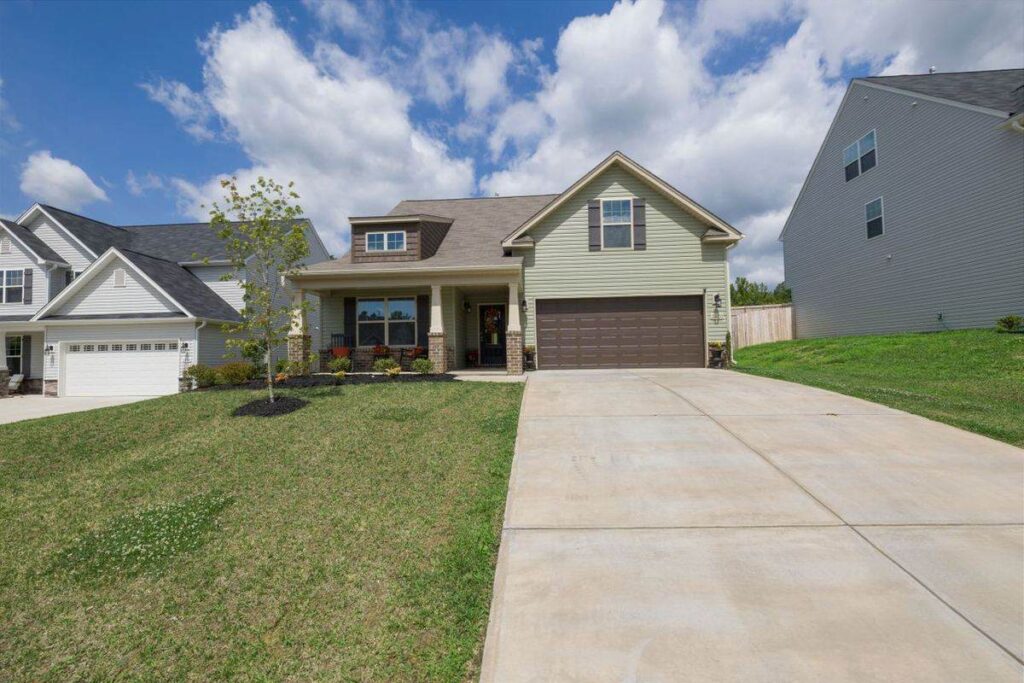
Concrete resurfacing hides its most important fact under every finished photo: the new surface has no strength of its own. A quarter inch of overlay borrows everything — flatness, adhesion, future — from the slab underneath and the preparation nobody photographs. That is why two bids for the same driveway can land at $1,800 and $5,600 and both call themselves resurfacing. The spread in concrete resurfacing cost is rarely a spread in material; it is a spread in diagnosis and prep.
An overlay placed on an unprofiled, cracked, or damp slab looks perfect for about a year, then peels in sheets or reprints every old crack. Ten questions, asked before any deposit, tell you whether a bidder is pricing preparation or skipping it. We install and finish concrete across the Bay Area, and this is the interview we would run for our own family.
Key Takeaways
- Resurfacing is a bond product — the overlay is only as strong as the surface prep, which is most of the labor in an honest bid.
- California caps contractor down payments at $1,000 or 10 percent, whichever is less, and jobs of $500 or more require a CSLB license.
- Illustrative Bay Area ranges run roughly $3 to $9 per square foot for basic overlays and $8 to $20 for stamped systems — condition moves every number.
- Print the Concrete Project Readiness Checklist and make every bidder answer the same questions side by side.
What This Guide Covers
- The Five Minute License Check Before Anyone Quotes Your Slab
- Diagnosis Questions That Decide Whether Your Slab Qualifies
- Prep Questions That Reveal Where the Money Actually Goes
- System Questions That Match the Product to Your Surface
- Cost Questions That Make Competing Bids Comparable
- Cure and Traffic Questions That Protect the New Surface
- Warranty Questions That Show Whether the Bond Will Hold
- When Replacement Is the Honest Answer
- Put the Checklist in Your Pocket Before the First Walkthrough
- Get a Resurfacing Bid You Can Actually Compare
- FAQs
The Five Minute License Check Before Anyone Quotes Your Slab
Any California job of $500 or more in labor and materials requires an active state contractor license. Ask for the number and run it through the CSLB license check — it shows whether the license is active, bonded, and carrying workers’ compensation. Check the number they gave you, not the name on the truck; an uninsured injury on your property can reach your homeowner’s policy.
Diagnosis Questions That Decide Whether Your Slab Qualifies
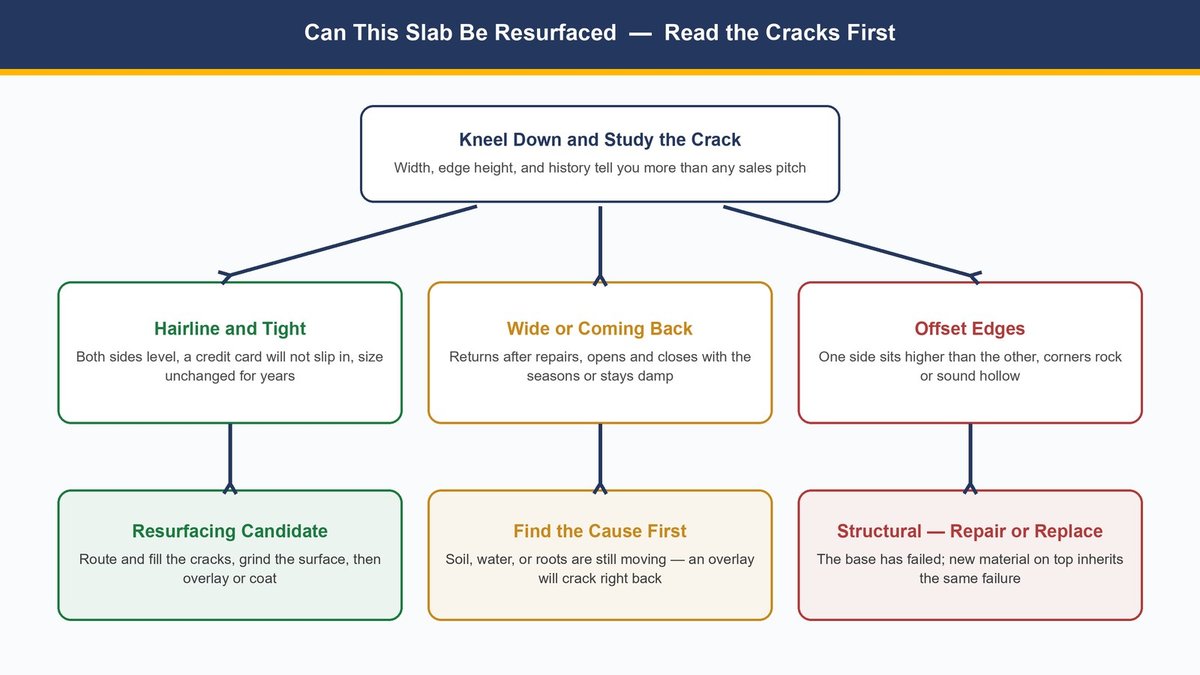
An overlay inherits the behavior of the slab it bonds to: cracks that have finished moving can be routed, filled, and covered, while cracks still moving will reprint through any thickness of new material.
Are These Cracks Surface Wear or Structural Movement
Why It Matters
Hairline shrinkage cracks with both sides level are cosmetic and near-universal — candidates for routing and filling. A crack with offset edges, one side sitting higher than the other, means the ground itself has moved, and no overlay fixes ground.
A Strong Answer Sounds Like
The bidder kneels at your worst crack and narrates what they see — width, edge height, corners that rock or sound hollow when tapped — sorting each crack into fill-and-cover versus investigate-first.
Walk Away If
The damage is diagnosed from the truck or from photos, or every crack gets the same overlay-bridges-everything answer. A quote written without reading the cracks prices the easy outcome, not your slab.
What Is Making the Slab Crack and Will It Keep Moving
Why It Matters
East Bay and South Bay clay swells and shrinks with the seasons, tree roots lift panels from below, and washed-out base leaves corners unsupported. Resurfacing over an active cause buys one dry season before the same crack returns.
A Strong Answer Sounds Like
A cause named for your yard — the oak beside the heaved panel, the downspout dumping at the slab edge, seasonal movement typical of Alameda and Contra Costa clay — with the fix quoted alongside the surface work.
Walk Away If
Nobody asks how old the cracks are, whether they have grown, or whether they follow a tree line or a downspout. Covering a moving crack is not a repair; it is a scheduled reappearance with your money underneath.
One measurement settles it.
Prep Questions That Reveal Where the Money Actually Goes
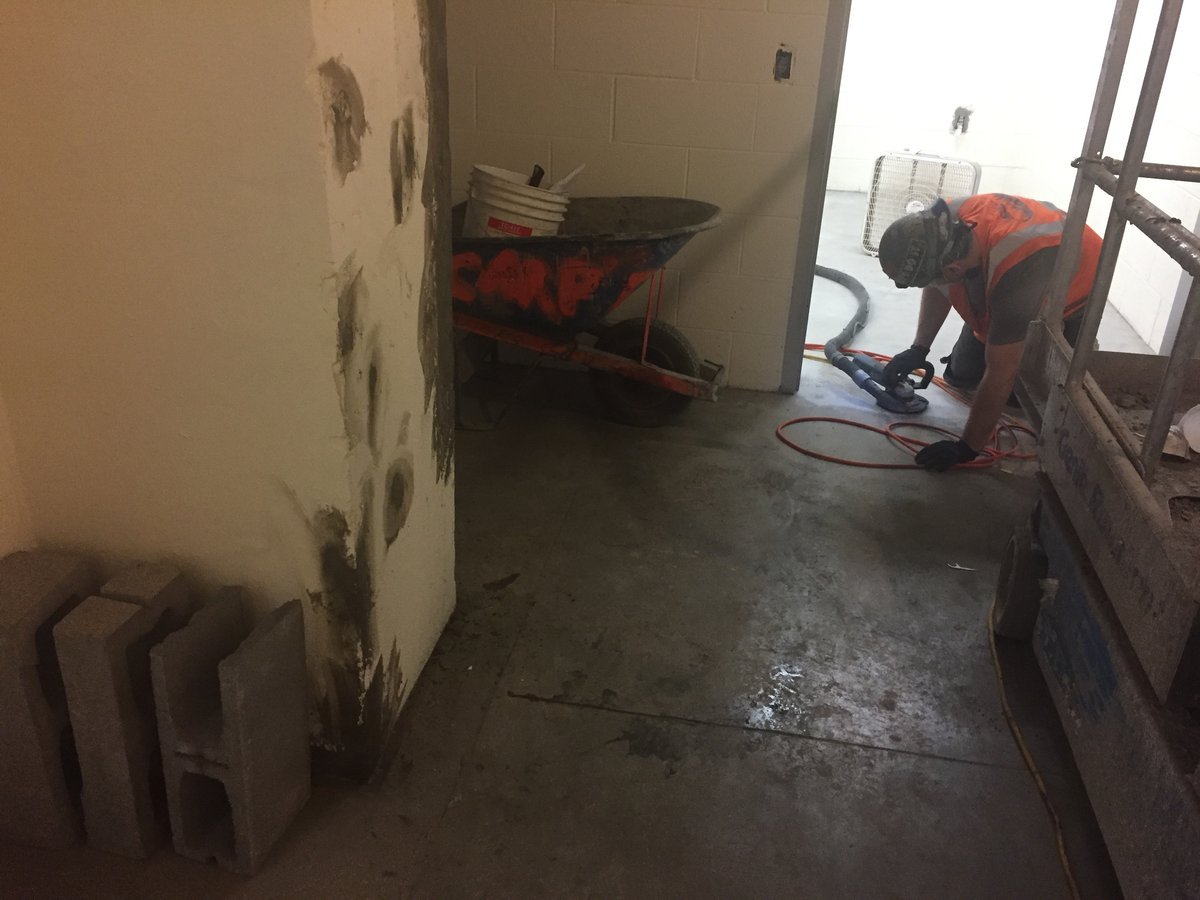
Nearly every overlay or coating failure is a bond failure, and the bond is built before the first bag is mixed. Prep is the labor in this trade.
How Will You Profile the Surface Before Anything Goes Down
Why It Matters
Overlays cannot grip a smooth, sealed, or contaminated slab. The surface must be mechanically opened — diamond grinding or shot blasting — into a measurable texture so the polymer keys into the concrete instead of resting on it.
A Strong Answer Sounds Like
Named equipment and a named texture target, plus what comes off first — old sealers, paint, oil spots — and how dust is controlled at an occupied home — grind first, then water-test a spot for porosity.
Walk Away If
Prep is described as pressure washing. Water removes dirt; it does not open a troweled surface or strip sealer, and an overlay on a merely clean slab is the classic peel-in-a-year failure.
How Do You Treat Cracks and Joints Before Resurfacing
Why It Matters
Cracks must be routed and filled with a repair material matched to their movement, not skimmed over, or they telegraph through. Control joints exist to move — the overlay has to honor them straight through the new surface.
A Strong Answer Sounds Like
A crack-by-crack plan with the filler named, plus the unprompted statement that every control joint will be carried through the overlay and re-cut — because covering a working joint only relocates the crack upward.
Walk Away If
The plan is to bury the joints for a seamless look. Concrete moves at its joints by design; hide them and the slab redraws them through your new surface, usually within the first seasonal swing.
How Will You Check the Slab for Moisture First
Why It Matters
Vapor rising through a slab lifts coatings and overlays from below — the same mechanism that makes epoxy garage floors peel. Garages and interior floors on grade are the highest-risk surfaces for it.
A Strong Answer Sounds Like
A test named before any product — a taped plastic-sheet check at minimum, calcium chloride or in-slab humidity probes for interior coatings — and a moisture-tolerant primer or a different system if the slab reads damp.
Walk Away If
Moisture never comes up for a garage or interior floor. Vapor failures on those surfaces are common enough that an untested slab means the risk has simply been transferred, unpriced, onto you.
One screening test needs no contractor.
System Questions That Match the Product to Your Surface
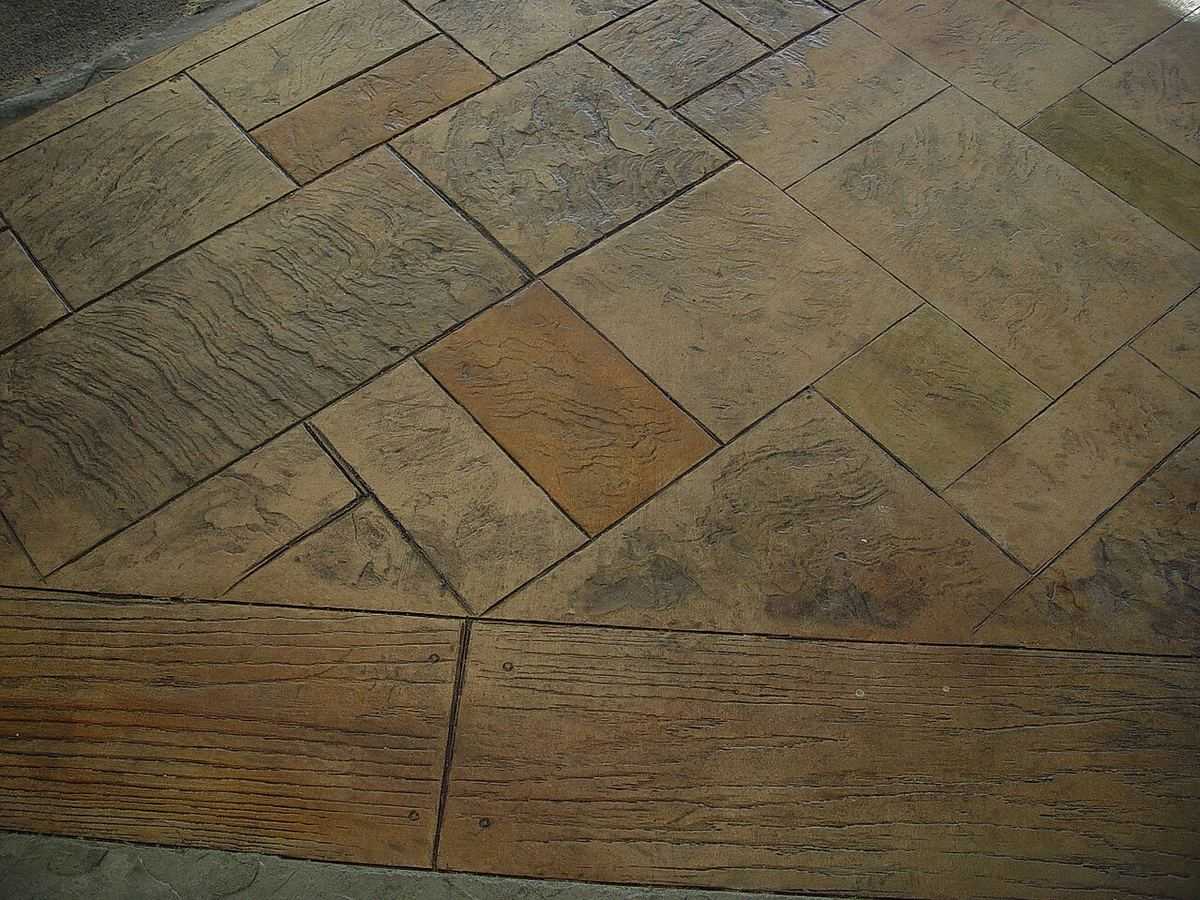
Resurfacing is a family of systems, not one product, and each has a design thickness and a habitat. An honest bid names a product line, quotes its data sheet, and explains why that system fits your slab.
Every figure is illustrative rather than a quote — condition, access, and finish level move all of them.
Which System and Thickness Are You Proposing for My Slab
Why It Matters
Thickness separates systems: a microtopping at a sixteenth of an inch is a finish, not a repair; a stamped overlay at half an inch absorbs pattern and texture; a coating measured in mils is protection, not leveling.
A Strong Answer Sounds Like
A named product line with its data sheet available, the design thickness for your surface, and the primer or bond coat underneath it — details an experienced crew recites without checking.
Walk Away If
The proposal is a special mix with no manufacturer, no thickness, and no data sheet. Mystery products cannot be compared across bids, and a warranty on an unnamed system is a promise with no spec behind it.
Why This System for a Driveway Versus a Garage or Patio
Why It Matters
Exterior slabs need UV-stable, slip-resistant systems that tolerate rain and temperature swings; epoxies chalk in sunlight and belong indoors, where hot-tire pickup and vapor drive the spec. Diamond polishing exists only for interior slabs.
A Strong Answer Sounds Like
Reasons tied to your surface — broom or knockdown texture for a sloped driveway that sees winter rain, polyaspartic over epoxy where tires sit, sealer chosen for foot versus vehicle traffic and honest trade-offs.
Walk Away If
One product answers every surface you ask about. A system simultaneously right for a pool deck, a garage floor, and a driveway is being sold, not specified. Ask to see the data sheet that lists all three surfaces, and read what it says about UV exposure.
Cost Questions That Make Competing Bids Comparable
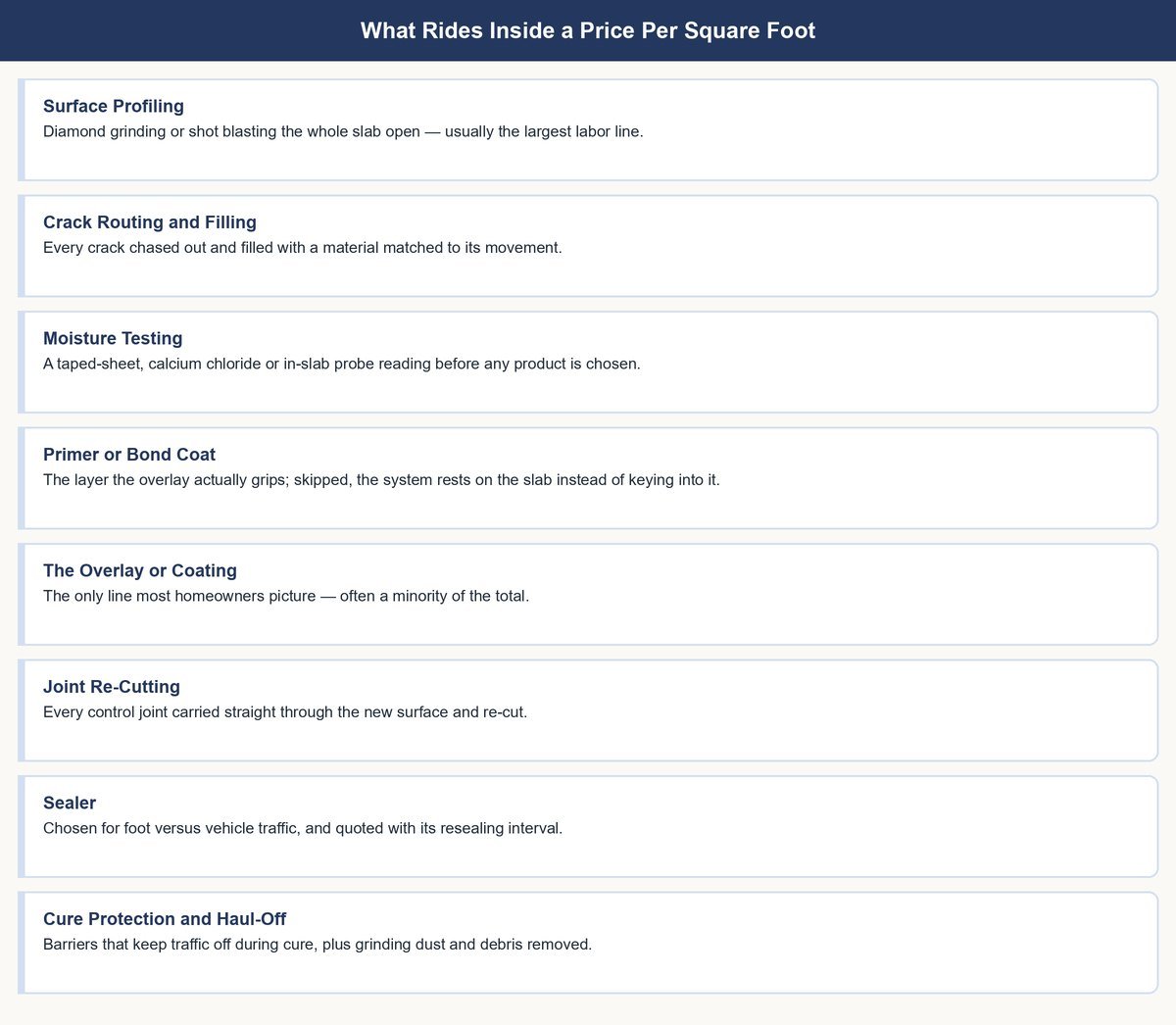
Bids diverge because scopes diverge. Slab condition, system, texture, color, and access set the price — an Oakland hillside driveway and a San Jose flatland pad do not cost the same to work on — and mobilization minimums put a floor under small jobs. For scale, resurfacing a typical two-car driveway of roughly 400 to 600 square feet commonly lands between about $1,500 and $5,000, system and condition depending.
What Exactly Is Included in Your Price Per Square Foot
Why It Matters
A per-square-foot number means nothing until you know what rides inside it: grinding, crack routing, moisture testing, primer, the overlay, joint re-cutting, sealer, haul-off. Bids get cheap by omission before they get cheap by efficiency.
A Strong Answer Sounds Like
A written scope with prep as its own line, product and sealer named, joint treatment listed, and cure protection included — plus exclusions like root removal or grading correction, priced separately.
Walk Away If
The number is one lump line and prep questions get that’s-all-included with nothing on paper. When two bids sit $2,000 apart, the difference is usually written in the lines the low one left out.
Cure and Traffic Questions That Protect the New Surface
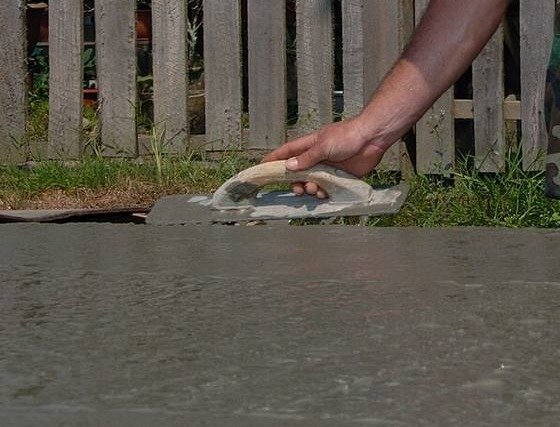
Fresh overlays are weakest exactly when they look finished; cure windows are chemistry, differing by product and temperature.
When Can We Walk on It Drive on It and Park on It
Why It Matters
Driving early is the cheapest way to ruin the job — tires flex and shear a green surface, and hot tires can pull a young coating clean off. The cure schedule is a spec, not a suggestion.
A Strong Answer Sounds Like
Three separate numbers from the data sheet for your season — foot traffic, commonly around a day; vehicles, commonly two to four days; full chemical cure — plus a warning that cool, damp Bay Area weather stretches every window.
Walk Away If
Every question gets it’s-dry-by-tomorrow. Dry to the touch and ready for a 4,000-pound vehicle are different chemical events, and only the product data sheet separates them — ask which number came from it.
Warranty Questions That Show Whether the Bond Will Hold
A resurfacing warranty is only as useful as its treatment of the failure that matters: peeling traces to prep, priming, and moisture judgment — workmanship — which is precisely what a confident installer puts in writing.
What Does Your Warranty Say About Delamination
Why It Matters
Nearly every overlay dispute is a bond dispute. A warranty covering workmanship defects while excluding peeling, moisture, and existing slab conditions — on a slab nobody tested — has quietly excluded the failure you are paying to avoid.
A Strong Answer Sounds Like
A written term, commonly one to five years on workmanship, that names delamination as covered, states exclusions honestly — new structural movement, impacts, de-icing salts — and points to the moisture and prep records behind it.
Walk Away If
The warranty is verbal, or the exclusions swallow the coverage. An installer who ground the slab and tested for moisture is warranting their evidence; one who skipped both is warranting luck.
When Replacement Is the Honest Answer
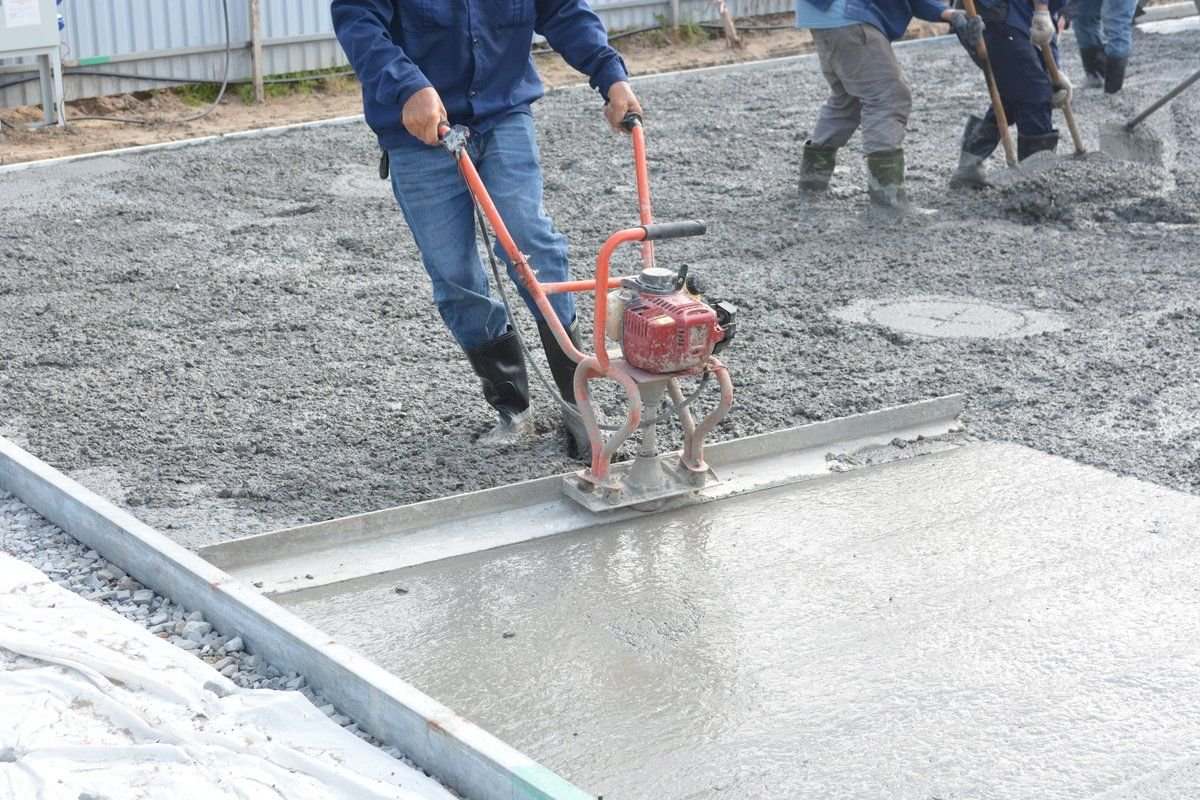
Some slabs fail the interview. Widespread offset cracking, rocking or hollow-sounding panels, or a slab poured thin over a failed base cannot be rescued by any thickness of overlay — FHWA draws the same line for pavements, reserving reconstruction for a structure that has failed, and driveways obey the same physics. Replacement costs more up front, but it resets the base, the drainage, and the clock.
The test of a good contractor is whether they say this against their own quote — pricing both paths and naming the one they would choose for their own house.
Put the Checklist in Your Pocket Before the First Walkthrough
Make every bidder answer the same ten questions in the same order. Print the one-page Concrete Project Readiness Checklist and bring it to every walkthrough — with room to write each company’s answers side by side, where “pressure wash and pour” rarely survives next to a grind-test-prime answer.
Still deciding whether your slab is a candidate at all? Our concrete and entry finishes page covers the work itself, and it pairs with the checklist and this guide as a complete pre-hire kit.
Get a Resurfacing Bid You Can Actually Compare
Ask these ten questions of every bidder. The right company usually identifies itself — the one kneeling at your cracks, naming its grinder and its primer, quoting a thickness from a data sheet, and telling you plainly when replacement would serve you better.
We are happy to be interviewed with the whole list. Top Tier Building Services Inc. is a Castro Valley based general contractor serving the Bay Area — licensed, bonded, and insured, with workers’ compensation coverage, under California General Contractor License #1146790. Call 510-566-4906, email sales@toptierbuildingservices.com, or request an estimate — or start with the checklist and our concrete entry finishes page, and call when the answers start mattering.
FAQs
How much does concrete resurfacing cost per square foot?
Bay Area homeowners commonly see roughly $3 to $9 per square foot for basic polymer overlays and $8 to $20 for stamped or decorative systems, plus mobilization minimums on small jobs. Heavy cracking, old coatings to grind off, and tight access all add prep hours.
Is it cheaper to resurface or replace a concrete driveway?
Resurfacing usually costs a fraction of replacement, which pays for demolition, haul-off, base work, and new concrete — commonly $8 to $18 per square foot. But the comparison holds only if the slab qualifies: on a structurally failed driveway, the overlay must come off before the repour, so the wrong call costs more.
How long does concrete resurfacing last?
A properly prepped overlay on a sound slab commonly serves 10 to 25 years outdoors with periodic resealing. The range is wide because the bond decides it — the same product lasts decades on a ground, primed, dry slab and one year on a sealed, damp one.
Can badly cracked concrete be resurfaced?
Extensive hairline cracking with level edges is routine — routed, filled, and covered. Offset edges, active movement, or rocking panels mean the base has failed, and an overlay will re-crack along the same lines. A bidder should sort your cracks before quoting.
How soon can you drive on a resurfaced driveway?
Most polymer overlay systems accept foot traffic in about 24 hours and vehicles in two to four days; cool, damp weather stretches cure times, and a freshly repoured slab generally wants about a week before cars. Get your product’s numbers in writing, and keep hot tires off young coatings.
Do I need a permit to resurface concrete in the Bay Area?
Resurfacing an existing residential slab in place generally does not trigger a building permit, but rules vary by city, and work touching the public right-of-way — sidewalks, curbs, driveway approaches — usually needs an encroachment permit from public works. Have a licensed local contractor confirm for your address.