
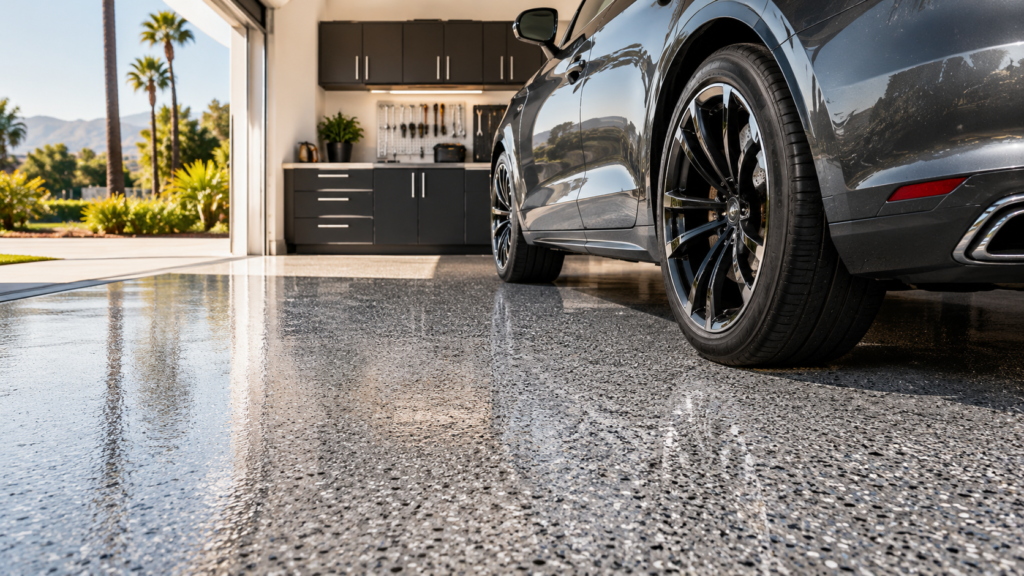
Every California homeowner knows the drill: after a long afternoon commute on heat-soaked valley roads or stop-and-go Bay Area highways, you pull your vehicle into the garage. What you may not realize is that your tires have transformed into high-heat thermal delivery systems. If your garage floor is coated with a standard retail product, those tires are actively initiating a destructive process known as hot tire pickup.
Finding the best garage flooring for hot tire resistance isn’t just about selecting a pretty color pattern. It requires understanding the material science behind thermal stress, chemical migration, and concrete bonding. In this guide, we will analyze why tires destroy low-grade floors and look at the professional systems engineered to stop the stick for good.
What is Hot Tire Pickup and Why Does It Happen?
Hot tire pickup occurs when the combined heat and pressure from a recently driven vehicle softens a floor coating, causing it to bond directly to the rubber tread blocks. When the vehicle is backed out the next morning, the cooling tire contracts and rips the coating right off the concrete substrate, leaving behind unsightly bare patches.
There are two hidden scientific catalysts that accelerate this failure in California garages:
Ranking the Contenders for Thermal Defense
To figure out how to stop hot tire pickup permanently, let’s examine how different structural materials react to extreme thermal loads and chemical plasticizers.
Resinous Systems: Polyurea vs 100% Solids Epoxy
• DIY Water-Based Epoxy Paints: These single-component retail products are highly vulnerable. Because they contain a low percentage of actual solids, the dried film build is incredibly thin and easily softens under a warm tire footprint.
• 100% Solids Epoxy (Two-Part Systems): Industrial-grade, 2-part epoxies form a significantly denser chemical web that creates a rigid mechanical bond with concrete. While highly durable, they cure slowly and can still exhibit slight thermoplastic softening if the concrete surface wasn’t mechanically profiled to support the bond strength.
• Polyurea Garage Floor Coating Systems: Engineered specifically for high-stress automotive environments, polyurea basecoats combined with a polyaspartic topcoat represent the ultimate protection against hot tires. Polyurea forms a covalent chemical bond with concrete that flexes with the shifting concrete rather than cracking. It is completely immune to tire plasticizer degradation.
Floating Foundations: Interlocking Modular Tiles
If you want to completely bypass chemical bonding, heavy-duty rigid polypropylene modular tiles are an excellent alternative. Because these interlocking tiles “float” freely over the concrete subfloor, there is no chemical layer to delaminate. The high-impact plastic construction naturally disperses vehicle weight and easily tolerates continuous heat cycling without warping or transferring stress to the subfloor.
The Hot Tire Resistance Comparison
The Professional Solution Blueprint
Achieving a completely bulletproof garage floor comes down to two non-negotiable variables: proper mechanical preparation and high-build polymer selection.
To ensure a floor never bubbles or pulls, professional crews completely skip weak chemical washes. Instead, they implement mechanical diamond grinding to open up the concrete pores, creating a profile similar to sandpaper. Laying an industrial polyurea or thick 100% solids epoxy base coat into this texture guarantees a mechanical grip that handles rolling weights effortlessly.
Furthermore, finishing the surface with a specialized polyaspartic topcoat introduces a dense, clear shield that isolates tire heat and prevents chemical compounds from leaching into the core layers. Professional-grade systems and their cost differences are explained in our epoxy flooring guide, allowing you to choose the exact level of thermal defense your garage demands.
Conclusion
If your main goal is to protect your investment from hot tire scars and ongoing repair costs, avoiding single-component paints is imperative. Investing in professional polyurea garage floor coating systems or heavy-duty modular tile architectures ensures your garage looks pristine, whether your vehicles are parked or out on the open road.