
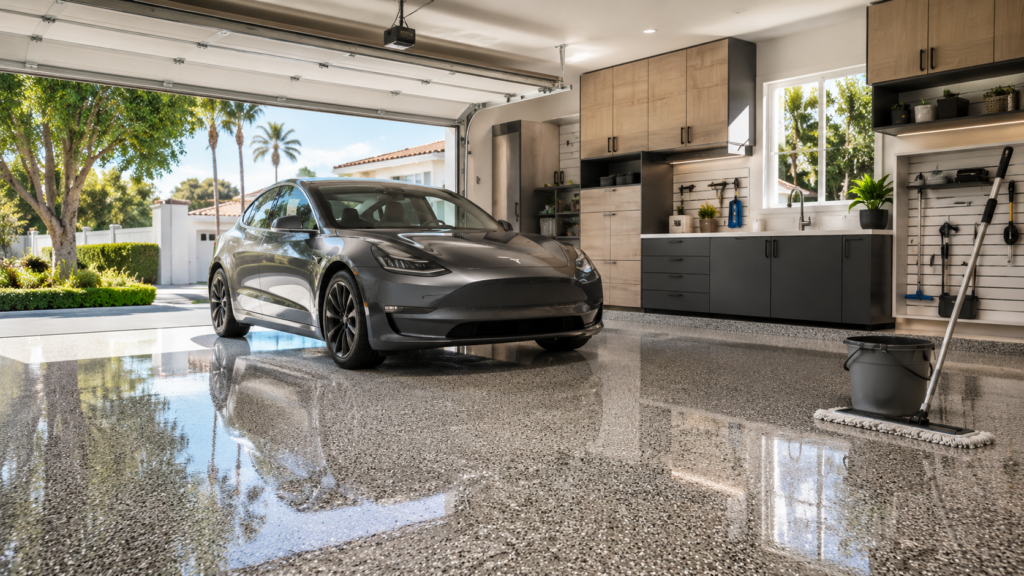
Investing in a professional-grade garage floor coating completely transforms your space, turning a dusty concrete slab into a sleek, showroom-ready environment. However, achieving true multi-decade durability requires more than just high-quality initial materials. Even the thickest, industrial-grade surfaces need intentional care to maintain their glossy finish and underlying structural integrity.
Fortunately, knowing how to clean epoxy garage floors without damage is simple once you understand the chemical composition of your topcoat. By avoiding common retail pitfalls and adopting a systematic routine, you can maximize your floor’s lifetime, protect your investment, and ensure your garage retains its high-end aesthetic for up to 20 years.
The Secret to Lifespan: Polyaspartic Topcoat Protection
The real secret to an epoxy garage floor’s 20-year lifespan isn’t actually the epoxy layer itself—it’s the clear polyaspartic topcoat sealed over the color flakes. This topcoat serves as a non-porous, sacrificial shield that takes the brunt of physical impacts, UV rays, road salt, and automotive fluids.
Over time, microscopic dirt, sand, and fine grit act like sandpaper under vehicle tires and foot traffic. If left on the surface, these abrasives slowly scratch and micro-etch the topcoat, clouding the shine and exposing the underlying layers to potential damage. Routine maintenance is entirely about protecting this clear barrier from physical abrasion and chemical degradation.
The Safe Cleaning Toolkit: Dos and Don’ts
Many homeowners inadvertently dull their floors by using the wrong tools or household chemicals. To preserve your floor’s factory gloss, stick to this approved maintenance checklist:
What to Use (The Dos):
• Microfiber Dust Mops or Soft-Bristle Brooms: Essential for daily or weekly dry sweeping to remove loose grit before it can scratch the topcoat.
• pH-Neutral Cleaners: Commercial solutions like Simple Green (properly diluted) safely lift grime without reacting chemically with the polymer matrix.
What to Avoid (The Don’ts):
Routine Maintenance Schedule for Maximum Durability
Tackling Stubborn Garage Stains Safely
No matter how careful you are, active garages encounter heavy-duty messes. Here is how to handle targeted issues without breaking down the floor’s chemical bonds:
Conclusion
A professional garage floor coating is designed to handle immense vehicular stress, but longevity is a partnership between material science and consistent upkeep. By prioritizing routine dust mopping, using pH-neutral cleaning agents, and addressing automotive spills quickly, you protect the high-performance polyaspartic topcoat from premature wear. Implement these straightforward maintenance habits today to ensure your garage floor remains a pristine, high-durability showcase for the next 20 years.