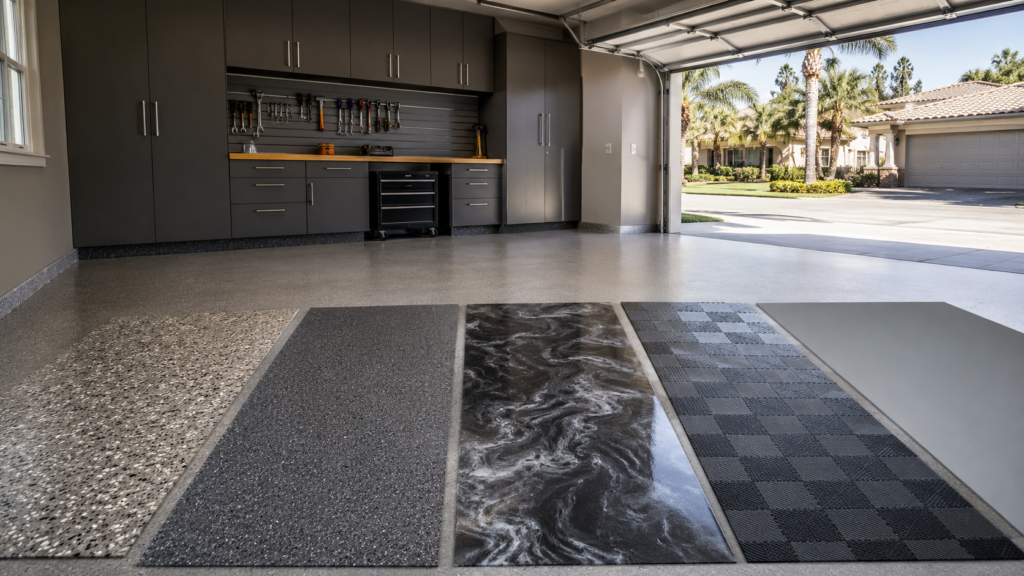
Upgrading your concrete slab is one of the most effective ways to boost your home’s functionality and value. However, searching for the right material can quickly lead to information overload. From high-tech polymers to simple weekend paints, navigating the garage floor coating options in California requires understanding how different materials hold up against our state’s distinct environmental factors.
In coastal regions like the Bay Area, concrete slabs constantly battle high sub-surface moisture levels and salt-heavy air. Meanwhile, Central Valley and Southern California garages endure extreme summer heat waves that test the thermal limits of any chemical bond. To help you cut through the marketing noise, this comprehensive guide evaluates the five primary garage flooring paths across durability, installation timelines, and long-term cost-efficiency.
The Top 5 Garage Floor Coating Options Evaluated
1. Professional 100% Solids Epoxy Systems
Industrial-grade, 100% solids epoxy remains a cornerstone of the garage remodeling industry. Unlike low-cost retail paint variants, this material contains zero volatile solvents, meaning it doesn’t shrink or evaporate as it cures. Instead, it undergoes a heavy chemical reaction that yields a thick, exceptionally hard surface with immense compressive strength. For a full per-square-foot price breakdown of these systems, see our guide to epoxy garage flooring cost in California.
Pros: Exceptional leveling properties, immense impact resistance, and a thick mil-profile that easily masks minor pitting and cosmetic flaws in older California concrete slabs.
Cons: Vulnerable to UV ambering if exposed to direct, sustained sunlight through open garage doors or large windows. Requires a multi-day curing window before vehicle traffic can be reintroduced.
2. High-Performance Polyaspartic Coatings
Polyaspartic technology represents a significant leap forward in polymer material science. Originally engineered to protect heavy industrial infrastructure from harsh weathering, it has adapted perfectly into residential garage settings. It is highly valued as a rapid-cure, ‘one-day’ installation solution.
Pros: 100% UV stable (will never discolor or turn yellow), highly flexible under seismic shifting, and sets with an extremely fast cure cycle that allows you to park your vehicle back in the garage within 24 hours.
Cons: Higher initial material expenditure and a razor-thin installation window that demands highly trained, specialized professional crews to lay down before the chemical sets.
3. Metallic Epoxy Formulas
For homeowners prioritizing high-end aesthetics or designing a dedicated automotive showroom, metallic epoxy stands in a class of its own. This method involves suspending reflective, pearlescent metallic powders within a crystal-clear clear resin base layer.
Pros: Provides a completely unique, high-gloss 3D visual effect resembling flowing stone or polished marble. Offers the exact same impact and chemical resilience as industrial epoxy coats.
Cons: Premium price point driven by intense manual labor requirements. The smooth, glass-like gloss surface demands anti-slip additives to maintain safe traction during wet coastal winter cycles.
4. Interlocking Modular Garage Tiles
Constructed from heavy-duty polypropylene or flexible PVC polymers, interlocking modular tiles present a mechanical alternative to liquid-applied resin coatings.
Pros: Fast, tool-free installation that bypasses all chemical curing phases. Completely immune to slab moisture issues and instantly covers severe cracks or old, damaged surface stains.
Cons: Debris, fine dust, and fluid leaks can seep through tile seams, requiring periodic unlinking or pressure washing underneath. Lacks the seamless, sterile barrier protection that liquids provide.
5. Retail DIY Garage Floor Paints
Water-based or single-component acrylic garage floor paints are standard commodities found on the shelves of local home improvement stores, targeted squarely at budget-conscious DIYers.
Pros: Highly accessible, requires no complex chemical mixing, and offers the lowest initial upfront out-of-pocket material expenses.
Cons: Extremely low resistance to friction and heat. Prone to cracking, flaking, and hot tire pickup within the first 6 to 18 months of real-world use.
Master Comparison Matrix: California Performance Standard
Aligning Your Material Selection with Your Budget
Selecting the perfect candidate out of these garage floor coating options in California ultimately hinges on your balancing timeline constraints against budget configurations. While interlocking tiles and DIY paints offer immediate financial relief, their lifecycle costs are often deceptive when accounting for maintenance or total replacement timelines. When the decision comes down to the two premium resin systems, our polyaspartic vs epoxy comparison breaks down which one wins for a California garage.
In contrast, investment into professional resinous systems like 100% solids epoxy or polyaspartic coats yields a much higher return on investment over a multi-decade timeline. Cost differences between systems are detailed in our Bay Area epoxy garage flooring cost breakdown, allowing you to weigh immediate labor costs against long-term asset security.
Conclusion
Whether you opt for the rapid turnaround of a polyaspartic shield, the artistic luxury of metallic pathways, or the balanced reliability of traditional solids, selecting a system built to withstand regional thermal changes is paramount. Protecting your garage floor shouldn’t be a temporary patch—it should be a structural asset.