
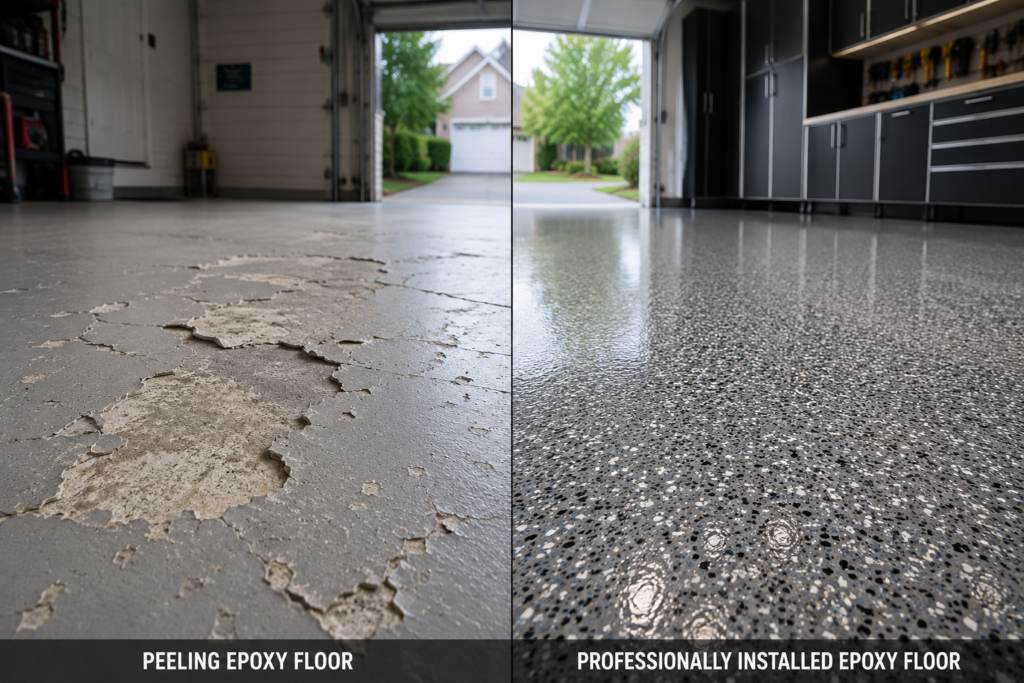
There is nothing more frustrating than investing time and money into a home improvement project, only to watch it deteriorate right before your eyes. In the world of concrete coatings, this nightmare manifests as bubbles, flakes, and sheets of resin lifting off the concrete slab. If you have ever wondered why epoxy garage floors peel, you are not alone. It is one of the most searched troubleshooting terms for homeowners across California.
While DIY epoxy kits from big-box retailers promise an easy weekend transformation, they frequently end in delamination. The truth is that epoxy doesn’t just peel because of ‘bad luck’—it peels due to specific chemical and physical failures during the preparation and application stages. In this guide, we will look at the core reasons behind coating failures and how professional installers guarantee a permanent bond.
The Top 4 Reasons Why Epoxy Garage Floors Peel
1. Moisture Vapor Transmission (Hydrostatic Pressure)
Concrete may look solid, but it behaves like a dense sponge. Moisture from the earth underneath your garage slab constantly migrates upward. If an installer applies a standard coating without checking the moisture vapor emission rate, this trapped water turns into vapor. As the temperature rises, hydrostatic pressure builds up beneath the surface, physically forcing the epoxy to bubble and snap its bond with the concrete.
2. Inadequate Surface Profiling (The “Acid Etching” Myth)
For an epoxy coating to stick, it requires microscopic ‘teeth’ to grab onto. Many DIY kits recommend acid etching with muriatic acid as a preparation method. However, acid etching rarely achieves the necessary Concrete Surface Profile (CSP) of 2 or 3. It often leaves the concrete too smooth, or worse, leaves behind a layer of acid residue that neutralizes the epoxy’s chemical reaction, leading directly to premature peeling.
3. Contaminants: Oil, Grease, and Laitance
Garages are historically dirty environments. Decades of engine oil leaks, brake fluid spills, and tire gloss penetrate deep into the porous concrete channels. If these oily zones aren’t mechanically ground away, the epoxy will float right on top of the grease layer instead of binding to the substrate. Similarly, ‘laitance’—a weak, powdery layer of cement dust on top of poorly cured concrete—will tear away easily, taking your premium floor coating down with it.
4. Hot Tire Pickup
This is a major issue for California drivers. When you drive home on hot summer days, your car tires heat up significantly. When parked on a low-solids or poorly cured epoxy floor, the hot rubber cools down, contracts, and creates a high-vacuum grip on the coating. When you back out of the garage the next morning, the tire literally rips the epoxy off the floor substrate.
Floor Failures vs. Professional Preventions
How Professionals Prevent Coating Failures
Professional installers avoid peeling by approaching the garage floor as an industrial engineering project, rather than a paint job. This involves a zero-compromise approach to substrate preparation and material chemistry:
- Mechanical Diamond Grinding: Instead of weak acids, professionals use planetary diamond grinders to shave off the weak top layers of concrete and expose clean, porous aggregate.
- Moisture-Mitigating Primers: If testing reveals high water vapor levels, specialized epoxy primers designed to withstand up to 20 lbs of hydrostatic pressure are laid down first to lock out moisture.
- Industrial-Grade Formulations: Instead of water-based formulas that shrink as they dry, pros deploy 100% solids epoxy and polyaspartic chemical networks that form a permanent covalent bond with the slab.
The Cost of Prevention vs. The Cost of Failure
While skipping steps might save money upfront, fixing a peeling floor is twice as expensive as doing it right the first time. The old, failing coating must be entirely ground off before a new system can be applied, which doubles the labor time. Proper installation costs and preparation standards are explained in our epoxy flooring cost guide.
Understanding these variables is critical when assessing estimates. To see how specialized preparation equipment and premium moisture barriers influence project budgets across the San Francisco region, check out our comprehensive guide to epoxy garage flooring cost in 2026.
Conclusion
In short, epoxy garage floors peel because of poor prep, moisture, or cheap materials. By utilizing mechanical diamond grinding, moisture-tolerant base layers, and UV-stable topcoats, professional crews build a floor that handles heavy traffic and hot tires effortlessly for decades.