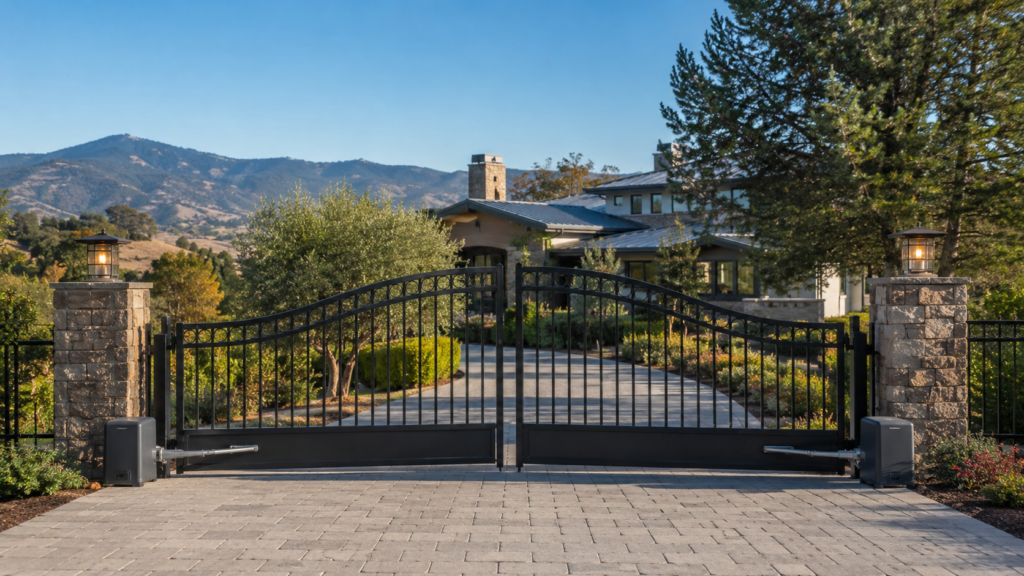
A Bay Area automatic gate and fencing project typically runs $3,500 to $8,000 for a standard residential driveway gate, plus $1,500 to $4,000 for matching fencing and access controls. The price climbs from there based on gate size, operator type, materials, and how complicated the site is. Most homeowners install gates for three reasons — security, privacy, and managing who comes onto the property — and the right setup depends on your driveway, your power, and how you want to let people in.
This guide covers what automatic gates and fencing actually are, the choices you’ll make, what the work costs, how long installation takes, and the Bay Area quirks that catch people off guard. For the full service overview, see our automatic gates and fencing services.
What Automatic Gates and Fencing Actually Are
An automatic gate is a driveway, pedestrian, or service gate that opens and closes by motor instead of by hand. The motor — called a gate operator — is the heart of the system. It connects to a control board, a power source (line voltage or solar), safety sensors, and one or more access devices like a keypad, remote, or smartphone app.
Fencing is the rest of the perimeter. Most automatic gate projects pair the gate with a coordinated fence run on both sides — wrought iron, ornamental steel, aluminum, wood, vinyl, or chain-link — so the whole property reads as one boundary.
The decisions get interesting because there are several gate styles, several operator types, several power options, and a long list of access devices that all need to work together. That’s where most of the planning effort goes — not the installation itself.
Three components do most of the work: the gate frame (what you see from the street), the operator (the motor that moves it), and the access and safety controls (keypads, intercoms, photo eyes, vehicle loops). The fence ties it together visually and physically. Some homeowners add pedestrian gates so people on foot don’t wait for the driveway gate. Others add lighting along the fence line, which is where gates start overlapping with lighting design and electrical work.
Why Homeowners Install Automatic Gates
Most projects come down to four motivations, often a mix.
Security. A locked gate changes the calculus for anyone considering walking up to the house and keeps delivery drivers, solicitors, and curious strangers off the property unless you let them in. For homes set back from the street, this is the main driver.
Privacy. A solid or semi-solid gate paired with privacy fencing blocks sightlines from the road — common for hillside homes with long driveways and properties near busy streets.
Curb appeal. The gate and matching fence is the first thing visitors see — for higher-end Bay Area homes, the gate is part of the property’s architecture.
HOA and access control requirements. Gated communities and shared-driveway properties often require automatic gates as part of the community’s access system, with controlled access for residents, guests, deliveries, and emergency services. This is one place gates intersect with HOA and property management services.
Most homeowners are buying two or three of these reasons at once.
Gate Types and How to Choose
Gates fall into two big families: swing gates and slide gates.
Swing gates hinge open like a door:
- Single-leaf — one panel that swings in or out. Simplest and least expensive. Works for driveways up to about 14 feet wide.
- Double-leaf (bi-parting) — two panels meeting in the middle. Common for wider driveways. Each leaf is shorter, so each motor works less and lasts longer.
- Cantilever-pivot — a swing variant for sloped or constrained sites where standard hinge geometry won’t clear.
Swing gates need clearance. In-swinging gates on a downsloping driveway have to clear the rising ground inside the property — often impossible without grading. Out-swinging gates have to clear the sidewalk, which most Bay Area cities won’t permit.
Slide gates roll horizontally beside the driveway:
- Track-mounted slide — rolls on a steel track set into the driveway. Reliable, but the track collects debris and needs to stay clear.
- Cantilever slide — supported by rollers at the gate post, no ground track. More expensive but cleaner-looking and immune to track debris. Most residential slide gates installed today are cantilever.
Slide gates need side clearance along the fence line for the gate to retract into. If your fence runs tight to a building or hillside, you may not have the space.
Pedestrian gates are the small walk-through gates next to the driveway gate, with their own keypad or intercom. We recommend them on any property where people might arrive on foot.
The right choice depends on driveway width, slope, side clearance, and aesthetics. For a Castro Valley ranch with a flat 12-foot driveway, a single-leaf swing or small slide both work. For a hillside Oakland property with a steep curving driveway, a cantilever slide is usually the only practical option. For more on matching gate style to architecture, see our deep dive on choosing gate and fence materials and style.
Gate Operators: The Motor That Moves It
The operator is the single most consequential mechanical choice. Pick the wrong one and you’ll be replacing it in three years.
- Linear arm (ram arm) — the most common residential choice. A motor drives a steel arm that pushes or pulls the gate. Rated for gates up to roughly 14 feet long and 500 pounds. Brands: LiftMaster LA400, Estate Swing, Apollo 1600.
- Top swing arm and bottom-mount swing arm — mounted on the gate post with a knuckled arm. Strong, more visible, slightly more industrial-looking than linear arms.
- Underground operators — the motor sits in a vault buried under the hinge. You see nothing. Cleanest look, highest cost, hardest maintenance. Common on premium custom installs.
- Chain-driven — a motor drives a chain attached to the gate. Strong and forgiving on uneven ground, but louder. Brands: Apollo Titan, LiftMaster CSL24.
- Rack-and-pinion — a toothed bar on the gate engages a gear on the motor. Smoother and quieter than chain. Preferred for residential installs where noise matters. Brands: LiftMaster SL3000, FAAC 844, Doorking 9100.
Brands worth knowing: LiftMaster, Genie, FAAC, Doorking, Estate Swing, Apollo. LiftMaster is the most widely installed in Bay Area residential work — parts are everywhere and any gate tech can service one. FAAC and Doorking show up more on premium and commercial installs.
The other big operator decision is power source:
- 110V AC line power — standard wall current run from the house to the gate via underground conduit. The most reliable option, and necessary for heavier or higher-cycle gates. Requires trenching, which adds cost if the gate is far from the house.
- Solar (DC battery + panel) — a sealed battery in a weatherproof box at the gate, charged by a small panel. No trenching. Trade-off: limited daily cycles, especially after foggy stretches in coastal microclimates.
For a gate 200+ feet up a hillside driveway, solar is often the only sensible choice — trenching that distance is brutal. For a gate 30 feet from the house with high cycle counts, line power is the right call. For a deeper look, see our guide to gate operators, intercoms, and smart access.
Access Control and Safety
Once the gate moves, you need a way to open it from outside — and the gate needs to know not to close on a car, a pet, or a person.
Access Options
- Wireless remote fobs — like a garage door remote. Cheap, reliable, what most household members use day to day.
- Keypads — a 4–6 digit PIN, wired or wireless. Good for housekeepers, occasional guests, or as a backup if a fob dies.
- Intercoms — audio or video. A visitor presses a call button; you talk to them from inside (or on your phone) and release the gate. Video intercoms have become the default for new installs.
- Smartphone apps — open the gate from your phone, see who’s there, grant temporary access codes. Most modern LiftMaster and Doorking systems include app control.
- Vehicle transponders and RFID — a windshield tag triggers the gate as you approach. Used more in HOAs and commercial settings.
- License-plate recognition cameras — a camera reads approved plates and opens the gate. Common for HOAs and gated communities; overkill for most single-family homes.
Each add-on lands between $100 and $1,500 depending on quality.
Safety and the UL 325 Standard
Automatic gates can hurt people. The U.S. standard for gate operator safety is UL 325, which has been required for residential gate operators sold in California since 2018. Any new install in the Bay Area should be UL 325 compliant. This means:
- Photo-eye sensors — infrared beams across the gate path. If something breaks the beam while the gate is closing, it stops or reverses.
- Edge sensors — pressure-sensitive strips along the leading edge. If the gate contacts anything, it stops.
- Auto-reverse on obstruction — the operator senses unusual resistance and reverses.
- Vehicle detection loops — wire loops embedded in the driveway that sense a car and prevent the gate from closing on it.
Skipping safety devices to save a few hundred dollars is the most common mistake we see on homeowner-installed gates. Don’t do it — an out-of-compliance operator can also leave you exposed if someone gets hurt.
Cost Overview
A representative Bay Area cost picture:
- Basic single-leaf swing gate, line power, wrought-iron, operator and basic access (keypad + remote): $3,500–$5,500 installed
- Sliding driveway gate, cantilever, line or solar, with operator and intercom: $4,000–$6,000 installed
- Double-swing or premium custom with underground operator, video intercom, smart-home integration: $8,000–$15,000+
- Commercial or HOA community gate with traffic loops, LPR, redundant access: $10,000–$25,000+
Other line items to budget for:
- Permits: $50–$300 depending on city or county
- Trenching for line power: $5–$15 per linear foot
- Concrete pad or footings: $400–$1,200
- Matching fencing: $35–$100 per linear foot depending on material
- Access add-ons: keypads $150–$400, fobs $40–$100 each, intercoms $300–$1,500, smart-home integration $200–$800
For the detailed breakdown — what changes the number, where homeowners overspend, and what an honest contractor’s quote should look like — see our deep dive on how much automatic gates cost in the Bay Area.
Installation Process and Timeline
A typical residential gate install runs 1 to 3 weeks from contract to final walk-through.
Week 1 — Site visit, design, and permits. A site visit measures the driveway, checks slope, identifies the power source, and confirms the gate style. Permits get pulled. Materials are ordered. A custom-fabricated gate adds 2–6 weeks of fab lead time, often overlapping with site prep.
Week 2 — Site prep and electrical. Posts and concrete footings get set. Trenching runs from the house to the gate location for line-power installs. Conduit goes in. The driveway gets a vehicle detection loop saw-cut and embedded if specified.
Week 3 — Gate, operator, and commissioning. The gate frame is hung or set on the slide track. The operator gets mounted and wired. Safety sensors and photo eyes get installed and tested. Access devices get programmed. The installer cycles the gate 20+ times to confirm everything works, then walks the homeowner through operation.
Schedules slip most often on three things: custom gate fab lead time (some Bay Area shops are 6–8 weeks out), slow permit processing, and trenching delays when crews hit rock or roots. Allow a buffer.
For driveways that need concrete work — pad pours, new aprons, repair after trenching — see concrete and entry finishes.
Ongoing Maintenance
Automatic gates work hard. A gate that opens 6–10 times a day racks up 2,000–3,500 cycles a year. Operators wear, hinges sag, photo eyes get hit by sprinklers, and mainboards take the occasional surge.
Reasonable maintenance looks like:
- Twice-yearly inspection of the operator, hinges or rollers, safety sensors, and gate alignment
- Lubrication of moving parts — hinges, rack-and-pinion teeth, chain
- Battery check on solar systems
- Tightening frame and post fasteners (vibration loosens them)
- Cleaning sensors and intercom faceplates
- Track cleaning on track-mounted slides
A neglected gate that fails at the wrong moment is the kind of small disaster homeowners remember for years. For the full playbook, see our guide to keeping your automatic gate running for years.
Bay Area Considerations
A few things specific to gates in this part of California.
Steep driveways. Hillside neighborhoods — Oakland hills, Berkeley hills, parts of Castro Valley, Hillsborough — have driveways that pitch up or down sharply. Standard swing gates bind or scrape on grade. Solutions: a cantilever-pivot swing that follows the grade, a slide gate, or grading the gate area flat as part of the install.
Coastal salt air. Half Moon Bay, Pacifica, the bay-facing slopes of Marin and the Peninsula — salt air rusts steel fast. Use galvanized steel with quality powder-coating, or marine-grade aluminum. Skip raw mild steel. Plan on touching up powder coat every 3–5 years.
HOA architectural review. Many Bay Area communities require board approval for any visible exterior change, including gates and front fencing. Get the architectural submission going early — some boards meet only monthly.
Permits vary by city. Each Bay Area city has its own threshold. Most require a permit any time the operator is hardwired to line voltage. Check before you build, not after.
California UL 325 enforcement. Since 2018, gate operators sold and installed in California must be UL 325 listed. Any new install must be compliant — a good reason to work with a contractor who installs gates regularly rather than a fabricator who occasionally does motors on the side.
Landscaping coordination. Gates almost always involve some landscape work — relocating an irrigation head, adjusting a planting bed, dealing with a tree root in the trench path. Running gate and landscaping and outdoor design under one contractor avoids the situation where the gate crew hits an irrigation main and nobody owns the fix.
Common Questions About Automatic Gates and Fencing
How Much Does an Automatic Gate Cost in the Bay Area?
A standard residential automatic gate runs $3,500 to $8,000 installed, including the gate, operator, basic access controls, and standard safety devices. Sliding driveway gates average $4,000 to $6,000. Premium custom gates with underground operators, video intercoms, and smart-home integration run $10,000 and up. Permits add $50 to $300 depending on the city.
Do I Need a Permit for an Automatic Gate in California?
In most Bay Area cities, yes. Any installation involving line-voltage electrical work — which covers most non-solar gates — requires a permit. Some cities also require a structural permit for tall gates or for posts set in property-line footings. Solar-only installs occasionally fall below the permit threshold, but check with your local building department before assuming.
Swing Gate or Slide Gate: Which Is Better?
It depends on your site. Swing gates are simpler and cheaper and work well on flat driveways with room to swing inward. Slide gates handle slope and tight clearances better but cost more and need side clearance along the fence line. For driveways under 14 feet on flat ground, a single-leaf swing is usually the right choice. For sloped, curved, or constrained driveways, a cantilever slide is the move.
Can I Connect an Automatic Gate to My Smart Home?
Yes. Most modern operators from LiftMaster, Doorking, and FAAC include Wi-Fi or work with hubs like myQ, Ring, and Control4. You can open the gate from a phone, get notifications when it opens, see camera feeds, and grant temporary access codes. Older operators can often be retrofitted with a smart relay for around $200 to $500.
How Long Does an Automatic Gate Last?
The gate frame itself — galvanized steel or aluminum, properly maintained — lasts 20+ years. Operators typically run 7 to 15 years before needing replacement, depending on brand, cycle count, and maintenance. Photo eyes and edge sensors get replaced more often, usually every 5 to 8 years. Routine maintenance is what stretches an operator from year 7 to year 15.
Getting Started
An automatic gate is a system, not a product. The right gate, operator, access setup, and safety devices have to match your site, usage, and budget. Top Tier Building Services Inc. installs and services automatic gates and matching fencing across the Bay Area — we’d be glad to walk a property with you and put together a straight quote.
By Top Tier Building Services Inc.
Licensed Bay Area General Contractor License #1146790 serving homeowners, HOAs, and property managers from Castro Valley. Top Tier delivers design-build, renovation, and maintenance services across 14 specialty trades.