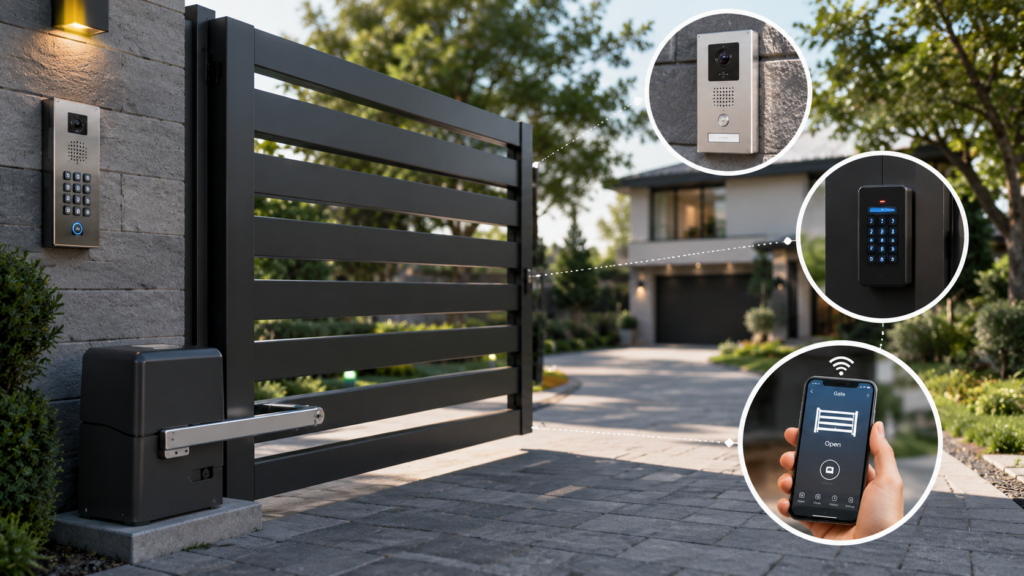
The right setup for most Bay Area driveways comes down to four questions: swing or slide, AC or solar, who needs to get in, and what happens when something blocks the gate. Gate operators and intercoms have changed a lot — quieter motors, smartphone control, sharper video, UL 325 safety enforcement — but the decisions are still mostly mechanical. If your driveway is straight with room alongside the fence, you probably want a slide gate. If it’s short and tight, a swing gate. The rest is access control and aesthetics. For the full picture, see the complete Bay Area automatic gates and fencing guide.
TL;DR: Swing Vs. Slide Operator Quick Reference
- Swing, linear arm: most common residential setup. Up to ~14 ft and 500 lbs. $400–$1,200.
- Swing, top swing arm: heavier-duty. Up to ~36 ft and 2,200 lbs. AC or DC.
- Swing, underground: hidden below grade. No visible arm. $1,500–$3,500 plus a more involved install.
- Slide, rack-and-pinion: residential default. Smoother, quieter, more precise.
- Slide, chain-driven: workhorse. Durable, slightly noisier. Common on commercial and multifamily.
Pick swing if your driveway is short with no side space. Pick slide if it’s straight with clear room along the fence for the gate to park itself.
Swing Gate Operators
Linear Arm (Ram Arm)
The linear arm is what most homeowners actually buy. The arm bolts to a post or column, pushes the gate open and pulls it closed, and the electronics live in a separate control box. LiftMaster, Estate Swing, and Apollo all make linear arms that run for years on residential driveways. They’re sized for low-duty-cycle use — a household opening the gate 20–40 times a day, not a 200-unit complex. Most top out around 14 ft and 500 lbs per leaf; if the gate is heavier, you size up.
Top Swing Arm and Bottom Mounted Arm
For heavier or longer gates, the top swing arm takes over. Some configurations handle 36 ft and 2,200 lbs. Most run on AC, some on DC for solar — typically from FAAC, Doorking, or LiftMaster’s commercial lines. A bottom mounted variant hides the operator below the gate hinge instead of running an arm across the front. Cleaner-looking without going fully underground.
Underground Operators
Underground operators are the premium option when you don’t want any visible hardware. The motor sits in a sealed pit at the base of each post, and the arm connects from below — from the driveway, you just see the gate swinging open by itself.
The tradeoff is cost and install complexity. The pit has to be excavated, formed, and drained (water sitting on the motor is the failure mode that kills these), and the operator runs $1,500–$3,500 per side versus $400–$1,200 for a linear arm. For ornamental iron gates, it’s worth it. For utilitarian driveways, overkill.
Slide Gate Operators
Rack-and-Pinion
Rack-and-pinion is the residential favorite. A toothed gear on the operator meshes with a toothed rail bolted to the bottom of the gate, pulling it along smoothly with less noise than a chain. Precision matters — if the rack is misaligned or the gate isn’t level, the teeth wear unevenly and you’ll hear it within a year.
Chain-Driven
Chain-driven operators use a steel chain stretched along the gate path. Durable, mechanically simple, a little louder. You’ll see them on commercial properties, multifamily complexes, and HOAs where reliability and cost outrank quiet operation.
Either type needs the same thing: a smooth, level track and a clear sliding path along the fence. If a slope, tree, or planted bed is in the way, that has to be solved first — which is why landscaping and outdoor design sometimes has to be coordinated with the gate install.
AC Vs. DC: How You Power the Operator
Most residential operators run on standard AC line power, which means trenching a conduit from the house out to the gate. A 50 ft run is quick. A 300 ft run up a long driveway is often the single biggest line item on the estimate. Coordinating it with lighting design and electrical work can save real money if other low-voltage runs are going in at the same time.
DC solar operators are the alternative — a panel charges a battery, the battery runs the motor, no trench. The catch in the Bay Area: solar needs sunlight. Parts of Marin, the coast, and tree-shaded properties in Oakland and Berkeley get persistent fog or canopy shade. We’ve seen solar operators run fine in San Ramon and underperform in Mill Valley. Site matters.
Access Control: Who Gets in and How
Access control is the layer on top of the operator — the operator opens the gate, access control decides when.
- Remote fobs. One per driver. Cheap, reliable.
- Keypads. Codes for family, the housekeeper, the dog walker. No fob to lose.
- Audio intercoms. $300–$800. Visitor presses a button, you talk through the indoor station.
- Video intercoms. $600–$1,500. Same idea, with a camera.
- Smartphone apps. LiftMaster’s MyQ and Genie’s Aladdin Connect let you open the gate from anywhere and issue time-limited codes. This is what most clients ask about first.
- Vehicle transponders. A windshield tag triggers the gate as you drive up — no stopping.
- License-plate recognition. A camera reads plates and opens for approved vehicles. Mostly commercial and HOA.
- Vehicle detection loops. A wire loop embedded in the driveway senses a car and triggers the gate.
For HOA and property management gates, a video intercom plus a directory and transponder system is the usual combination — easy for residents, traceable for the board.
Safety Standards: UL 325 and ASTM F2200
Two standards govern the work. They’re not optional.
UL 325 is the U.S. safety standard for gate operators. California has required compliance since 2018, and any operator sold today has to meet it. It mandates photo-eye sensors (an infrared beam across the gate path that stops the gate if something interrupts it), force monitoring (auto-reverse on resistance), and entrapment protection at every pinch or crush point. If a quote skips photo-eyes or talks about disabling the safety reverse, walk away.
ASTM F2200 is the gate construction standard — gaps between pickets, hinge clearances, spacing between gate and post. A UL 325 operator on an F2200 non-compliant gate doesn’t pass inspection.
How Top Tier Handles This
We start every gate project with two site visits: one to measure and look at power, the other to confirm the operator choice with the gate fabricator. For most Bay Area homeowners we end up specifying a LiftMaster or FAAC linear arm on swing gates and a rack-and-pinion on slides — parts are widely available locally and we can service them ourselves years later. Solar gets specified when trenching cost will blow the budget, but we confirm sun exposure first. Every install includes UL 325 photo-eyes, force testing, and a written commissioning checklist. Top Tier is a licensed Bay Area general contractor (CA License #1146790), so the electrical, the concrete, and the gate stay under one roof.
Common Questions About Gate Operators and Intercoms
What’s the Most Reliable Residential Gate Operator?
For swing gates, a LiftMaster or Apollo linear arm handles residential use for years with minimal service. For slide gates, a rack-and-pinion from LiftMaster, FAAC, or Doorking is the standard. Avoid DIY-grade brands like Mighty Mule for daily-use driveways — they’re often replaced within a few years.
Is Solar Power a Good Choice for a Driveway Gate?
It depends on sun exposure. If the gate sits in open sunlight most of the day, solar is reliable and saves the trenching cost. In foggy coastal areas or under tree canopy, a solar setup can struggle in winter. Walk the site at different times of day before committing.
What’s the Difference Between a Chain Drive and Rack-and-Pinion Slide?
Chain drives use a steel chain to pull the gate — durable, simple, slightly louder. Rack-and-pinion uses a toothed gear meshing with a toothed rail — smoother, quieter, more precise. Rack-and-pinion is the residential default; chain drive is more common on commercial and HOA gates.
Is UL 325 Compliance Required in California?
Yes. California has required UL 325 compliance for all new automatic gate operator installations since 2018. That means photo-eye sensors, force monitoring with automatic reverse, and entrapment protection at every pinch point. Reputable installers document all of this in the commissioning paperwork.
Plan Your Gate Around the Right Operator
If you’re weighing operator choices for a new gate or upgrading older hardware to smart access, we’re happy to walk your driveway and talk through the options. Top Tier handles the gate, the electrical, and the access control as one project — see our automatic gates and fencing service page for project examples.
By Top Tier Building Services Inc.
Licensed Bay Area General Contractor License #1146790 serving homeowners, HOAs, and property managers from Castro Valley. Top Tier delivers design-build, renovation, and maintenance services across 14 specialty trades.