
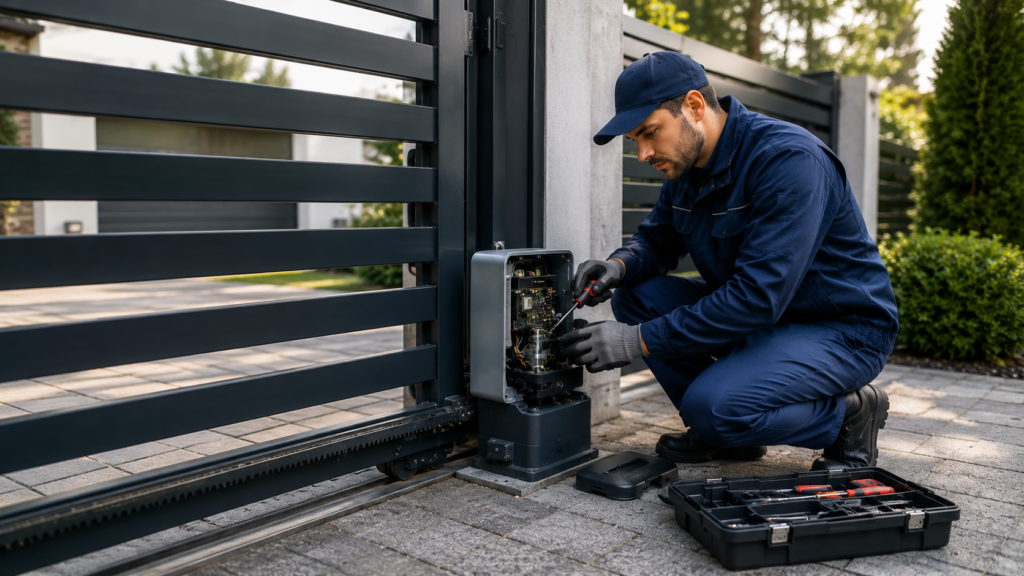
A well-installed automatic gate should run 15 to 20 years with the right care. The pattern is simple: a five-minute monthly walk-around, a quarterly hands-on tune-up, and one annual professional service. That schedule prevents most failures and keeps the operator under warranty. This guide covers what to do yourself, when to call a pro, what common problems mean, and what repairs cost in the Bay Area. For the broader picture, see our complete Bay Area automatic gates and fencing guide.
The Maintenance Schedule at a Glance
If you do nothing else, do these three things on time. Most operator failures we see in the field trace to one of them being skipped.
- Monthly (5 minutes, homeowner): Walk the gate. Look at hinges, posts, photo-eye sensors, and the gate itself. Anything bent, loose, dirty, or rusting goes on the list.
- Quarterly (30 minutes, homeowner): Lubricate hinges with white lithium grease, wipe the photo-eye lenses, clear debris from a slide-gate track, and check chain tension on slide operators.
- Annual (1–2 hours, pro): Full operator inspection, force-test the auto-reverse, UL 325 safety check, tighten electrical connections, battery test, photo-eye calibration, and a hinge wear assessment.
Coastal homes and gates under heavy tree cover should run that schedule about 1.5x more often.
Quarterly Tasks You Can Do Yourself
Quarterly maintenance is the most useful thing a homeowner can do. Half an hour prevents the bulk of avoidable service calls.
Lubricate the hinges. Use white lithium grease — not WD-40, which is a solvent that strips existing grease. One pump per hinge; work the gate back and forth. Dry hinges cause most of the squeal homeowners mistake for operator failure.
Wipe the photo-eye sensors. A microfiber cloth and glass cleaner is all it needs. Dust, pollen, and wildfire smoke residue throw the sensors off and cause phantom reversals.
Check chain tension on slide gates. The chain should deflect about half an inch with finger pressure at the midpoint. Loose chains skip teeth; tight chains accelerate gear wear.
Clear the slide-gate track. Leaves, acorns, and irrigation debris collect in the V-groove. A stiff brush and a shop vacuum handle it.
Inspect the posts and welds. Look for hairline cracks at weld points, post lean, or rust starting at the base. Catch it now, not when the gate is dragging on the driveway.
What an Annual Professional Service Covers
A real annual service runs $200 to $400 in the Bay Area, and pays for itself on operator life alone — skipped maintenance is a common reason warranty claims get denied.
A proper visit includes force testing the auto-reverse against UL 325, photo-eye recalibration, an electrical inspection with connections tightened, a battery load test (backup and solar batteries degrade on a 3–5 year cycle), a hinge wear assessment, and a track and chain inspection on slide gates. Most HOAs and larger residential accounts run on a scheduled maintenance plan rather than booking one-offs.
Common Issues and How to Troubleshoot Them
Before calling for service, walk through this short list — about half the calls we get could have been solved in five minutes.
Gate won’t open with the remote. Start with the remote battery — the cause about 70% of the time. If a new battery fails, try a second remote. If both fail, the issue is the receiver or its power.
Gate opens partially or moves slowly. On DC or solar systems, almost always low battery voltage. On AC systems, look for obstructions, then check chain tension. If the gate has been slow for months, the operator may be overworked for the gate weight.
Gate reverses for no reason. Nine times out of ten it’s the photo-eye sensors — misaligned or dirty. The other cause is a force setting that’s too sensitive and needs pro recalibration.
Intermittent operation. Usually water in the control box, a loose wire, or surge damage. After a winter storm, check whether the control box gasket is still sealing.
Loud noise from the operator. Squealing means dry hinges or a dry track. Grinding means bad bearings or gear wear and warrants service.
Gate sags or drags. The post moved. Bay Area clay soils heave seasonally; hinges wear oval. The fix is reseating the post or replacing the hinge — neither is a homeowner job.
When to Call a Pro Vs. DIY
The rule: anything mechanical and external is fair game; anything electrical or internal to the operator is a pro.
The line matters because an incorrectly adjusted force setting can defeat the auto-reverse safety. UL 325 is a safety standard, not a suggestion — a licensed contractor (Top Tier carries CA #1146790) is on the hook to get it right.
What Repairs Cost in the Bay Area
Current Bay Area ranges — low end for straightforward residential, high end for heavier gates or harder access.
- Standard service call: $150–$300
- Sensor realignment or cleaning: $150–$250
- Hinge replacement: $200–$500
- Control board replacement: $300–$800
- Operator full replacement: $800–$2,500+ depending on type
- Slide gate track repair or rerouting: $300–$1,500
- Post replacement or reseating: $500–$1,500
On a gate 12–15 years old, a failed control board usually argues for full operator replacement over a board swap — newer operators are quieter and easier to service.
Bay Area Specific Issues to Watch for
Coastal salt air corrodes wrought iron and bare steel fast. Touch up paint annually; replace zinc anode posts every 3 to 5 years.
Inland sun exposure in Pleasanton, Walnut Creek, and Livermore cracks plastic photo-eye housings faster than coastal installs. Replacement lenses run about $40 each.
Winter storm season brings tree debris onto slide gate tracks — by far the most common storm-season call. A walk-around after every major storm saves a service trip.
Clay soil is the Bay Area’s quiet gate killer. Soil heaves in winter and contracts in summer; posts move with it. Check for post lean each spring.
Wildfire smoke leaves a fine residue on photo-eye lenses. After any major fire event, wipe the sensors down.
How Top Tier Handles Gate Service
Top Tier offers gate maintenance and repair as part of our automatic gates and fencing service, with one-off calls and scheduled plans. Our techs carry diagnostics for LiftMaster and Genie operators and stay current on UL 325. We coordinate related work — electrical service for keypad or intercom replacement, or exterior touch-ups when a gate goes in for a full refresh. For HOA accounts, we handle the board communication loop through our HOA property management services.
Common Questions About Automatic Gate Maintenance
How Often Should I Service My Automatic Gate?
A homeowner check every month, a hands-on quarterly tune-up (lubricate, clean sensors, clear debris), and one professional service per year is the right cadence for most Bay Area gates. Coastal properties and heavy-traffic gates should bump that to twice-yearly professional service.
Why Is My Gate Not Opening?
The most common cause is a dead remote battery — start there. If the remote is good, check whether the operator has power and look for a tripped breaker. If the gate still won’t budge, a service call is the next step.
Can I Fix My Own Gate Operator?
Mechanical maintenance — hinges, sensors, batteries, debris clearing — yes. Anything involving the control board, force settings, limit switches, or electrical work should go to a licensed pro. Incorrectly set force values can defeat the auto-reverse safety, which is both dangerous and a UL 325 violation.
How Much Does It Cost to Repair a Gate in the Bay Area?
A standard service call runs $150 to $300. Sensor work is $150 to $250. Hinge replacement runs $200 to $500. A new control board is $300 to $800. Full operator replacement starts around $800 and runs to $2,500 or more depending on the gate.
Keep Your Gate on the Schedule
A gate that gets the monthly look, the quarterly tune-up, and the annual professional service rarely surprises anyone. If you’re behind on maintenance, or your gate is making a noise that wasn’t there a year ago, we’d be glad to come take a look.
By Top Tier Building Services Inc.
Licensed Bay Area General Contractor License #1146790 serving homeowners, HOAs, and property managers from Castro Valley. Top Tier delivers design-build, renovation, and maintenance services across 14 specialty trades.