If you want a single team accountable for both design and construction with budget clarity earlier and a faster path to a finished project, design-build is usually the right call. If you want maximum control over the design before any contractor sees the drawings — and you have the time and project management experience to run two separate contracts — design-bid-build still has a place. The rest of this post unpacks the real differences in cost, schedule, risk, and communication, and offers a clean framework for choosing. For the broader picture, see our Bay Area design-build guide.
TLDR: A Quick Comparison Snapshot
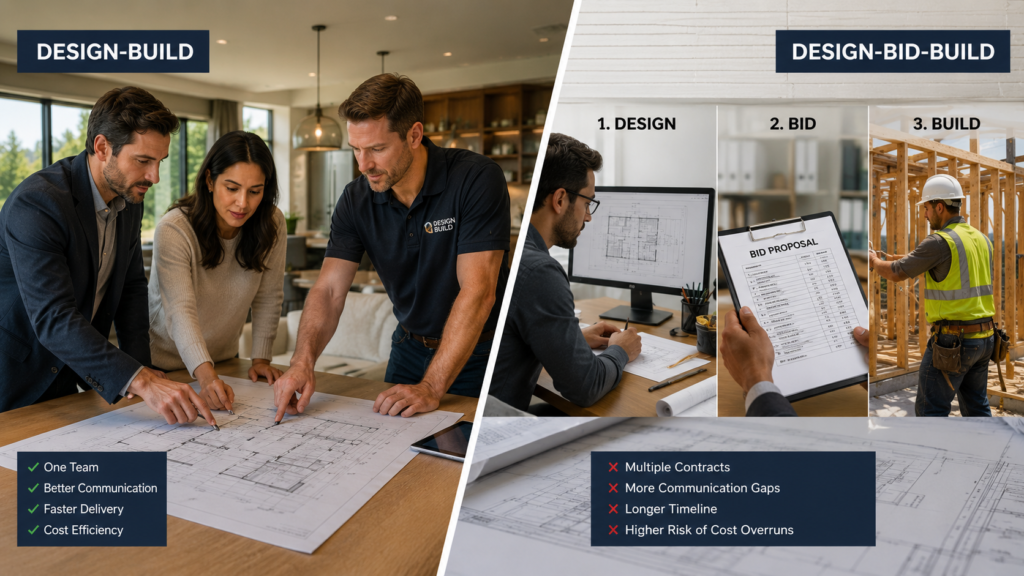
- Design-build = one contract, one team handling both design and construction. Industry research shows it tends to deliver projects up to 102% faster, ~6–10% lower total cost, with ~6% fewer change orders and 3.8% less cost growth than traditional delivery.
- Design-bid-build = three separate relationships (owner-designer, owner-contractor, designer-contractor advisory). The owner controls the design fully before bidding, then takes on more coordination risk during construction.
- Pick design-build when you want speed, single-point accountability, and earlier budget certainty.
- Pick design-bid-build when you want absolute design control before pricing, the project is simple or budget-sensitive, and you have an experienced project manager on your side.
How Each Method Actually Works
The two delivery methods diverge from the first phone call you make.
The Design-Build Model
In design-build, you hire one firm. That firm employs (or partners closely with) the architect, the designer, and the construction team, and signs a single contract with you. The same group drawing the plans hands them to the same group that builds them — often the same people in the same weekly meeting. One point of accountability, and budget conversations start the moment design conversations do.
That structure is the point. Constructability feedback happens during design, not after. If a beam doesn’t pencil out, the builder says so before drawings are finalized. If a tile selection will blow the budget, you hear it at the spec stage — not during permitting.
The Design-Bid-Build Model
In design-bid-build (sometimes called “traditional construction” or “DBB”), you hire a designer first. They develop plans to whatever level of detail you’ve agreed on — schematic design, design development, sometimes all the way to construction documents. Then those drawings go out to bid. Contractors price the work, you pick one, and you sign a second contract.
The designer typically stays on in an advisory role during construction — visiting the site, reviewing submittals, responding to RFIs. But they have no contractual relationship with the contractor. You sit in the middle of both.
For owners who want to fully crystallize the design before any contractor sees a number, that sequence has real appeal. The tradeoff: you don’t know what the project will cost until the bids come in — and by then, the design is essentially fixed.
Cost, Schedule, Risk, Communication: The Real Differences
Cost
Design-build comes out ahead on cost more often than not. Industry studies put total project cost roughly 6–10% lower than design-bid-build, with about 3.8% less cost growth from initial budget to final invoice. The mechanism is simple: integrated teams catch budget-busting decisions during design, when changing them is free.
Where does DBB leak money? Mostly through change orders. Around 80% of budget overruns come from change orders, and DBB structurally produces more — because designers and builders aren’t collaborating during design, gaps in the drawings surface mid-construction. Design-build projects log roughly 6% fewer change orders.
That said, DBB can be cheaper for simple, well-defined scopes where competitive bidding genuinely lowers the construction price. A standard fence replacement is a different animal than a whole-home renovation.
Schedule
Speed is where design-build’s lead is widest. Studies measure delivery up to 102% faster than DBB — and the reason is structural, not magical. In DBB, design and construction are sequential: finish design, bid, then build. In design-build, those phases overlap. Foundation work can start while interior selections are still being finalized. For owners working against a hard date, that overlap is hard to beat.
Risk
In DBB, the owner sits between two contracts and bears the gap. If drawings have an error and the contractor builds to spec, the owner pays to fix it (and may chase the designer for reimbursement). If the contractor misreads a detail, the designer may or may not catch it on a site visit.
In design-build, that gap closes. One entity is responsible for design and build, so finger-pointing has nowhere to go. Owners trade some control for less risk exposure.
Communication
Three parties versus one team. The math is what you’d expect: more interfaces, more chances for messages to get garbled. Design-build’s single weekly meeting tends to replace what would otherwise be three sets of calls in DBB.
When to Pick Design-Build Vs Design-Bid-Build
A practical framework:
- You have a hard schedule (move-in date, school year, lease end)
- You want budget certainty before construction documents are 100% complete
- You don’t want to manage two contracts and the seam between them
- Your project is complex (whole-home renovation, additions, structural work)
- You value single-point accountability over maximum design control
- You have a specific design vision you want fully developed before any contractor sees a price
- Your project is simple, well-defined, and not schedule-sensitive
- You have an experienced project manager who can broker between designer and contractor
- You’ll accept more change-order risk in exchange for design control and competitive bidding
- The work is largely interior or cosmetic, where drawings are unlikely to surprise the builder
Neither method is universally better. The right choice is the one that matches your priorities — and your tolerance for managing a multi-party project.
How Top Tier Approaches Design-Build
At Top Tier Building Services Inc. (CA License #1146790), our design-build practice keeps architects, designers, and construction on the same project from first sketch to final walkthrough. That means architectural design and planning decisions get pressure-tested against real Bay Area cost data — and against the seismic, Title 24, and city-specific permit requirements that quietly drive a lot of the budget here. Our project management layer keeps the schedule honest week to week. Owners get one number, one contact, one team accountable from concept to keys.
For a wider look at how we structure design-build engagements locally, the complete Bay Area design-build overview covers process, cost benchmarks, and team selection in depth.
Common Questions About Design-Build Vs Design-Bid-Build
Is Design-Build Always Cheaper Than Design-Bid-Build?
Not always, but usually. Across most project types, design-build comes in about 6–10% lower in total cost and shows roughly 3.8% less cost growth from initial budget to final invoice. The exceptions tend to be very simple, tightly scoped projects where competitive bidding on a finished design genuinely produces the lowest number.
Which Is Faster, Design-Build or Design-Bid-Build?
Design-build, by a meaningful margin. Because design and construction phases overlap rather than running sequentially, design-build has been measured up to 102% faster than design-bid-build on equivalent projects. If schedule matters, design-build is the safer pick.
Who Bears More Risk in Each Delivery Method?
The owner bears more risk in design-bid-build, because they sit between two contracts (designer and contractor) and absorb the gaps when drawings and construction don’t align. In design-build, one entity is contractually responsible for both, so the owner’s exposure to coordination errors drops significantly.
Can You Switch From Design-Bid-Build to Design-Build Mid-Project?
Sometimes, but it’s not clean. If you’ve engaged a designer and bidding isn’t going well, a design-build firm can take over construction with the existing drawings — though they’ll typically want to review and value-engineer them first. Switching the other direction is rarer, and usually only happens when the relationship has broken down.
Choosing a delivery method is one of the first real decisions in any renovation, and it shapes everything that follows. If you’re weighing design-build for a Bay Area project and want to talk through whether it fits your scope and schedule, we’d welcome the conversation.
By Top Tier Building Services Inc.
Licensed Bay Area General Contractor License #1146790 serving homeowners, HOAs, and property managers from Castro Valley. Top Tier delivers design-build, renovation, and maintenance services across 14 specialty trades.