
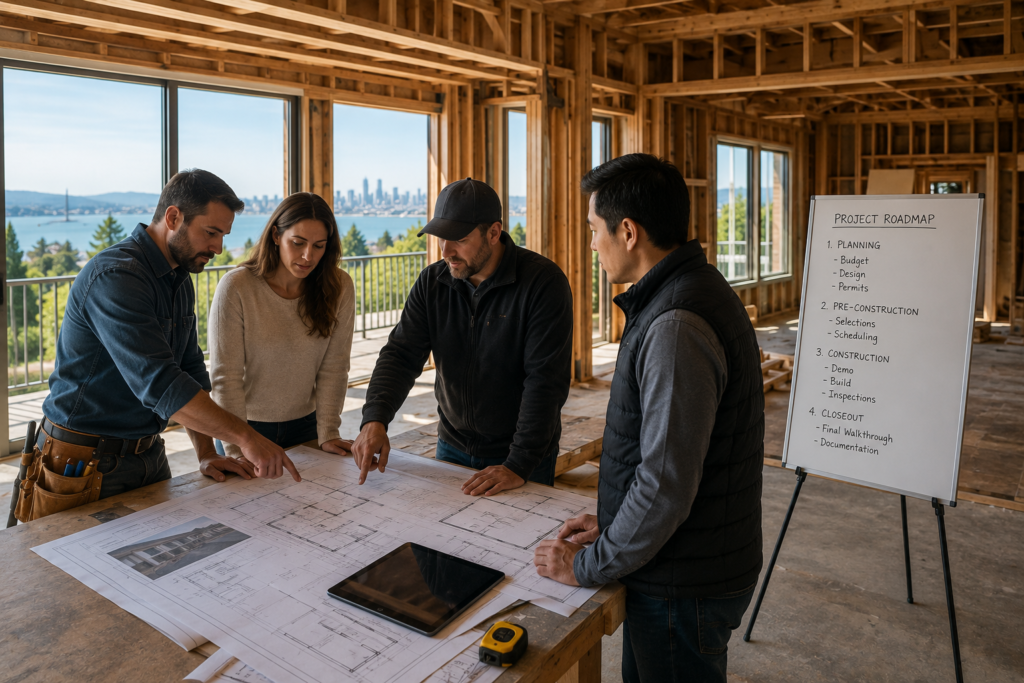
A residential construction project manager (PM) is the single point of contact that keeps a complex renovation from spiraling — schedules the trades, controls the budget, signs off on quality, and absorbs the daily friction so the homeowner doesn’t have to. In the Bay Area, where labor is expensive, permits take time, and a single missed inspection can cost two weeks, good project management is often the difference between a project that finishes on time and one that drags through three seasons. This guide walks through what a PM actually does, when it makes sense to hire one, what it costs, how the typical project runs phase by phase, and the mistakes Bay Area homeowners most often make when they try to manage a renovation themselves.
Overview: What a Construction Project Manager Actually Does
A construction project manager runs a renovation the way an air traffic controller runs an airport. The work is mostly invisible when it’s going well. You see it when it’s not.
On any given week of a mid-sized Bay Area renovation, a PM is sequencing four to seven trades, ordering long-lead materials, pulling permits, scheduling inspections, reviewing change orders, paying subs, and fielding questions from the homeowner. The role exists because no single trade — framer, electrician, plumber, tile setter — has the bandwidth or incentive to coordinate with all the others. Without a PM, that job falls to the homeowner, and most homeowners haven’t done it before.
The clearest way to describe the role is by what it absorbs. The PM absorbs:
- The decision load (which finish, which fixture, which subcontractor)
- The scheduling load (what happens in what order, who’s on site Tuesday)
- The vendor relationships (knowing which tile supplier delivers on time)
- The risk of mistakes (catching a framing error before drywall buries it)
- The financial tracking (where the budget is going, in real time)
- The communication load (keeping everyone informed without nine group texts a day)
For a kitchen remodel, you might not need a dedicated PM — a competent general contractor handles most of these. For a full house renovation, an addition, or a project with multiple trades running in parallel, dedicated project management starts to pay for itself quickly.
How to Think About Project Management on a Renovation
The biggest mistake Bay Area homeowners make is treating project management as overhead — a fee to minimize. In our experience, the projects with weak PM are the ones that go over budget by 20 to 40 percent. The projects with strong PM hit budget within five percent and finish within two weeks of schedule.
That’s because most cost overruns aren’t caused by surprises in the walls. They’re caused by decisions made too late, materials ordered after the trade is on site waiting, change orders piled up without review, and small problems that become large because no one was watching for them. Project management is the function that catches those before they compound.
The mental model that helps: think of a renovation as a chain of dependencies. The drywaller can’t start until the framer is done. The framer can’t start until the inspector signs off on the rough plumbing. The plumber can’t start until the demo crew has opened the wall. If any link slips, everything downstream slips with it. A PM exists to keep the chain tight.
For a Bay Area homeowner, the question isn’t really whether to have project management on a substantial renovation. The question is who does it — a dedicated PM, the general contractor as part of their fee, an architect extending scope, or the homeowner themselves. Each option has a different cost and a different risk profile.
The Key Decisions You’ll Make Around Project Management
A few choices set the tone for how the project runs. They’re worth thinking through before signing any contract.
Do You Hire a Dedicated PM, or Use the GC’s Built-in PM?
Most Bay Area general contractors include project management in their fee — typically 15 to 25 percent of the construction cost. That fee covers scheduling, vendor management, and quality control during construction. For most homeowners on a single-trade project (a bathroom, a kitchen, a single-room remodel), that’s plenty.
For larger or more complex projects, a dedicated PM separate from the GC adds an independent layer. They represent the homeowner’s interests, review the GC’s pay applications, push back on change orders, and catch problems the GC might rather you not see. It costs extra — usually four to seven percent of project cost — but on a $400,000-plus renovation that protection often pays for itself.
Where Does Your PM Get Involved?
A PM hired in the design phase can save real money. They catch buildability issues before plans are stamped, get accurate trade pricing during design, and prevent the classic problem of expensive design choices the trades then have to bid blind.
A PM hired only at construction start has less leverage. The design is set, the plans are stamped, and the PM is now managing what they didn’t help shape. They can still do good work, but the most valuable decisions have already been made.
How Hands-on Will You Be?
Some homeowners want daily updates and weekly meetings. Others want to disappear and reappear at the final walkthrough. Both work — but the agreement has to be explicit. The communication cadence you want should be in writing before the first wall comes down. Mismatched expectations on communication are the most common source of conflict on otherwise well-run projects.
What Decision-Making Authority Do You Delegate?
A good PM will ask early: for changes under $1,000, do you want to be consulted or just informed? Setting that threshold up front prevents two failure modes. Either the homeowner gets flooded with trivial choices (and starts ignoring them), or the PM makes call after call without the homeowner’s input and arrives at the final walkthrough with surprises. Pick a number that fits your tolerance.
Cost Overview: What Bay Area Project Management Actually Costs
Bay Area numbers for 2026 are higher than national averages, mostly because of labor costs and permit timelines.
For a general contractor’s built-in project management (the most common arrangement), expect 15 to 25 percent of the construction cost. On a $200,000 renovation, that’s $30,000 to $50,000 of the total — and it covers scheduling, sub management, quality control, and warranty handling.
For a standalone project manager — separate from any trade work — expect:
- Hourly: $125 to $225 per hour for senior PMs in the Bay Area, $90 to $140 for less experienced
- Percentage of project cost: typically 4 to 10 percent, depending on scope and how hands-on the PM is
- Fixed fee per phase: some PMs charge a flat fee for the construction phase and a separate fee for design coordination
What drives the price up: multi-trade projects, custom or imported materials, complex permitting (historic neighborhoods, hillside lots, ADUs), absentee owners, and tight timelines.
What keeps the price reasonable: clear scope, decisions made early, standard materials, owners who can decide quickly, and projects scoped as design-build under one team rather than designer + contractor + PM as three separate hires.
A note on the cheapest option: managing the project yourself looks free until you count the cost of mistakes. On a recent East Bay full-house remodel where the homeowner tried to PM, a missed coordination call between the framer and the HVAC subcontractor cost an extra $11,000 to retrofit chase space. The “free” PM saved nothing.
For more on costs, see what construction project management actually costs in the Bay Area.
Process and Timeline: What the Project Actually Looks Like
A well-managed Bay Area renovation usually breaks into six phases. Each one has different decisions and a different cadence of communication.
Phase 1: Pre-construction (2 to 6 weeks) — Scope finalized, contracts signed, permits submitted, long-lead materials ordered (tile, fixtures, windows, custom cabinetry). This is where weeks get saved or lost. A PM who pushes hard to lock material selections during pre-construction protects the timeline downstream.
Phase 2: Demo and rough trades (2 to 8 weeks depending on scope) — Walls open, framing changes complete, rough plumbing and electrical in. Inspections run. This is the phase where surprises emerge — old knob-and-tube wiring, undersized framing, hidden water damage. A good PM has 10 to 20 percent contingency budgeted for exactly this.
Phase 3: Insulation and drywall (1 to 3 weeks) — Walls close up. From this point, anything you didn’t catch before drywall is expensive to fix.
Phase 4: Finishes (3 to 10 weeks) — Tile, cabinetry, flooring, paint, trim. This is the longest phase on most projects and the one with the most micro-decisions. Communication intensifies.
Phase 5: Punch list and final inspections (1 to 3 weeks) — Final inspections, deficiency list, fixes. Often takes longer than homeowners expect, especially when waiting on city inspectors during busy seasons in the East Bay.
Phase 6: Closeout (1 to 2 weeks) — Final walkthrough, warranty handover, manuals, lien releases.
Total typical duration for a substantial Bay Area renovation: 4 to 9 months for a kitchen or full bath suite, 6 to 14 months for an addition, 9 to 18 months for a full house.
Common Mistakes Bay Area Homeowners Make
A few patterns show up over and over in projects that go sideways.
Hiring a PM too late. By the time construction starts, the most leverage-generating decisions have already been made. A PM in design can save more than they cost.
Choosing the lowest GC bid without checking PM strength. Two bids on the same project can come in $40,000 apart, and the lower one almost always wins. The lower bid often comes from a GC with weaker project management — and that gap shows up later as change orders and delays. The total project cost ends up higher, not lower.
Skipping the change order discipline. Every change should be priced and signed before the work happens. Verbal “just go ahead and do it” instructions create disputes at the end of a project. A PM enforces this; without one, it falls apart fast.
Not budgeting contingency. 10 percent minimum for a kitchen or bath, 15 to 20 percent for a full house, 20 to 25 percent for older homes in the East Bay or Peninsula. The renovations that finish on budget are the ones that planned for the unknowns from day one.
Mistaking activity for progress. A site full of workers feels productive. But a PM tracks completion against the schedule, not against how busy the site looks. Some of the most efficient days on a project have only one or two people on site — they’re the right people doing the critical-path task.
Common Questions About Construction Project Management in the Bay Area
Do I Need a Project Manager for a Simple Kitchen Remodel?
Probably not as a separate hire. A reputable Bay Area general contractor handles project management for a single-room remodel as part of their fee. Where dedicated PM starts to pay off is on multi-room remodels, additions, and full-house projects with multiple trades running in parallel.
How Is Construction Project Management Different From Being a General Contractor?
A general contractor holds the construction license, signs the prime contract, and is legally responsible for the work. A project manager coordinates the work and represents the owner’s interests but may not hold a contractor’s license. Many Bay Area GCs (including Top Tier, CA License #1146790) provide both functions in one team; some owners prefer to hire an independent PM on top of the GC for larger projects.
What Does a PM Do During Permitting?
A good PM tracks the permit application through the local jurisdiction, responds to plan-check comments, schedules inspections, and adjusts the construction schedule when permit timelines slip. In Bay Area cities like Oakland, Berkeley, and San Francisco, permitting can take 8 to 20 weeks, and a PM who knows the local plan-check process saves real time.
Can I Manage My Own Renovation Project?
You can — and some homeowners do, successfully. It usually works when the homeowner is in the construction industry, when the project is small and single-trade, or when the homeowner has months of flexible daytime hours. For everyone else, the unpaid hours and the cost of mistakes usually outweigh the saved fee.
How Do I Know If a PM Is Doing a Good Job?
Two signs: the project is hitting its weekly milestones, and you don’t feel like you’re chasing answers. A weak PM produces busy reports and unanswered questions. A strong PM produces clear weekly updates with decisions needed, decisions made, schedule status, and budget status — and you can read each one in five minutes.
How Top Tier Approaches Project Management
Project management is woven into every renovation Top Tier takes on, not bolted on as an extra. For homeowners managing a full house renovation or a multi-trade project, a senior project manager runs weekly site meetings, maintains a live schedule, and keeps the budget current to the dollar. For HOA boards and property managers, the same discipline applies to capital improvement projects across multiple buildings. The team coordinates closely with architectural design and planning when projects need design support, and the design-build approach folds project management into a single accountable team rather than splitting it across separate firms.
If you’re planning a major Bay Area renovation and trying to figure out the right project management approach for your scope, we’d welcome a conversation. A 30-minute scoping call usually clarifies whether a single GC-led team is enough or whether a dedicated PM layer makes sense for your project.
By Top Tier Building Services Inc.
Licensed Bay Area General Contractor License #1146790 serving homeowners, HOAs, and property managers from Castro Valley. Top Tier delivers design-build, renovation, and maintenance services across 14 specialty trades.