
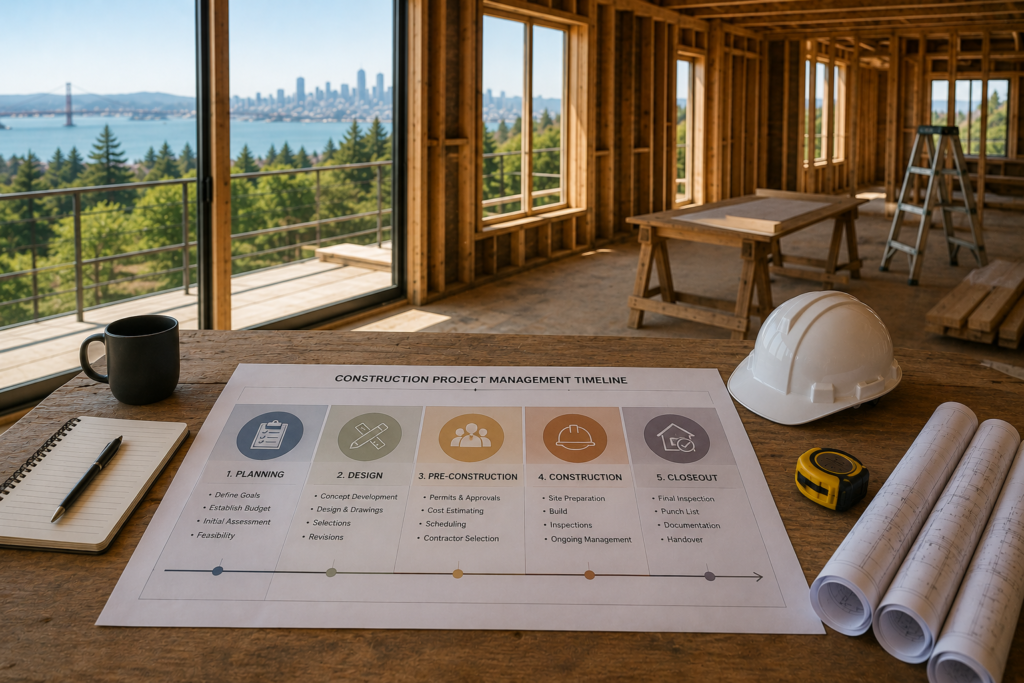
A well-managed Bay Area renovation moves through six predictable phases over roughly 4 to 18 months, depending on scope. Most homeowners think of construction as one long phase, but a project manager sees six — and each one has different decisions, different risks, and different cadences of activity. Knowing what’s supposed to happen each phase makes it much easier to tell whether your project is on track. This timeline breakdown walks through what to expect week by week from contract signing to closeout. For the broader picture, see the complete Bay Area construction project management guide.
The Short Answer
For a typical mid-sized Bay Area renovation in 2026:
- Pre-construction: 8 to 16 weeks (longer for additions or full-house)
- Demo and rough trades: 3 to 8 weeks
- Insulation, drywall, prep for finish: 2 to 4 weeks
- Finishes: 6 to 14 weeks
- Punch list and inspections: 2 to 4 weeks
- Closeout: 1 to 2 weeks
A bathroom remodel runs about 8 to 14 weeks of on-site work. A kitchen runs about 10 to 16. A full-house renovation runs 6 to 14 months of on-site work, with 3 to 6 months of pre-construction before that.
The timelines below assume permits are in hand. Permits add 6 to 24 weeks depending on jurisdiction and complexity — Castro Valley, Hayward, and Dublin move faster; Oakland, Berkeley, and San Francisco take longer.
Phase 1: Pre-Construction (8 to 16 Weeks)
Pre-construction is where the project gets engineered for success or set up for failure. It runs in parallel with permitting and often takes longer than the homeowner expects.
The PM is doing this work during pre-construction:
- Finalizing the contract scope (week 1 to 2)
- Coordinating with the architect or designer on construction documents (week 1 to 8)
- Submitting and managing the permit application (week 2 to 14)
- Bidding out and contracting subcontractors (week 2 to 6)
- Specifying and ordering long-lead materials — tile, cabinetry, windows, fixtures (week 2 to 8)
- Building the construction schedule (week 4 to 8)
- Conducting pre-construction inspections of the home (week 6 to 10)
- Final material selections with the homeowner (week 6 to 10)
The end of pre-construction is marked by a kickoff meeting: scope, schedule, communication plan, decision authority, contingency, and roles all aligned among the homeowner, PM, and trades. From this point, the meter is running.
Phase 2: Demo and Rough Trades (3 to 8 Weeks)
Demolition is fast and dramatic. The wall comes down, the floor comes up, the cabinets come out. It’s usually 3 to 7 days for a bathroom, 5 to 10 days for a kitchen, 2 to 4 weeks for a full house.
After demo, the rough trades come in:
- Framing changes — any structural modifications, new walls, removed walls, additions framed (3 to 14 days)
- Rough plumbing — supply and waste lines, drains, vents, water heater locations (2 to 7 days)
- Rough electrical — wires pulled, boxes set, panels upgraded if needed (2 to 7 days)
- Rough HVAC — ducts, returns, refrigerant lines (2 to 5 days, if applicable)
- Rough low-voltage — data, security, audio, smart-home wiring (1 to 3 days)
This is the phase where surprises emerge. Old knob-and-tube wiring. Undersized framing. Water damage hidden behind tile. A PM’s job during this phase is to triage discoveries quickly: what’s required to fix, what’s discretionary, what it costs, how it affects the schedule. Contingency burn is highest here.
Inspections close this phase. Rough plumbing, rough electrical, framing, sometimes mechanical — each gets signed off before the walls close. Inspection scheduling in Bay Area cities can take 2 to 7 business days depending on jurisdiction and time of year.
Phase 3: Insulation, Drywall, and Pre-Finish (2 to 4 Weeks)
Once inspections pass, the walls close. Insulation goes in (usually 1 to 2 days), drywall hangs (2 to 5 days), tape and mud (3 to 7 days with cure time), then prime and paint primer (1 to 3 days). Tile substrate, in-floor heating if applicable, and rough-in for finish plumbing also happen in this window.
This is the quietest phase of the project visually. From the outside it looks like nothing is happening some days — but materials are curing, finish materials are arriving, and the next trade sequence is being staged.
From this phase onward, anything you decide to change is expensive. Moving a light switch after drywall is up costs ten times what it would have cost two weeks earlier. The PM’s job here is to confirm every finish decision is locked.
Phase 4: Finishes (6 to 14 Weeks)
The longest and most homeowner-facing phase. Multiple trades work in parallel and in sequence:
- Cabinetry install — usually 3 to 10 days for a kitchen, 1 to 3 days for a bathroom vanity
- Stone or quartz counter template, fabrication, install — template after cabinets set, install 7 to 14 days later
- Tile work — 5 to 15 days for a bathroom, 3 to 7 days for a kitchen backsplash
- Hardwood or LVP flooring — 3 to 10 days depending on square footage
- Trim and millwork — 3 to 10 days
- Finish plumbing — 2 to 5 days
- Finish electrical — 3 to 7 days
- Paint final coats — 5 to 12 days
- Appliance install — 1 to 2 days
- Hardware, mirrors, accessories — 1 to 3 days
The PM is sequencing trades to avoid conflicts (you can’t paint the same room a tile setter is grouting in), tracking materials arriving and being staged, and reviewing finish quality at each stage.
Homeowner involvement peaks here — material has to be approved on arrival, finish colors confirmed in person, hardware located on cabinetry, paint sheen verified. A PM who manages this well batches decisions so the homeowner gets all their micro-choices in one or two visits per week.
Phase 5: Punch List and Final Inspections (2 to 4 Weeks)
Substantial completion is reached, and the project moves to closeout. The PM and homeowner walk the project together, generating a punch list of deficiencies — paint touch-ups, hardware adjustments, caulking, missed trim — typically 30 to 80 items on a mid-sized renovation.
Final inspections happen during this window. Final plumbing, final electrical, final mechanical, final building. In Bay Area cities, the inspection wait can stretch the punch list phase by a week or more if scheduling backs up.
This phase often takes longer than homeowners expect. The work itself is mostly done — but each punch list item takes coordination, the trades have moved on to other jobs, and inspectors are on their own schedule.
Phase 6: Closeout (1 to 2 Weeks)
Final walkthrough. Punch list signed off. Warranties, manuals, paint colors and product specs handed over. Final pay application. Lien releases from all subcontractors. Final occupancy or certificate of completion as applicable.
A good PM also schedules a 30-day and 90-day follow-up to catch settling issues — a door that won’t close after the framing dried, a tile grout line that cracked, a sticky drawer pull. These are warranty items, but most homeowners don’t think to flag them. A PM who proactively checks in catches them.
How Top Tier Manages the Timeline
Top Tier runs every active project against a live schedule visible to the homeowner. Weekly updates flag any task that’s drifted from the baseline, with the reason and the plan to recover. For homeowners managing a full-house renovation, the team also runs a longer-range outlook — what’s coming in 4 weeks, what’s coming in 8 weeks — so material deliveries and homeowner decisions never get squeezed against the schedule. Licensed under CA License #1146790 and operating across the East Bay, Peninsula, and South Bay, Top Tier’s PMs know each jurisdiction’s inspection rhythm and pace the schedule accordingly.
Common Questions About Construction Project Timelines
Why Does a Bathroom Remodel Take so Long?
A typical Bay Area bathroom remodel runs 8 to 14 weeks because the trade sequence is fixed and most steps have curing or inspection time. Tile substrate cures, mortar cures, grout cures, inspections schedule. The actual labor hours are maybe 4 weeks; the calendar weeks come from waiting for things to dry and inspectors to show up.
What Are the Most Common Causes of Delay?
Long-lead material slips (tile or windows arriving late), permit revisions from the city, weather (mostly for exterior work), discoveries during demo (knob-and-tube, water damage), and homeowner decision delays. A PM controls some of these and not others — the goal is to absorb the controllable ones and communicate clearly about the rest.
Can a Project Be Speed up?
Some — rarely as much as homeowners hope. Speeding up usually means running more trades in parallel, which requires careful coordination and often premium rates. Cutting 20 to 30 percent off a normal schedule is possible with the right budget and a flexible scope; cutting 50 percent usually isn’t realistic on a Bay Area renovation.
Bottom Line
Construction timelines aren’t black magic. They’re built from real durations, real curing times, real permit cycles, and real inspection windows. A PM who can walk you through the schedule and explain why each phase takes as long as it does is a PM who has actually built the schedule from first principles — not one who copied a template.
If you’re trying to assess whether a contractor’s proposed schedule is realistic for your Bay Area project, Top Tier is happy to look it over. A quick review usually surfaces the assumptions worth pressure-testing.
By Top Tier Building Services Inc.
Licensed Bay Area General Contractor License #1146790 serving homeowners, HOAs, and property managers from Castro Valley. Top Tier delivers design-build, renovation, and maintenance services across 14 specialty trades.