Drywall bids are hard to compare. Contractors quote them three different ways: per sheet, per square foot, or per project. Homeowners often line up numbers that were never measuring the same thing. Then there is a variable most quotes never mention: the finish level. The same hung drywall can cost close to double, depending on how smooth the finished wall must be. Most bargain bids quietly assume a finish level that looks fine flat. But every seam shows once you paint it with any sheen and the light rakes across it. Drywall is priced by wall-and-ceiling area, not floor area. So a “12 by 12 room” holds far more drywall than 144 square feet. That is why the numbers can feel impossible to pin down. This guide untangles all three, so you can compare drywall bids that actually match.
Key Takeaways
- Drywall installation typically runs about $1.50 to $3.75 per square foot of surface installed. That is roughly $60 to $120 per 4-by-8 sheet hung and finished. The way it is quoted varies by contractor.
- The finish level is the biggest hidden cost driver. It ranges from a basic taped Level 2 to a glass-smooth Level 5. It can change the price of the same hung board dramatically.
- Drywall is measured by wall and ceiling surface area, not floor area. So a small room contains several times more drywall than its footprint suggests.
- Hanging and finishing are two different skills. Hanging is fast and forgiving. Finishing, the taping, mudding, and sanding, is the craft that determines how the wall looks.
- Ceiling height, ceilings versus walls, specialty board, and texture all move the number beyond raw square footage.
- In the Bay Area, higher labor rates push drywall costs above national calculators. So do fire-rated assembly requirements in some applications. Additions also require a permit and inspection.
What This Guide Covers
- Why Drywall Is Priced Three Different Ways
- Drywall Cost per Sheet, per Square Foot, and per Room
- Where a Drywall Budget Actually Goes
- Drywall Finish Levels and Why They Change the Price
- The Factors That Move Drywall Cost Beyond Square Footage
- Hanging Versus Finishing and Why Finishing Is the Skill
- What Drywall Costs in the Bay Area
- Get a Drywall Finish You Will Not Notice, From Top Tier
- FAQs
Why Drywall Is Priced Three Different Ways
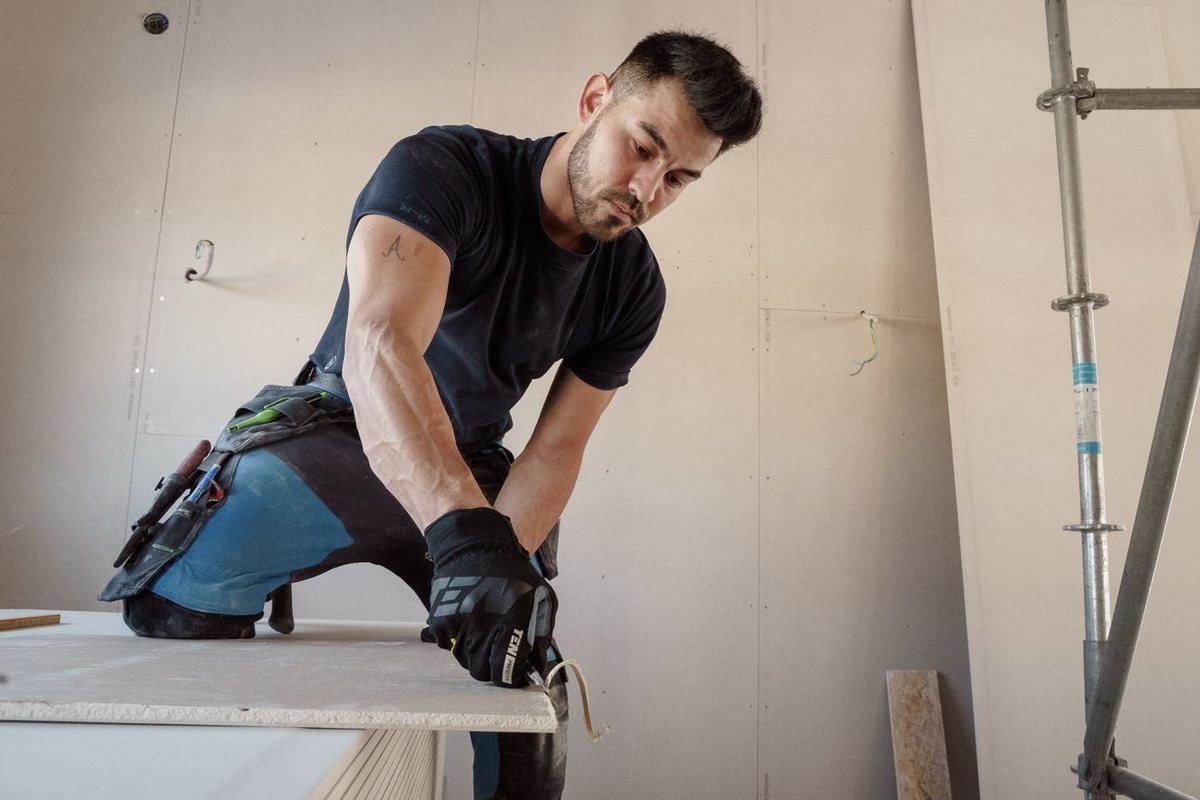
Walk through three drywall bids and you may see three units of measure. One contractor quotes per sheet, the classic four-by-eight or four-by-twelve panel. That is how installers think about material and hanging labor. Another quotes per square foot of surface. That is cleaner for estimating, but it requires you to know the total wall and ceiling area. A third quotes a lump sum for the whole room or house. That hides the math entirely. None of these is wrong. But they are not the same at a glance. The per-sheet number trips people up the most. A “sheet” is 32 square feet for a four-by-eight and 48 for a four-by-twelve. So a per-sheet price only means something once you know the sheet size.
The pricing feels slippery for a deeper reason. A lot of the cost is labor, and that labor does not scale evenly with area. Labor splits into two very different activities. Hanging the board, lifting, cutting, and screwing panels to the framing, is relatively quick and forgiving. Finishing the board is different. It means taping the joints, applying and sanding multiple coats of joint compound, and getting the surface flat and smooth. It is slow, skilled work, and it is where most of the labor hours go on a quality job. When a bid is cheap, it is almost always cheap on the finishing. Finishing is exactly the part you see every day for the life of the room.
Drywall Cost per Sheet, per Square Foot, and per Room
Here are the numbers in the units you will actually encounter. Use them to translate any bid into the others. These figures assume installation, both hanging and a standard finish, not bare board. They cover typical residential work. Specialty board, high ceilings, and higher finish levels push them up.
The room number is the one that surprises people. A 12-by-12 room with an eight-foot ceiling has about 384 square feet of wall. Add 144 square feet of ceiling. That is well over 500 square feet of drywall. That is why the finished cost of a “small” room lands where it does. When you price a project, always work from the surface area, not the floor area.
Where a Drywall Budget Actually Goes
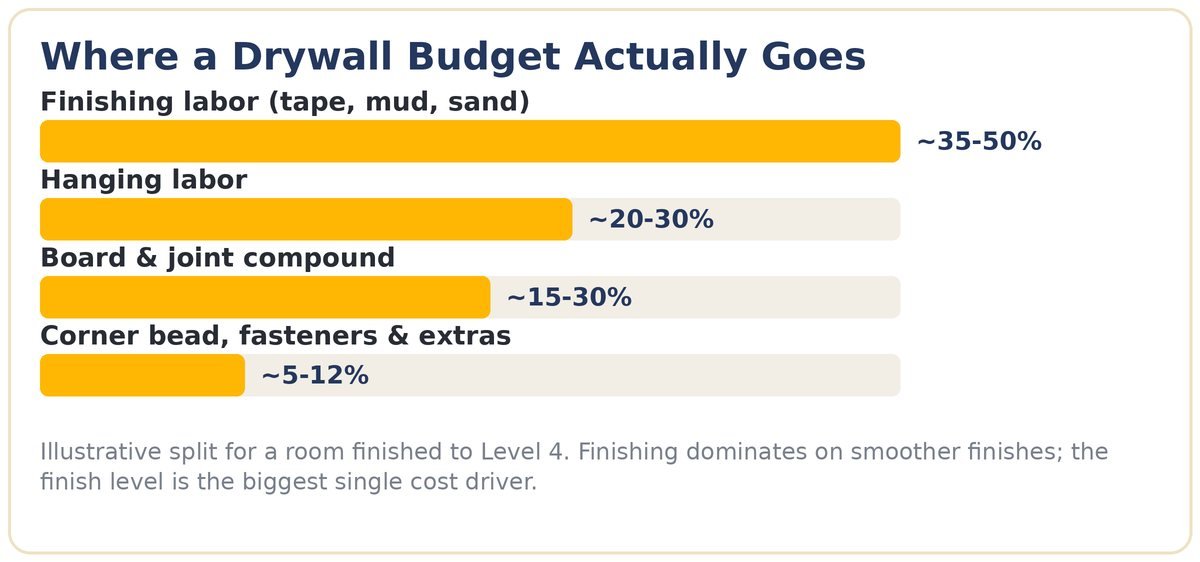
The instinct is to assume drywall cost is mostly the panels. That is backwards. Board and joint compound are inexpensive. The money is in labor. Within labor, finishing usually outweighs hanging on any job with a decent finish standard. The rough split below is typical for a standard residential room finished to Level 4. It shifts with the job. A smooth Level 5 has more finishing share. A big, simple warehouse-style space has more hanging share. But the lesson holds: you are buying skilled finishing time. That is exactly why the finish level moves the price so much.
Drywall Finish Levels and Why They Change the Price
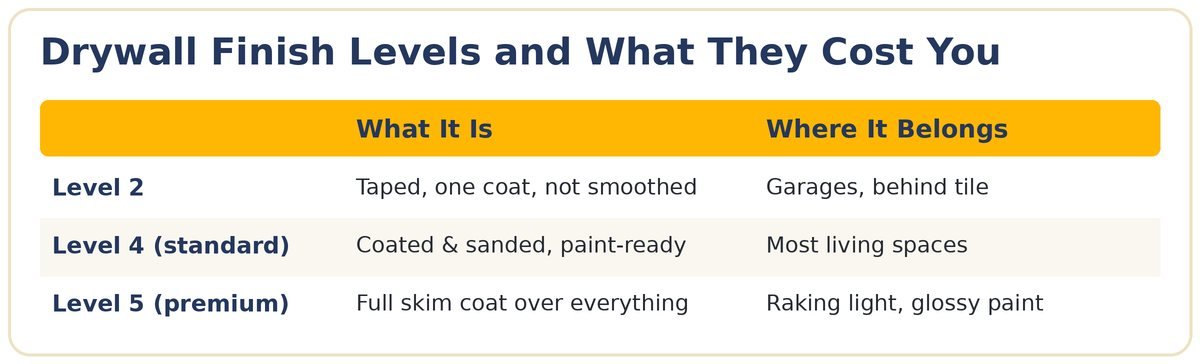
The finish level is the single most misunderstood driver of drywall cost. It is a real, defined standard, not a vague notion of quality. The Gypsum Association publishes the recognized levels. Knowing which one a bid assumes is the key to comparing quotes honestly.
Level 2 Is for Utility Spaces
Taped, Not Finished
At Level 2, joints and interior angles get tape embedded in compound and one coat over the tape and screws. But the surface is not built up smooth. It is appropriate for garages, workshops, and areas behind tile or paneling, where appearance does not matter. It is the cheapest finish because it skips the coats and sanding that make a wall paint-ready. It should never be quoted for a living space you will paint and look at.
Level 4 Is the Standard for Painted Walls
The Normal Residential Finish
Level 4 adds several more coats over the tape, screws, and beads, each wider than the last. Then it gets sanded smooth. The result is a flat surface suitable for flat and low-sheen paints and light wall textures. This is the finish most homeowners actually want for bedrooms, living rooms, and hallways. It is the honest baseline a residential bid should assume. A quote that is cheaper than its neighbors is often quietly assuming Level 3 instead.
Level 5 Is for Critical Lighting and High Sheen
The Glass-Smooth Upgrade
Level 5 takes a Level 4 and adds a skim coat of compound over the entire surface. That produces the flattest, most uniform result. It is worth the added cost where raking light, large windows, or glossy and dark paints would expose every seam and imperfection. Those are exactly the conditions that make a Level 4 look wavy. Because it coats the whole surface, it is the most labor-intensive and expensive standard finish.
The Factors That Move Drywall Cost Beyond Square Footage
Two jobs with the same surface area can price very differently, and these are the reasons. Knowing them helps you understand why a bid is where it is.
Ceiling Height and Access Slow the Work
Reach Adds Time and Risk
Standard eight-foot walls are quick. Nine, ten, and taller walls, plus any stairwell or vaulted ceiling, need staging, lifts, and more careful handling. That adds labor hours and cost per square foot. Ceilings themselves are slower and harder than walls, because installers work overhead against gravity. So a room with a lot of ceiling area finishes more slowly than its square footage implies.
Specialty Board Costs More Than Standard
Moisture, Fire, and Sound
Standard half-inch drywall is the cheap default, but moisture-resistant board for bathrooms, fire-rated Type X board where code requires it, such as garage-to-house walls and some multifamily assemblies, and specialty soundproofing panels all cost more per sheet and sometimes more to install. The code often dictates which one you must use in a given location, so this is frequently not a choice but a requirement that raises the number.
Texture Versus Smooth Changes the Finish
Spray, Knockdown, or Flat
A sprayed texture like orange peel or knockdown can actually be quicker and cheaper than a perfectly smooth wall. Texture hides minor imperfections and reduces the sanding and skim-coating required. A dead-flat smooth wall, by contrast, demands a higher finish level and more skilled labor. So the surface look you want interacts directly with the finish level and the price.
Hanging Versus Finishing and Why Finishing Is the Skill
If you remember one thing about drywall cost, make it this: hanging is labor, finishing is craft, and craft is what you are really paying for. Almost anyone can be taught to hang board reasonably well in a day. You lift the panel, mark the cuts, score and snap, and screw it to the studs on the right spacing. Finishing is different. It means feathering joint compound out invisibly over a seam, building up coats that are flat and free of ridges, and sanding the surface so it will not show through every imperfection when painted. That is a genuine skill, and it takes years to do quickly and well. That is why the finishing share of the labor is so large, and why the cheapest bids cut it.
The practical consequence: a low drywall bid rarely fails at hanging. It fails at finishing. The board goes up fine. Then the seams get one hurried coat instead of three, and the sanding is skipped or rushed. The wall looks acceptable under flat light. But paint it, hang a bright fixture, or catch it in raking afternoon sun, and suddenly every joint and screw dimple shows as a shadow. Fixing a badly finished wall means re-coating and re-sanding the whole thing. That is often more expensive than doing it right the first time. When you read a drywall bid, the question that matters is not the number of sheets. It is the finish level, and how many coats the finishing includes. That is the part you will live with.
What Drywall Costs in the Bay Area
Bay Area drywall pricing sits above national calculators for the familiar reason: labor. Skilled drywall finishers across Alameda, Contra Costa, and Santa Clara counties command rates well over the national mean. Since finishing is the labor-heavy part of the job, that premium lands squarely on the biggest cost driver. The same room that a national estimator prices for the Midwest finishes higher here. The gap widens on higher finish levels, where labor dominates.
There are also code-driven cost factors specific to how homes are built here. Fire-rated drywall rules apply to the garage-to-house separation. The garage side of the shared wall needs at least half-inch gypsum board. The garage ceiling needs 5/8-inch Type X board when there are rooms above. Many multifamily and ADU assemblies have their own fire-rated requirements. Rated board costs more, and it must be installed so the rated assembly stays intact. New drywall as part of an addition, a garage conversion, or an ADU is part of a permitted project and gets inspected. That is a feature worth having. The inspection catches missing fire-blocking and improper fastening that a homeowner would never see behind the finished surface. The takeaway for a Bay Area project: budget from surface area at a realistic finish level, usually Level 4 for living spaces. Expect the labor-heavy finishing to carry a regional premium that a national per-sheet number will understate.
Get a Drywall Finish You Will Not Notice, From Top Tier
The measure of good drywall is that you never think about it. No shadowed seams. No screws showing through. No wavy walls under the afternoon light. That result comes from finishing, the part cheap bids cut, done to the right level for how the room is lit and painted. If you are planning a room, an addition, an ADU, or a full renovation in the Bay Area and want drywall finished to a standard that holds up under real light, reach out to Top Tier Building Services or explore our framing services. We finish to the level your space actually needs and install fire-rated assemblies correctly where code requires them, from Castro Valley to San Jose. Top Tier Building Services is a licensed Bay Area general contractor, CSLB #1146790, and you can verify the license at the CSLB license check. If drywall is part of a bigger project, our full house renovation services page shows how it fits into the whole scope.
FAQs
How much does drywall installation cost per square foot?
Installed drywall, both hung and finished to a standard Level 4, typically runs about $1.50 to $3.75 per square foot of wall and ceiling surface. The range reflects finish level, ceiling height, board type, and region. Remember the measurement is surface area, not floor area. A room contains several times more drywall than its footprint. Always confirm a per-square-foot quote includes both hanging and finishing.
How much does it cost to drywall a 12×12 room?
A 12-by-12 room with an eight-foot ceiling has roughly 500 to 600 square feet of drywall surface. So a finished installation commonly runs about $900 to $2,000, depending on finish level, ceiling height, and region. Higher finish levels, taller ceilings, and specialty board push it up. The figure surprises people because the room’s 144-square-foot floor area is far smaller than the wall-and-ceiling area actually being drywalled.
What is the difference between drywall finish levels?
Finish levels are defined by the Gypsum Association, from Level 0 to Level 5. They describe how smoothly the drywall is finished. Level 2 is taped only, for utility spaces. Level 4, the residential standard, adds coats and sanding for a paint-ready surface under flat and low-sheen paint. Level 5 adds a full skim coat for the smoothest result, worth it under raking light or glossy paint. Higher levels cost more because they add coats and skilled labor.
Is hanging or finishing drywall the bigger cost?
Finishing usually costs more than hanging on any job with a decent finish standard. Hanging the board is relatively quick and forgiving. Finishing is different: taping, applying multiple coats of joint compound, and sanding is slow, skilled work where most labor hours go. This is why bargain bids tend to cut finishing quality. It is also why the finish level, which governs how much finishing is done, is the biggest cost driver.
Why is my drywall quote higher than an online estimate?
Online estimates usually assume a national average labor rate, a standard Level 4 finish, standard board, and eight-foot ceilings. Your quote may be higher for several reasons: a higher regional labor rate, a smoother finish level, taller ceilings, specialty or fire-rated board required by code, or ceiling-heavy rooms. Bay Area labor rates in particular run above national averages. Since finishing is labor-intensive, that premium lands on the largest part of the cost.
Do I need a permit to install drywall?
Replacing drywall in an existing room as a repair generally does not require a permit. But drywall installed as part of a larger project, an addition, a garage conversion, an ADU, or a renovation that touches framing, electrical, or plumbing, is part of a permitted job and gets inspected. The inspection typically occurs before the drywall goes up, to verify framing, fire-blocking, and rough-ins. That is why it matters to sequence it correctly.