

A dead gate behaves like a big problem — car trapped, keypad silent, every option apparently starting with a trip fee. Yet the automatic gate repair trade rarely admits it: a large share of “dead gate” calls end with a technician resetting a breaker, swapping a remote battery, or wiping a spiderweb off a photo eye. The gate was never broken. The chain of small things that let it move was.
That chain is checkable by any owner in twenty minutes, no tools needed. Run the ten checks and either the gate wakes up, or you make a far better call — one that opens with the operator has power, the remotes work, the photo eyes are aligned, and the error light blinks four times. A company hearing that cannot sell you a new operator for a roller problem. We build and service automatic gates across the East Bay; this is the pre-call routine we would want our neighbors using, and it pairs with our Before You Call a Gate Repair Company page and its checklist.
Key Takeaways
- Most gate failures are electrical-chain problems — power, remote batteries, photo eyes — and every link is owner-checkable before you pay a trip fee.
- The manual release turns a gate failure into an inconvenience — find yours before the gate fails, not at 10 p.m. in the rain.
- A gate that opens but refuses to close is the classic photo-eye symptom; blocked, crooked, or sun-blinded sensors take two minutes to fix.
- A repair quote near half the installed cost of a new operator usually means replacement wins — especially past 10 to 12 years.
- Print the Gate Repair Readiness Checklist before you book — the checks and phone questions on one page.
What This Guide Covers
- Run These 10 Checks Before You Pick Up the Phone
- What Common Gate Repairs Typically Cost
- What a Good Technician Should Diagnose
- Parts Availability Depends on the Opener Brand
- Entrapment Protection Is Not an Upsell
- Trip Fees and Questions Worth Asking Before Booking
- How to Judge Repair Against Replacement
- Red Flags That Should End the Conversation
- Print the Checklist Before You Call Anyone
- Get a Straight Answer From a Licensed Gate Contractor
- FAQs
Run These 10 Checks Before You Pick Up the Phone
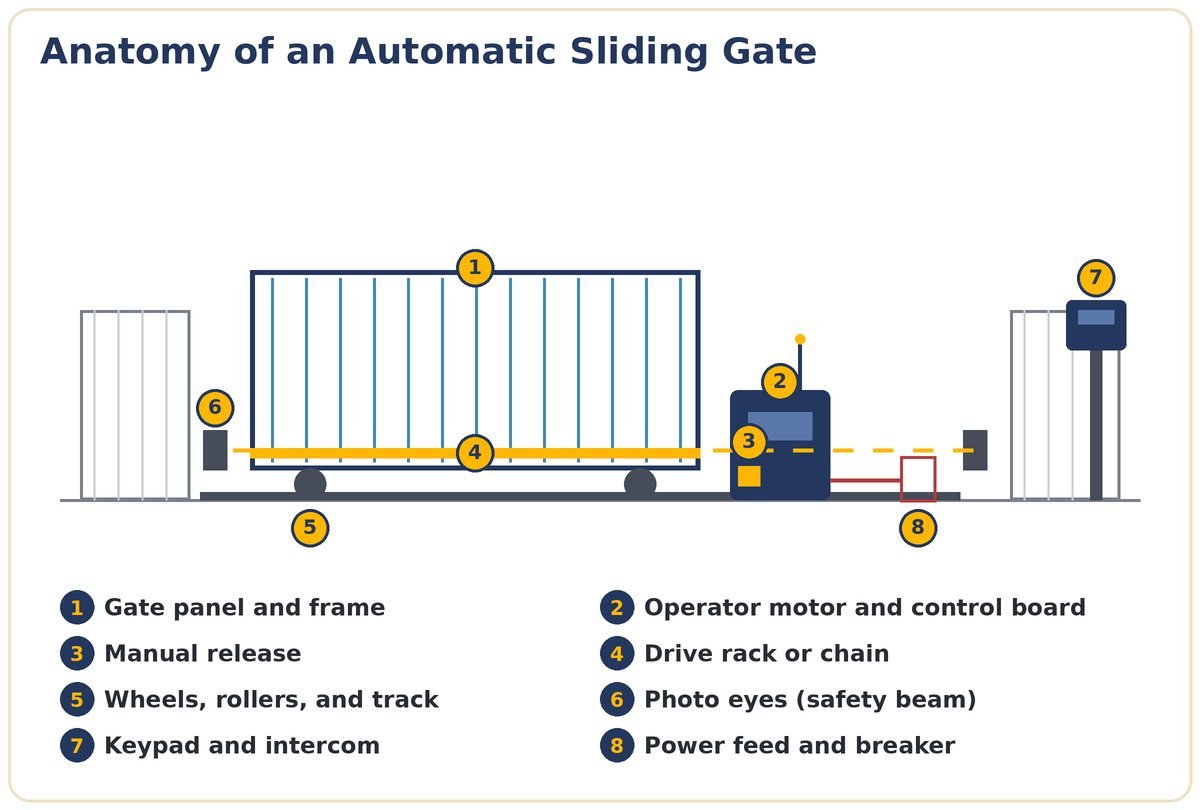
Work the list in order — it follows the path electricity and motion take: power in, command received, safety cleared, mechanics free to move. Stop when the gate wakes up; nothing here voids a warranty.
Power at the Outlet and Breaker
What to Check
Find the operator’s power source — usually a dedicated breaker, sometimes a GFCI outlet near the gate. Confirm it is on, reset a tripped breaker once, reset any GFCI, and look for a status light.
What It Tells You
A breaker that holds moves the search elsewhere; one that trips again immediately is a real electrical fault and a professional’s job. No lights with power on suggests a failed transformer or board.
Remote Batteries and Second Transmitters
What to Check
Try every remote in the household, plus the keypad and any phone app, before declaring the gate broken. Swap one remote’s battery — coin cells fade gradually, so shrinking range is the early symptom.
What It Tells You
One dead remote with another working is a $5 battery problem, not a gate problem. Everything failing at once points at the receiver or operator — you just saved the technician half an hour of guessing.
Photo Eye Alignment and Blockage
What to Check
Find the two small sensors facing each other low across the opening. Wipe both lenses, clear cobwebs, leaves, and sprinkler spray, and check neither was knocked crooked; most eyes show an LED when the beam aligns.
What It Tells You
Opens fine but will not close is the photo-eye signature — most operators only demand a clear beam before closing. Low sun can also blind an eye at the same hour daily, an intermittent fault that looks supernatural.
Manual Release and Padlock Position

What to Check
Every operator has a manual release — a keyed lever or pull that lets the gate move by hand. Confirm it is fully re-engaged; a half-latched release lets the motor spin uselessly. Check for a forgotten padlock or drop pin.
What It Tells You
A release disengaged during an outage and never re-latched is a common no-fault service call. Knowing the release also gets the car out today, removing the emergency premium from every decision after.
Track, Rollers, and Debris
What to Check
On sliding gates, walk the full track for gravel, acorns, mud, or a lifted section, and watch the wheels for flat spots, wobble, or grinding. With the release disengaged, the gate should roll smoothly by hand.
What It Tells You
A gate that hums but barely moves, or stalls at the same spot every cycle, is fighting its track, not its wiring. Modern operators deliberately stop rather than out-muscle an obstruction — “broken” is the machine protecting itself.
Hinge Wear and Gate Sag

What to Check
On swing gates, inspect hinges for rust streaks, elongated bolt holes, and play — lift the free end and feel the movement. Sight along the top rail; a sagging leaf drags its corner or binds the latch post.
What It Tells You
Sag loads the opener arm far beyond design — today’s hinge problem becomes next season’s burned-out motor. Marine air near the Bay speeds corrosion and hillside posts shift in soggy winter soil; check geometry yearly.
Obstructions Along the Travel Path
What to Check
Walk the gate’s full travel — the swing arc or the pocket a slider retracts into — and clear branches, shrubs, bins, hoses, and anything new since the gate last worked, including a dropped limb on the panel.
What It Tells You
Because modern operators reverse on resistance, a mid-path obstruction convincingly mimics an electrical fault. A gate that always stops at the same point in travel is drawing you a map — inspect that spot first.
Opener Lights and Error Codes
What to Check
Watch the operator’s LEDs while someone presses the remote and count any blink pattern. Major brands blink diagnostic codes — one pattern for a blocked photo eye, another for a limit fault — searchable by model number in seconds.
What It Tells You
An error code turns a mystery into a named fault before anyone is paid to guess. Reporting “the board flashes code 4-1” lets the company arrive with the right part — one visit instead of two.
Keypad and Intercom Behavior
What to Check
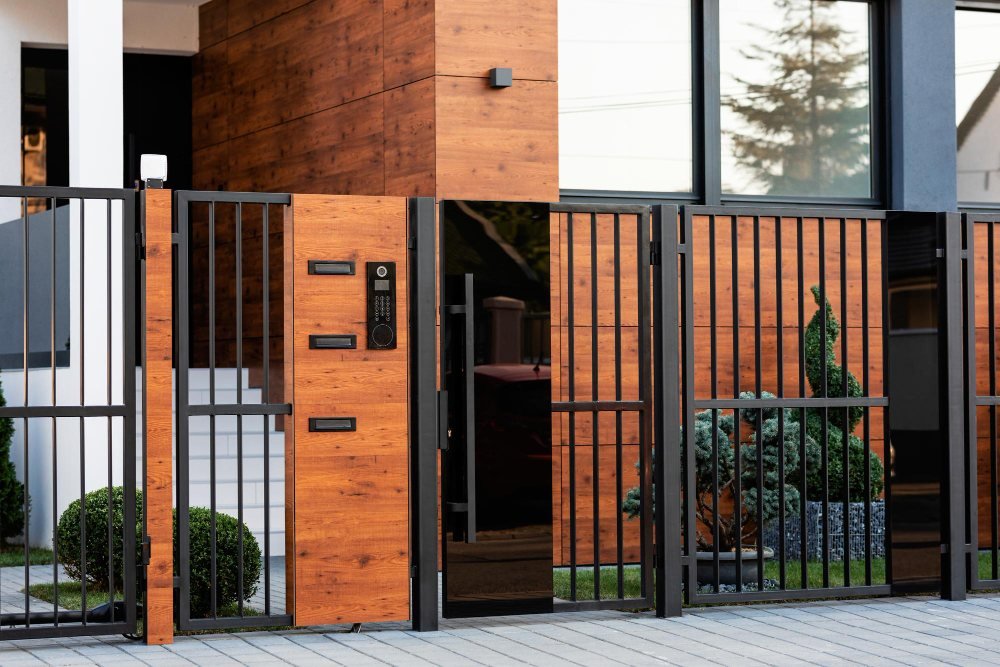
Test the keypad with a known-good code and watch the response — dead display, lit-but-ignored entries, or normal beeps with no motion each point to different failures. Test the intercom or call-box path too.
What It Tells You
A dead keypad with working remotes isolates the fault to the keypad or its wiring run — often trenched shallow and nicked by gardening years later. Dead remotes with a working keypad point at the receiver instead.
Recent Damage and New Noises
What to Check
Look for fresh scrapes, a bent leading edge, or a post knocked out of plumb — an unreported delivery-truck tap is a classic origin story. Note any new grinding, clicking, or straining sound and where it happens.
What It Tells You
A gate racked even slightly out of square binds in ways that look electrical but are structural — no board replacement fixes geometry. Write down what you hear and when; that description is diagnostic gold.
One quirk fails on a delay and deserves its own warning.
What Common Gate Repairs Typically Cost
Illustrative Bay Area planning ranges, not quotes — access, brand, and wiring condition move every number; only written estimates count. Note the ladder’s shape: everything above the motor line is minor money.
The cheap rows are also the common rows — the trade sees far more photo-eye than motor calls. And the anchor row matters even when nothing is replaced: read every big repair quote against a new operator’s installed cost, broken down in our Bay Area automatic gate cost guide.
What a Good Technician Should Diagnose
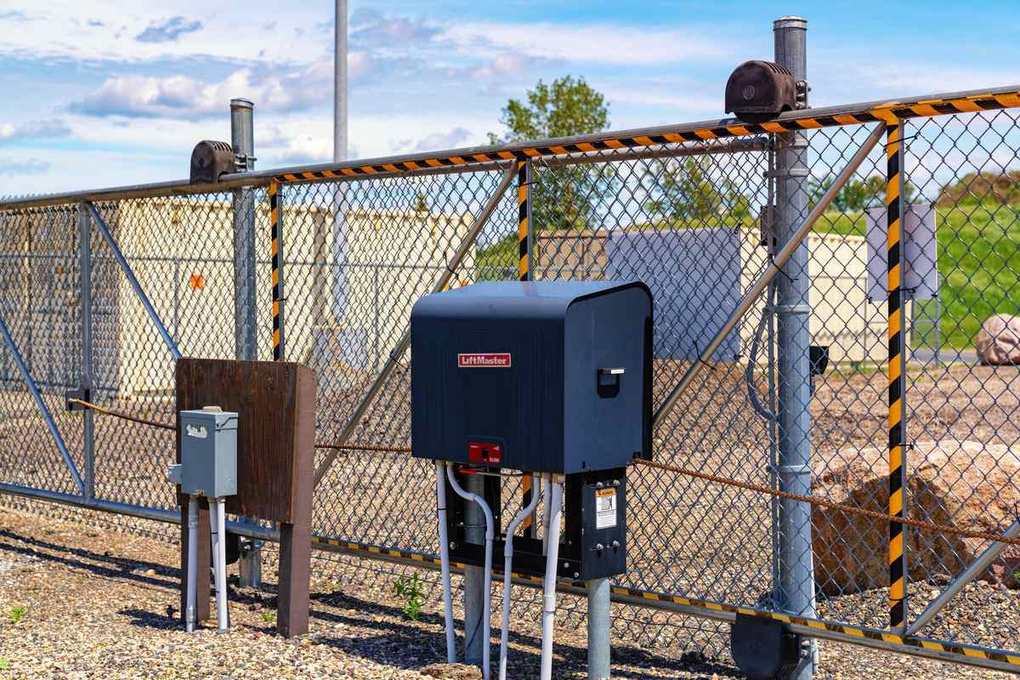
Photo: LiftMaster SL585 slide gate operator — Tony Webster, CC BY 2.0.
“It needs a new operator” is a conclusion, not a diagnosis. A competent visit works component-level: voltage measured at the board, transformer and fuses verified, the board inspected for burned traces or surge damage, limit switches tested at both travel ends, the start capacitor checked on AC motors, gear and sprocket wear assessed, the battery load-tested on solar or backup systems. Each is a quick yes-or-no check; together they name the failed part.
Insist, because failures look identical from the driveway: a gate that clicks but does not move can be a $15 capacitor, a $300 board, or a $900 motor, and a company quoting replacement without naming the component is pricing its uncertainty into your invoice. One phone question predicts the relationship: “Will you tell me which component failed and show me?” Good diagnosis also asks why — surge, water in the enclosure, a shorted accessory wire — because a board replaced without the cause found is on a countdown. The maintenance side of that logic is in our guide to keeping an automatic gate running.
Parts Availability Depends on the Opener Brand
The name on your operator decides how fast — and whether — a repair can happen. Read the model plate before calling; brand and model are the most useful facts you can give a company.
The last row is the strategic point: a bargain operator with no parts channel is disposable by design — its first board failure costs more than the unit did. It doubles as a pre-hire test: a company that services your brand says so immediately; one that hedges may plan to learn on your gate.
Entrapment Protection Is Not an Upsell
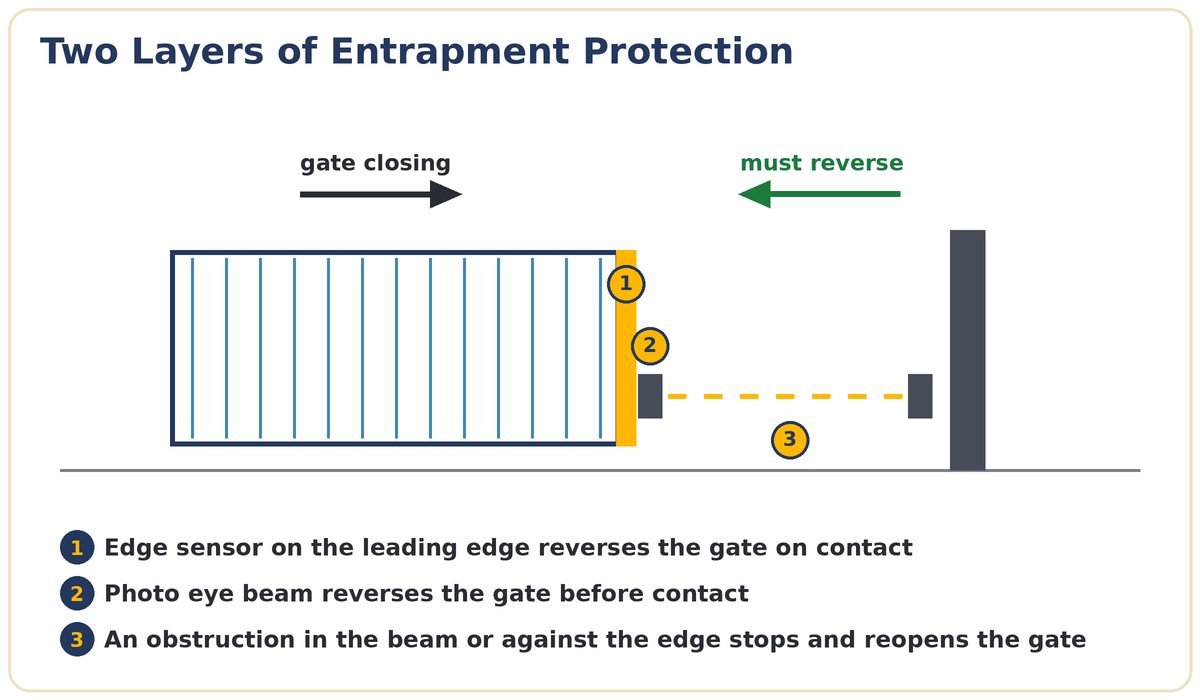
Automatic gates are heavy machines moving through spaces people and pets occupy; the governing U.S. safety standard, ANSI/CAN/UL 325, exists because unprotected gates have hurt people. Current editions expect vehicular operators to protect against entrapment in both the opening and closing cycles — monitored devices such as photo eyes and edge sensors backed by the operator’s own reversal — with the gate itself built to the companion standard ASTM F2200. Industry association DASMA publishes plain-language gate operator safety guidance; its bluntest advice: older operators without modern entrapment protection are replacement candidates, not nostalgia.
A technician recommending photo eyes or edge sensors on an older gate is therefore quoting the current safety expectation, not padding the invoice. The owner’s test is free: a properly protected gate stops and reverses when its beam is interrupted or its leading edge meets resistance while closing. If yours plows on, that is a real defect even though the gate “works.”
Trip Fees and Questions Worth Asking Before Booking
Most gate companies charge a service-call fee; the useful question is the structure, not the amount: is the fee credited against the repair if you approve work, is diagnosis included or billed hourly, and what is the after-hours multiplier — the premium a manual release often makes unnecessary. Then the sorting questions: do they service your brand and stock its parts on the truck, will the diagnosis be written with the failed component named, and what warranty covers parts and labor.
Finally, verify the company on the state’s CSLB license check — two minutes covering bond and workers’ compensation status. Gate work mixes welding, electrical, and access-control wiring; the license record is the fastest honesty test.
How to Judge Repair Against Replacement
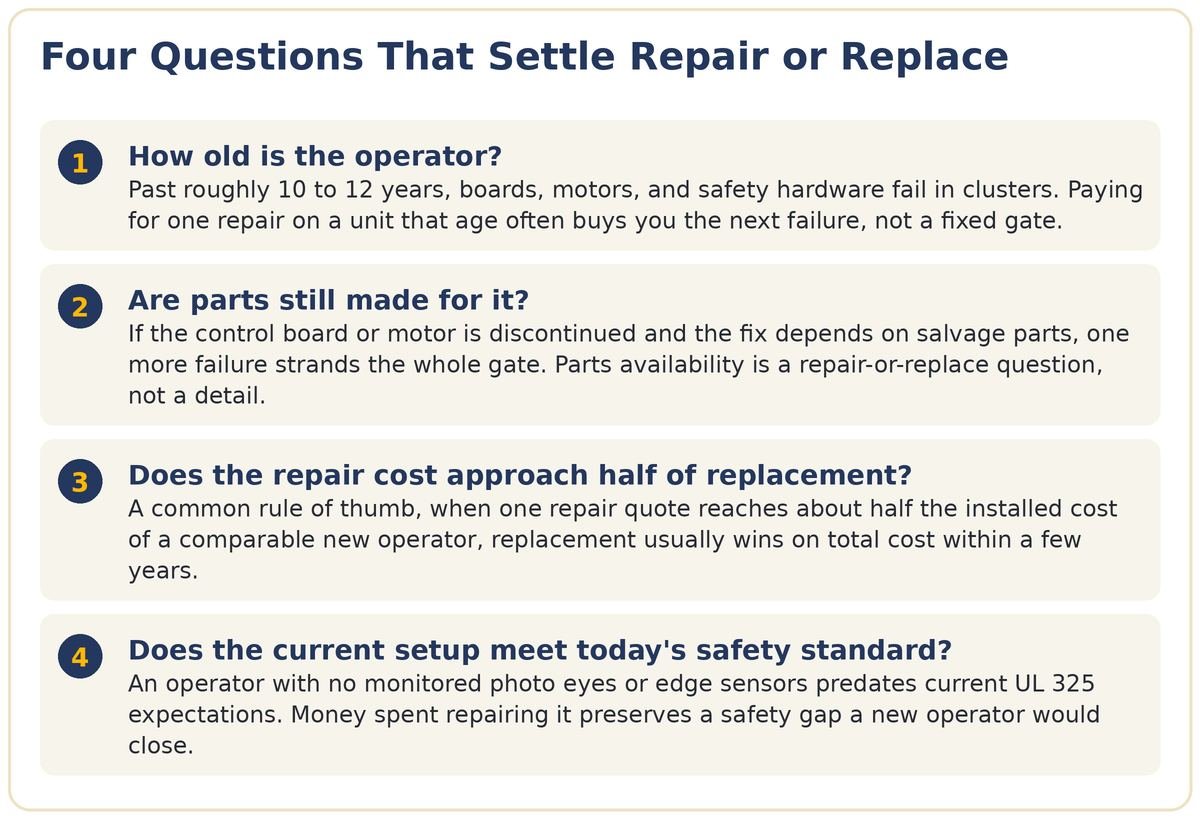
The call is four questions. Age: operators commonly serve 10 to 15 years; past 10 to 12, failures cluster as boards, motors, and safety hardware age together. Parts: a discontinued board makes the next failure a forced replacement — repairing around it is renting time. Cost: a quote near half the installed price of a comparable new operator usually loses to replacement within a few years. Safety: an operator predating modern entrapment protection carries a liability a new unit retires.
Notice what this does to the emotional math. A $700 motor repair on a 14-year-old operator with a discontinued board and no monitored sensors is not “cheaper than $3,000” — it is $700 toward a machine three of the four questions already voted against. Equally, a 6-year-old LiftMaster with stocked parts and working sensors almost always deserves the repair. If the answer is “replace,” our automatic gates and fencing service page shows what a current, safety-compliant installation looks like.
Red Flags That Should End the Conversation
Some signals justify hanging up regardless of price: a whole-operator replacement quoted without component-level diagnosis, any proposal to bypass safety sensors, a license number that fails the CSLB lookup, cash-only pricing, pressure to decide “before the price goes up,” and refusal to put the diagnosis or warranty in writing.
None of these are style differences — each shifts a specific risk onto you: guesswork, injury, uninsured workers, no recourse. The trade has plenty of honest operators, so the flagged ones are safe to skip — the choice is never a red flag or no gate, only a red flag or a better call tomorrow.
Print the Checklist Before You Call Anyone
Everything above compresses onto one printable page. The Gate Repair Readiness Checklist walks the ten checks in order, then blanks for the facts a company will ask — opener brand and model, gate type, what the error light does — the questions to ask back, and room to record answers side by side.
The side-by-side format is deliberate: vague answers survive phone calls but not paper. Still deciding between repair, upgrade, and replacement? The long-form routine lives on our Before You Call a Gate Repair Company page — with the checklist, a complete pre-hire kit.
Get a Straight Answer From a Licensed Gate Contractor
Run the checks, write down what you find, and the call you make will be shorter, cheaper, and harder to upsell. If the gate is still down, test the questions on us. Top Tier Building Services Inc. is a Castro Valley based general contractor serving the Bay Area — licensed, bonded, and insured, with workers’ compensation coverage, under California General Contractor License #1146790. Call 510-470-1870, email sales@toptierbuildingservices.com, or request a visit — we will name the failed component, show you, and put the fix in writing.
FAQs
Why is my automatic gate not opening or closing?
The most common causes, in rough order: power interruptions at the breaker or GFCI, dead remote batteries, blocked or misaligned photo eyes, a disengaged manual release, and obstructions in the track or path — all owner-checkable in minutes.
How much does automatic gate repair usually cost?
Small repairs — remotes, photo eyes, keypads — commonly run tens to low hundreds of dollars, mechanical and board work runs in the hundreds, and motor or gearbox replacement can reach four figures. A new operator installed commonly runs $1,800 to $4,500+ locally; insist on a written estimate.
Can I fix my automatic gate myself?
The ten checks are safe owner-level territory. Beyond them, stop: operators combine line voltage, strong motor forces, and UL 325 safety systems, and a wrong repair can leave a machine that moves without knowing when to reverse. Anything electrical belongs with a licensed professional.
How long do automatic gate openers last?
A commonly cited service life is 10 to 15 years, with duty cycle, climate, and maintenance moving units either way — near-coastal installations corrode faster and heavy-use gates age quicker. Past 10 to 12 years failures cluster — the band where replacement starts winning.
What is UL 325 and why does it matter for my gate?
ANSI/CAN/UL 325 is the U.S. safety standard for gate operators. Current editions expect entrapment protection in both opening and closing directions — monitored photo eyes and edge sensors plus the operator’s reversal. An older installation without these protections is a liability a repair visit should flag.
Should I repair or replace my gate opener?
Ask four questions: past roughly 10 to 12 years old, parts discontinued, repair quote near half the installed cost of a new operator, and no modern entrapment protection. One yes usually still favors repair; two or more favor replacement.