Every year, thousands of California homeowners head to big-box retailers to purchase off-the-shelf garage floor paint, hoping for a showroom-quality finish on a DIY budget. However, the debate between Epoxy vs Garage Floor Paint often ends in disappointment when the DIY coating begins to peel, flake, or succumb to hot tire pickup within the first six months.
While the low price point of single-component floor paint is tempting, understanding the chemical differences between a simple topical coating and a high-performance resinous system is essential for a long-lasting garage floor. This guide explores the mechanical and chemical reasons why professional-grade epoxy is the standard for California garages.
Topical Paint vs. Chemical Bonds: The Science of Adhesion
The primary reason garage floor paint fails is that it is a topical coating. Much like the paint on your bedroom walls, it relies on a physical bond to the surface. Concrete is naturally porous and prone to moisture vapor transmission. Standard acrylic or latex-based paints lack the adhesive strength to resist the upward pressure of moisture or the aggressive friction of vehicle tires.
Professional-grade epoxy, on the other hand, is a two-component polymer consisting of a resin and a hardener. When mixed, a chemical reaction occurs that transforms the liquid into a rigid plastic. Unlike paint, epoxy creates a cross-linked chemical bond with the concrete substrate—provided the surface has been mechanically profiled through diamond grinding.
The “Hot Tire Pickup”
If you’ve ever seen a garage floor where the coating has peeled away exactly where the car tires sit, you’ve witnessed hot tire pickup. When you drive your car on California highways, your tires accumulate heat. When you park in the garage, the heat softens low-quality floor paint. As the tires cool, they literally shrink and grab the paint, pulling it off the concrete the moment you back out of the driveway.
True epoxy systems are thermosetting polymers. Once they cure, they are heat-resistant and do not soften. This makes them immune to the physics of hot tire pickup, ensuring your floor stays intact even after long summer drives.
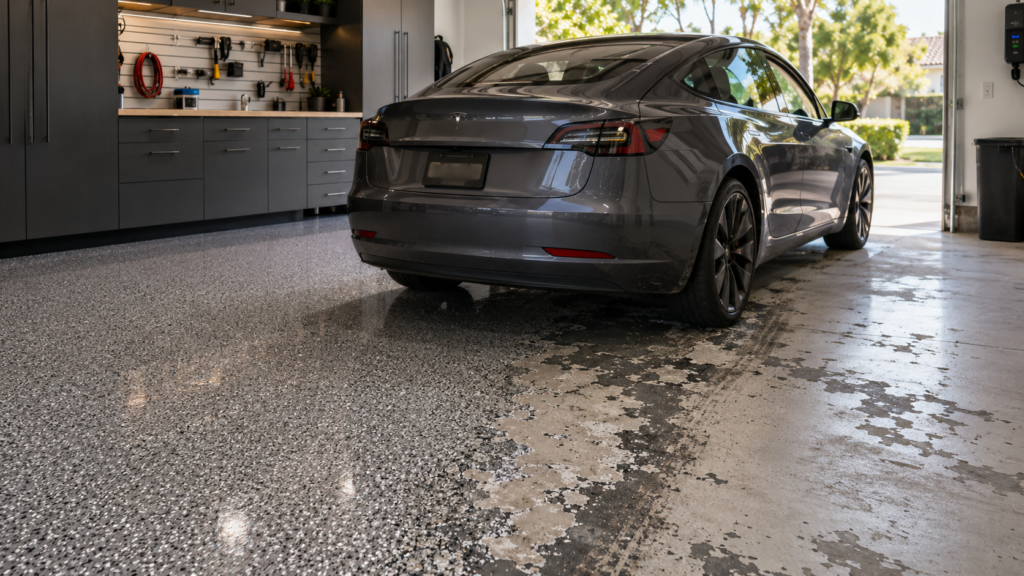
Garage Floor Paint vs Professional Epoxy
Preparation is All That Matters
Most DIY kits suggest a simple acid wash to prepare the concrete. In reality, acid etching is rarely sufficient for a permanent bond, especially if the concrete has previous sealers or oil stains. Acid often fails to open the pores of the concrete deeply enough for the coating to anchor.
Professional installers use industrial diamond grinders to open the pores of the concrete, creating a Concrete Surface Profile (CSP) of 2 or 3. This mechanical profile is what allows the epoxy to ‘bite’ into the slab. Without it, the coating is simply sitting on top, waiting for the first sign of moisture or heat to fail.
Maintenance and Life Cycle Costs
A common misconception is that garage floor paint is the ‘cheaper’ option. However, when you factor in the time, materials, and labor of stripping and re-painting every 18 to 24 months, the costs skyrocket. A professionally installed epoxy floor is a one-time investment that requires nothing more than simple mopping to look new for over a decade.
Making the Right Choice for Your Bay Area Home
While the initial investment in a professional system is higher, the total cost of ownership and the quality of the finish are incomparable. Don’t risk a DIY failure that ends up costing double to fix.
Professional installation costs and breakdowns are explained in our Bay Area epoxy garage flooring cost guide, helping you make an informed decision for your home.