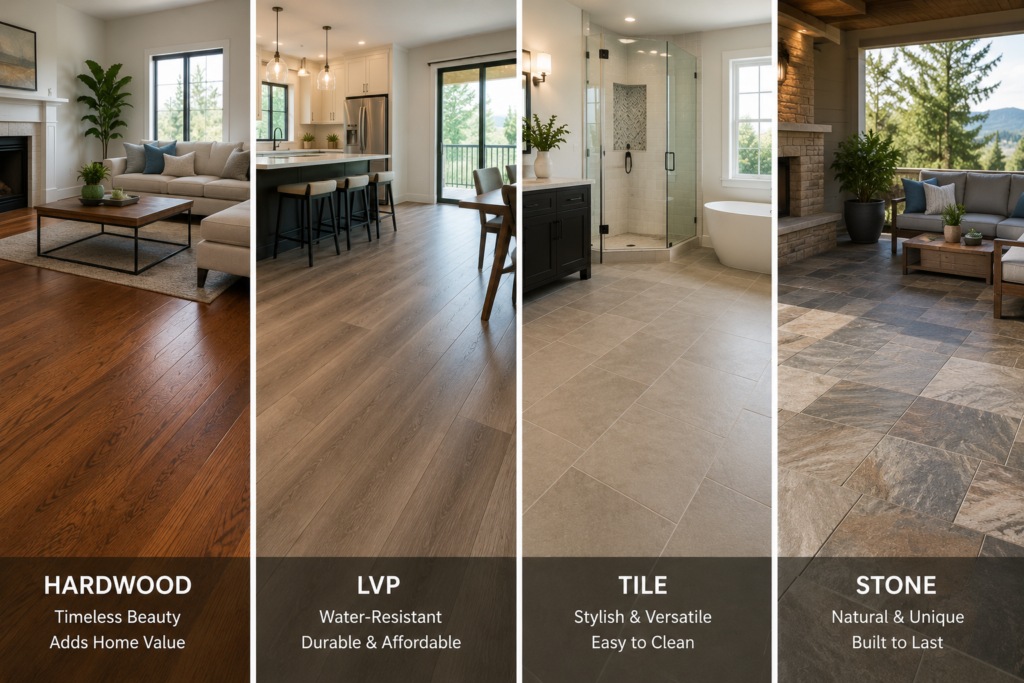
The four major flooring materials Bay Area homeowners choose between in 2026 — hardwood, luxury vinyl plank (LVP), porcelain or ceramic tile, and natural stone — each have a clear use case, a clear strength, and a clear failure mode. Knowing those helps homeowners pick the right material for each room rather than defaulting to whatever the showroom is pushing. This guide compares the four head-to-head: how each one looks, lasts, costs, and where each one struggles. For the broader picture, see the complete Bay Area flooring installation guide.
The Short Answer
A quick comparison of the four major options:
- Hardwood — beautiful, refinishable, ages with character; less waterproof, scratches
- LVP — waterproof, scratch-resistant, low-maintenance; harder to refinish, less premium feel
- Tile — extremely durable, fully waterproof; hard underfoot, cold without heat
- Natural stone — distinctive character, premium feel; high maintenance, sensitive to acids
There’s no single winner. The right material depends on the room, the household, the budget, and what kind of maintenance the homeowner will actually do.
Hardwood: The Classic
Hardwood — solid or engineered — has been the residential flooring standard for a century, and for good reasons. It looks warm, ages gracefully, and adds value to a home.
Solid Vs. Engineered
Solid hardwood is a single piece of wood top to bottom, 3/4 inch thick. It can be sanded and refinished 3 to 6 times over its life, lasting 80 to 100 years with care. Best installed over a wood subfloor, not concrete.
Engineered hardwood has a real wood top layer (the wear layer) over a plywood substrate. The wear layer can be 1mm (cheap engineered) to 6mm (premium). A 4mm or thicker wear layer can be refinished 1 to 3 times. Engineered is more dimensionally stable, works over concrete slabs, and handles humidity changes better.
For most Bay Area homes in 2026, engineered with a thick wear layer is the smart choice. The “real wood = solid” instinct is dated — engineered is real wood, just with better engineering underneath.
Species and Hardness
The Janka hardness rating measures how well a wood resists denting:
- Pine: 690 (soft, dents easily)
- Walnut: 1010 (medium-soft)
- Cherry: 950 (soft)
- Red oak: 1290 (medium-hard)
- White oak: 1360 (hard)
- Hickory: 1820 (very hard)
- Brazilian cherry: 2350 (very hard)
For active Bay Area households (kids, pets), aim for 1300+. White oak is the most popular Bay Area choice for good reason — hard enough, beautiful, takes stain well.
Pros
- Looks warm and timeless
- Adds resale value
- Refinishable, repairable
- Real wood texture and feel
- Ages with character
Cons
- Vulnerable to water — even small leaks cause cupping
- Scratches show (especially in dark finishes)
- Requires acclimation before install
- Higher material and labor cost
- Wood movement with humidity changes
Best Used for
Living areas, dining rooms, hallways, bedrooms. Increasingly common in Bay Area kitchens with careful spill response. Not for bathrooms, basements, or laundry rooms.
Cost
$11 to $35+ per square foot installed in the Bay Area for 2026, depending on species, plank size, and finish.
Luxury Vinyl Plank (LVP): The Modern Practical Choice
LVP has come a long way. Early vinyl looked like vinyl. Modern premium LVP looks remarkably like hardwood — the giveaway used to be repeating patterns, but the best 2026 products have enough pattern variation that even close inspection can be inconclusive.
Construction
LVP is built in layers: a clear wear layer on top (10 to 30 mils thick), a printed decorative layer that mimics wood or stone, a vinyl core (rigid or flexible), and a backing. Premium products add a felt or cork underlayment for sound dampening.
Wear Layer Thickness
This is the spec that matters most:
- 6 to 10 mil: budget, suitable for low-traffic residential
- 12 to 20 mil: standard residential
- 20 to 30+ mil: heavy residential or light commercial
For a Bay Area home with kids or pets, 20-mil or thicker is the right floor.
Pros
- Fully waterproof
- Scratch-resistant
- Easy to install (most click-lock)
- No acclimation issues
- Lower cost than hardwood
- Works in any room — bathrooms, basements, anywhere
Cons
- Doesn’t refinish (worn LVP gets replaced)
- Doesn’t add the same resale value as hardwood
- Can dent under heavy furniture
- Some products off-gas VOCs (look for FloorScore-certified)
- Lower-tier products look obviously fake
Best Used for
Whole-house in budget or pet-heavy households. Kitchens, bathrooms, basements, laundry rooms in any household. Increasingly common in Bay Area rental properties and short-term-rental ADUs.
Cost
$7 to $20 per square foot installed in the Bay Area for 2026, with premium 20-mil+ products on the higher end.
Porcelain and Ceramic Tile: The Durable Workhorse
Tile has been a residential flooring material for thousands of years and isn’t going away. Modern porcelain tiles are nearly indestructible and come in nearly any look — including convincing imitations of wood, marble, concrete, and natural stone.
Porcelain Vs. Ceramic
Porcelain is fired hotter, denser, less porous, more durable. Suitable for floors, walls, indoor, outdoor.
Ceramic is less dense, more porous, less durable. Fine for walls and light-traffic floors. Not the best choice for high-traffic Bay Area kitchen or entry floors.
For floor applications, porcelain is the choice.
Spec Sheet Items That Matter
- Coefficient of friction (COF) over 0.42 wet for any wet-area floor tile
- PEI rating of 4 or 5 for residential floor applications (commercial rates higher)
- Water absorption under 0.5% for porcelain (defines it from ceramic)
Pros
- Extremely durable (50+ year life)
- Fully waterproof
- Heat-conductive (good for heated floor systems)
- Easy to clean
- Doesn’t burn, doesn’t rot, doesn’t dent
- Wide range of looks (wood-look, marble-look, concrete-look)
Cons
- Hard and cold underfoot (heated floor helps)
- Difficult and expensive to repair if cracked
- Grout requires sealing and maintenance
- Heavy — may require subfloor reinforcement
- Less forgiving of subfloor imperfections (cracks telegraph)
Best Used for
Bathrooms, kitchens, entries, laundry rooms, mudrooms, outdoor patios. Some Bay Area homeowners use porcelain throughout the main floor with rugs for warmth.
Cost
$10 to $50 per square foot installed in the Bay Area, with mid-range porcelain at $10 to $20 and premium imported tile at $25 to $50.
Natural Stone: The Character Choice
Marble, travertine, limestone, granite, slate, and quartzite each have distinct characters. Stone brings a depth and warmth that engineered surfaces don’t quite replicate — but it requires real maintenance.
The Major Stones
- Marble — classic, elegant, soft. Etches from acids (vinegar, citrus, wine). Sensitive to scratches.
- Travertine — warm Mediterranean look, naturally pitted (can be filled or honed). Etches like marble.
- Limestone — softer, more subtle than marble. Etches.
- Granite — very durable, less reactive, easier to live with. Less premium-looking than marble to most eyes.
- Slate — textured, casual, very durable. Best for entries, outdoor spaces, casual interiors.
- Quartzite (the natural stone, not engineered quartz) — combines marble look with granite durability. Expensive.
Pros
- Distinctive character no manufactured product matches
- Ages with patina
- Adds significant resale value (in the right design)
- Heat-conductive
- Durable when sealed and maintained
Cons
- Maintenance-intensive (sealing every 1 to 3 years)
- Sensitive to acidic cleaners
- Expensive
- Cold underfoot
- Etches on marble are not always repairable without professional restoration
Best Used for
Premium bathrooms, entries, formal living spaces. Most Bay Area homeowners use natural stone selectively — a marble bathroom floor, a slate entry — rather than throughout a home.
Cost
$25 to $80+ per square foot installed in the Bay Area, depending on stone and slab grade.
Side-by-Side Decision
A quick frame for which material wins where:
- Want it to last 50+ years and add resale value: hardwood
- Want it to be bulletproof against water, scratches, and active families: LVP (good) or porcelain tile (best)
- Want premium feel in a wet area: porcelain tile (large-format marble-look) or natural stone
- Want a single material everywhere on a budget: premium LVP
- Want the best high-end feel and you’ll actually maintain it: natural stone in select rooms, hardwood everywhere else
How Top Tier Recommends Materials
Top Tier walks through material choices by use case rather than starting with what the homeowner has seen in showrooms. The team often steers clients away from the most expensive option when it doesn’t match their household — a Bay Area couple with three big dogs and two kids gets engineered hardwood or premium LVP, not marble. For projects involving natural stone, the team coordinates with stone polishing and restoration for maintenance guidance from day one. Licensed under CA License #1146790, with installation experience across all four major material categories.
Common Questions About Flooring Material Choice
What’s the Most Durable Flooring Material?
Porcelain tile and modern premium LVP are both essentially indestructible in residential conditions. Hardwood scratches and dents but can be refinished. Natural stone is durable when maintained.
Which Material Adds the Most Resale Value?
Hardwood, particularly in Bay Area homes where buyers expect it. LVP is increasingly accepted but still reads as a budget choice in higher-end markets. Tile and stone add value in the right rooms (bathrooms, kitchens, entries).
Is Engineered Hardwood Really as Good as Solid?
For 95 percent of Bay Area homeowners, yes — and often better. The wear surface is real wood. The substrate is more stable. The performance over a Bay Area slab or in a humid coastal home is meaningfully better than solid.
Can LVP Replace Hardwood in a High-End Home?
It can — and increasingly does — but the visual difference is real on close inspection. For homes where buyers will look closely at floors, hardwood still wins. For most active family homes, premium LVP is fully respectable.
Bottom Line
The right flooring material isn’t the most expensive or the trendiest — it’s the one that matches the room, the household, and the maintenance the homeowner will actually do. Picking from this menu honestly produces a floor that works for decades.
If you’re choosing between flooring materials for a Bay Area project and want a sounding board, Top Tier is happy to walk through the tradeoffs with you. A 20-minute conversation usually clarifies which material fits your specific situation.
By Top Tier Building Services Inc.
Licensed Bay Area General Contractor License #1146790 serving homeowners, HOAs, and property managers from Castro Valley. Top Tier delivers design-build, renovation, and maintenance services across 14 specialty trades.