
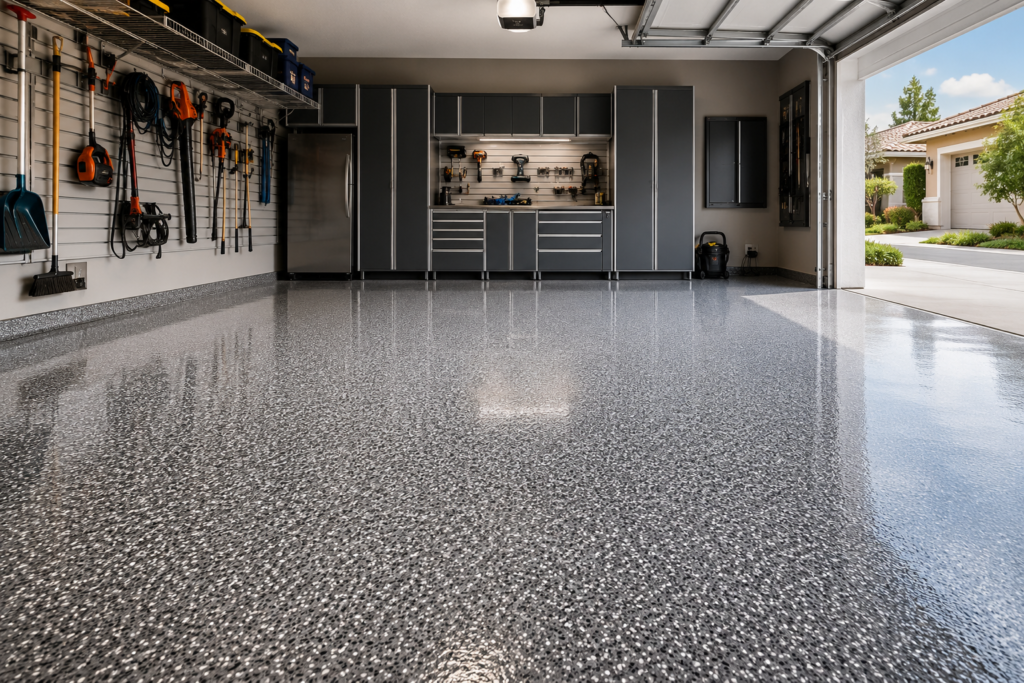
When homeowners invest in a professional garage transformation, the most pressing question is usually about longevity. While marketing materials often claim “lifetime” durability, understanding how long epoxy garage flooring lasts in the real-world conditions of a busy California household requires a look at the variables of chemistry, climate, and daily wear.
In professional applications, a high-quality epoxy system typically lasts between 10 to 20 years. However, achieving the upper end of that spectrum depends heavily on the “Total System” approach rather than just the topcoat itself.
The Lifecycle of a Resinous Floor: Expectations vs. Reality
The lifespan of an epoxy floor isn’t dictated by a single expiration date but by its resistance to “delamination”—the process where the coating separates from the concrete.
Residential Garages (Light to Medium Use): With two vehicles, standard foot traffic, and routine cleaning, a professional 100% solids epoxy floor easily reaches the 15-20 year mark.
Active Workshops (Heavy Use): If the garage is used for heavy machinery, welding, or frequent chemical spills, the lifespan may lean toward 10-12 years before a sacrificial topcoat needs to be reapplied.
Factors That Determine Epoxy Longevity
1. Industrial Diamond Grinding (The Foundation): The #1 factor in how long your floor lasts is the quality of the “mechanical profile.” If the concrete isn’t ground down to a Concrete Surface Profile (CSP) of 2 or 3, the epoxy cannot achieve a deep root system within the slab. Floors that are merely acid-etched often fail within 3-5 years.
2. Moisture Vapor Transmission (MVT): California slabs, particularly in the Bay Area, can deal with high hydrostatic pressure. High-end professional installations include a Moisture Vapor Barrier (MVB) primer designed to withstand up to 20 lbs of moisture pressure, preventing bubbles and blisters.
3. UV Exposure and “Chalking”: Standard epoxy is sensitive to ultraviolet light. A Polyaspartic or Urethane topcoat is essential to act as a sunscreen for your floor, extending the aesthetic life of the system by 5-10 years.
Comparison: Professional Epoxy vs. DIY Lifespan
Maintenance vs. Durability
To make an epoxy floor last 20 years, a simple maintenance schedule is required. Dust mopping removes sand and grit that act like sandpaper. Monthly mopping with a pH-neutral cleaner is recommended. Avoid citrus-based or acidic cleaners that can dull the resin over time.
Summary
The durability of your garage floor is a direct reflection of the preparation and the materials used. While the initial Bay Area epoxy garage flooring cost may be higher for a professional system, the 20-year lifecycle offers a much higher Return on Investment (ROI) than cheaper alternatives.For a detailed look at how high-quality materials and professional grinding impact your budget, see our complete Bay Area epoxy garage flooring cost guide.