
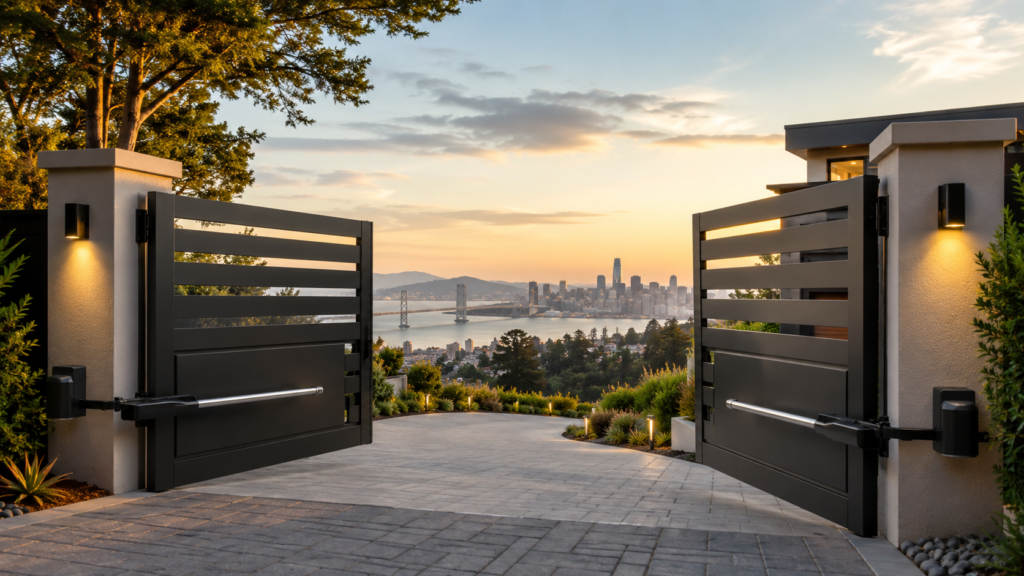
Most Bay Area homeowners spend somewhere between $3,500 and $8,000 to install a residential automatic gate, with custom designs and larger spans pushing into the $10,000 to $25,000+ range. The automatic gate cost bay area homeowners actually pay depends on five things: gate type, materials, the operator that drives it, what automation you add, and how much electrical and concrete work the site needs. For broader context on the whole service, see our complete Bay Area automatic gates and fencing guide. This piece walks through every line item in plain numbers so you can budget realistically before talking to anyone.
The Short Answer: Three Budget Tiers
Here’s how Bay Area projects tend to shake out by tier.
Basic ($3,500–$6,000). A standard-width swing or sliding driveway gate in wrought iron, aluminum, or pressure-treated wood. Linear arm operator, single remote, basic photo eye safety sensors, and a code-compliant install on a flat or near-flat driveway with power already close by. Most single-family Castro Valley, San Leandro, or Hayward driveways land here.
Mid-range ($6,000–$12,000). Upgraded gate material (ornamental steel, cedar with steel frame, or aluminum with custom infill), keypad and intercom, vehicle detection loop, and a more capable operator. Includes minor trenching for power and a permit pull. This is the most common range for replacement gates on existing driveways across Walnut Creek, Pleasanton, and the East Bay hills.
Premium ($12,000–$25,000+). Custom-designed gate (often 14–20+ feet across or bi-parting), underground or hidden operators, video intercom with smart home tie-in, solar backup, long power runs, structural concrete pillars, and architectural review for HOA or hillside lots. Coastal properties needing marine-grade corrosion protection also sit in this tier.
What Drives the Price up or Down
In our experience, two projects with identical-looking gates can be $4,000 apart because of what’s behind them. These are the variables that actually move the budget.
Gate Type: Swing Vs. Sliding
Swing gates use simpler, cheaper operators (linear arm units start around $400). Sliding gates need a rack-and-pinion operator running $800–$2,500 and require a flat track area beside the driveway. The gates themselves cost roughly the same in material, but a sliding setup adds track work and a longer overall gate. If your driveway slopes up or down from the street, swing gates often win on cost; if you have a flat shoulder and want zero swing arc into the driveway, sliding is worth the extra spend.
Material and Span
A 10-foot ornamental aluminum gate might cost $1,500 in material; the same design at 16 feet in wrought iron could be $4,500–$6,000. Custom welded designs, decorative casting, or wood-over-steel composites push higher. Homes near the coast (Half Moon Bay, Pacifica) should budget extra for hot-dip galvanizing or powder coat over zinc primer — salt air eats untreated steel fast. Material choice is one of the biggest swing factors, which is why we break it out separately in our gate and fence materials guide.
Site Conditions
A driveway with power already at the gate location is the cheap version. A long rural driveway in Pleasanton or Livermore that needs 150 feet of conduit trenched from the house adds $1,500–$4,000 in electrical and excavation. Steep grades require specialty operators rated for the load. Soft soil or expansive clay (common in parts of the East Bay) means deeper concrete footings for the gate posts.
HOA, Permits, and Architectural Review
Bay Area cities charge $50–$300 for gate permits depending on whether structural, electrical, or both are pulled. The bigger cost is time: HOA architectural committee review can add 4–8 weeks and sometimes requires revised drawings. If your project also touches the driveway approach, concrete entry work and landscaping permits may stack on top.
The Detailed Line-Item Breakdown
Here’s roughly where the money goes on a typical $7,500 mid-range install. Your project will vary, but the ratios hold up.
Gate (material + fabrication): $1,500–$5,000. Aluminum ornamental panels at the low end, custom welded steel or premium wood at the high end. This is the most visible line — it’s also where homeowners under- or over-spend most often.
Operator (the motor that moves the gate): $400–$3,500.
- Linear arm operator (residential swing): $400–$1,200
- Rack-and-pinion slide operator: $800–$2,500
- Underground or hidden swing operator: $1,500–$3,500
Automation and access controls (each, installed):
- Remote controls: $100–$300
- Keypad: $150–$500
- Audio intercom: $300–$800
- Video intercom: $600–$1,500
- Smart home / app integration: $200–$800
- Vehicle detection (exit loop): $300–$700
- Solar power kit: $500–$1,500
For a deeper look at which combination fits your property, see our gate operators and intercoms guide.
Electrical: $300–$2,500. Running 120V (or sometimes 24V low-voltage) to the gate, plus the control box, surge protection, and any GFCI or disconnect required by code. Trenching distance is the main variable.
Concrete and posts: $400–$2,000. Two footings for a swing setup, a track slab plus one footing for a slide. Bay Area soil conditions sometimes require oversized footings.
Permits: $50–$300. Varies by city. Castro Valley, Oakland, Berkeley, San Jose, and Fremont all run different fee schedules. We pull these in your name and handle inspections.
Labor: $1,500–$3,500. Bay Area labor rates run 2 to 2.5 times the national average. Electricians here are $100–$200 per hour; experienced gate installers price similarly. Most residential gate installs take 2–4 days of crew time once materials are on site.
How Top Tier Handles This
We give you a single itemized estimate that breaks gate, operator, automation, electrical, permits, and labor on separate lines — not one round number. That’s deliberate: if you want to value-engineer a $9,000 quote down to $7,000, you should be able to see which line moves and what you give up. We’re a licensed, bonded, and insured California general contractor (CA License #1146790, based in Castro Valley), and we handle the gate fabrication, electrical, concrete, and permits as one integrated install rather than coordinating three subcontractors. That’s where most cost overruns come from on gate jobs — handoffs between trades that nobody owns.
Common Questions About Automatic Gate Cost
How Much Does a Driveway Gate Cost in the Bay Area?
Most residential driveway gates with automation install for $3,500–$8,000. Custom designs, longer spans (14+ feet), underground operators, or hillside sites push toward $10,000–$25,000+. Sliding gates average $4,000–$6,000 including the operator and basic automation; swing gates typically come in slightly lower because the operator is cheaper.
Are Swing Gates Cheaper Than Sliding Gates?
Usually, yes — by a few hundred to a couple thousand dollars. The gate material is similar, but swing operators (linear arm units) cost less than rack-and-pinion slide operators, and sliding gates need a flat track surface and a longer overall gate to clear the post. Swing is the default cost-effective choice if your driveway has room for the arc.
Do Permits Add a Lot to the Cost?
Not directly — Bay Area cities charge $50–$300 for gate permits. The bigger cost impact is time and revisions. HOA architectural review can delay a project 4–8 weeks. Building department corrections after inspection (usually for the electrical or safety sensors) can add a few hundred dollars if the original install didn’t meet code.
How Much Does It Cost to Add an Intercom?
A basic audio intercom runs $300–$800 installed. Video intercoms with cellular or Wi-Fi connectivity run $600–$1,500, and tying that into a smart home system adds another $200–$800. The wiring is the variable — running cable from the gate to the house adds cost on long driveways, which is why many homeowners now choose cellular video intercoms instead.
Planning a Gate Install?
A good gate budget starts with a site walk: gate type, driveway length, where power lives, what automation you actually need, and whether HOA or city review will be in play. If you’re working out a number for a Bay Area property — or comparing estimates you’ve already received — we’d be glad to walk through the line items with you and tell you straight where the real costs land. See our automatic gates and fencing service page for project examples, or reach out for an itemized estimate.
────────────────────────────────────────────────────────────
By Top Tier Building Services Inc. Licensed Bay Area general contractor (CA License #1146790) serving homeowners, HOAs, and property managers from Castro Valley. Top Tier delivers design-build, renovation, and maintenance services across 14 specialty trades, including [HOA and property management services](https://toptierbuildingservices.com/services/hoa-property-management-services/) for communities with shared gates and entry systems.
────────────────────────────────────────────────────────────
By Top Tier Building Services Inc.
Licensed Bay Area general contractor (CA License #1146790) serving homeowners, HOAs, and property managers from Castro Valley. Top Tier delivers design-build, renovation, and maintenance services across 14 specialty trades.