
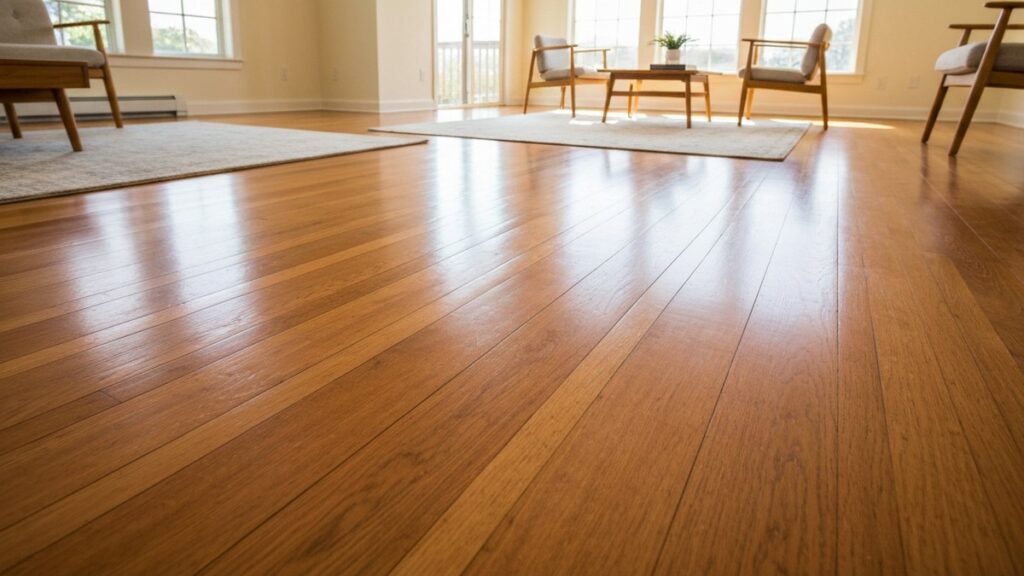
Hardwood is one of the few finishes in a home that can outlast the people who installed it. Walk into a 1920s Berkeley bungalow or a Pacific Heights Victorian and you will often find original floors still underfoot a century later. But those survivors are not lucky. They were cared for. The boards that get torn out and hauled to the landfill usually were not damaged by age at all. They were worn down by daily habits nobody thought twice about.
That is the frustrating part about learning how to maintain hardwood floors: the damage is slow, quiet, and almost always preventable. A little grit tracked in from the sidewalk acts like sandpaper. A splash near the kitchen sink sits a few minutes too long. The wrong cleaner gets used “just this once,” and the finish hazes over. None of it looks like a problem on day one. Three years later, the floor looks tired, the finish is scratched into the high-traffic lanes, and a homeowner is staring down a refinishing bill that proper care could have pushed off for another decade.
This guide gives you the full care routine — daily, weekly, seasonal, and long-term — plus the specific dos and don’ts that separate floors that age gracefully from floors that get replaced. Everything here reflects how we maintain real wood floors in real Bay Area homes, where coastal fog and inland heat each create their own challenges.
Key Takeaways
- Abrasion causes most hardwood wear — not water or pets. Stop grit at the door.
- Dry-dust traffic lanes daily; damp-mop weekly with a pH-neutral wood cleaner.
- Never use vinegar, ammonia, oil soap, wax or a steam mop on a finished floor.
- Shine comes from a clean, intact finish, not from a polish product.
- Screen-and-recoat every 3 to 5 years; full refinish only every 7 to 10.
Why Hardwood Floors Fail Early
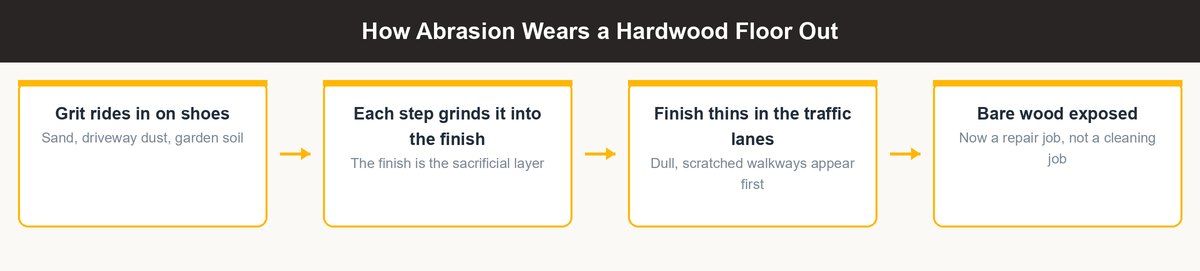
The number one killer of hardwood is not water and it is not pets. It is abrasion. Every grain of sand, every bit of grit, every speck of driveway dust that rides in on a shoe gets ground into the finish with each step. The finish — usually a polyurethane or hardwax oil — is the sacrificial layer protecting the wood. Once it wears through in a walkway, dirt and moisture reach the bare wood, and at that point you are no longer cleaning a floor, you are repairing one.
Water is the second threat, and it is sneakier than people expect. Wood is hygroscopic, meaning it constantly absorbs and releases moisture from the air. A puddle left after mopping, a leaky planter, or a dishwasher that weeps along its front edge will swell the boards, lift the finish, and leave dark stains that no cleaning will remove. Cupping and crowning — where boards warp into a concave or convex shape — almost always trace back to a moisture problem. The EPA recommends keeping indoor relative humidity below 60 percent, ideally between 30 and 50 percent, a band that also keeps seasonal wood movement in check.
The third threat is the one homeowners cause themselves: the wrong products. Vinegar, ammonia, oil soaps, steam mops, and all-purpose sprays are used on hardwood every single day with the best intentions, and every one of them quietly degrades the finish. We will get into exactly why below, because avoiding these is half the battle of good hardwood floor maintenance.
The Hardwood Floor Care Schedule
The single most useful thing you can do is stop treating floor care as one big occasional chore and start treating it as a layered routine. Different tasks belong on different clocks. Here is the schedule we recommend to homeowners, broken down by how often each task actually needs to happen.
The yearly assessment is the one that saves real money: it is what lets you intervene with a cheap recoat instead of an expensive full refinish.
How to Clean Hardwood Floors the Right Way
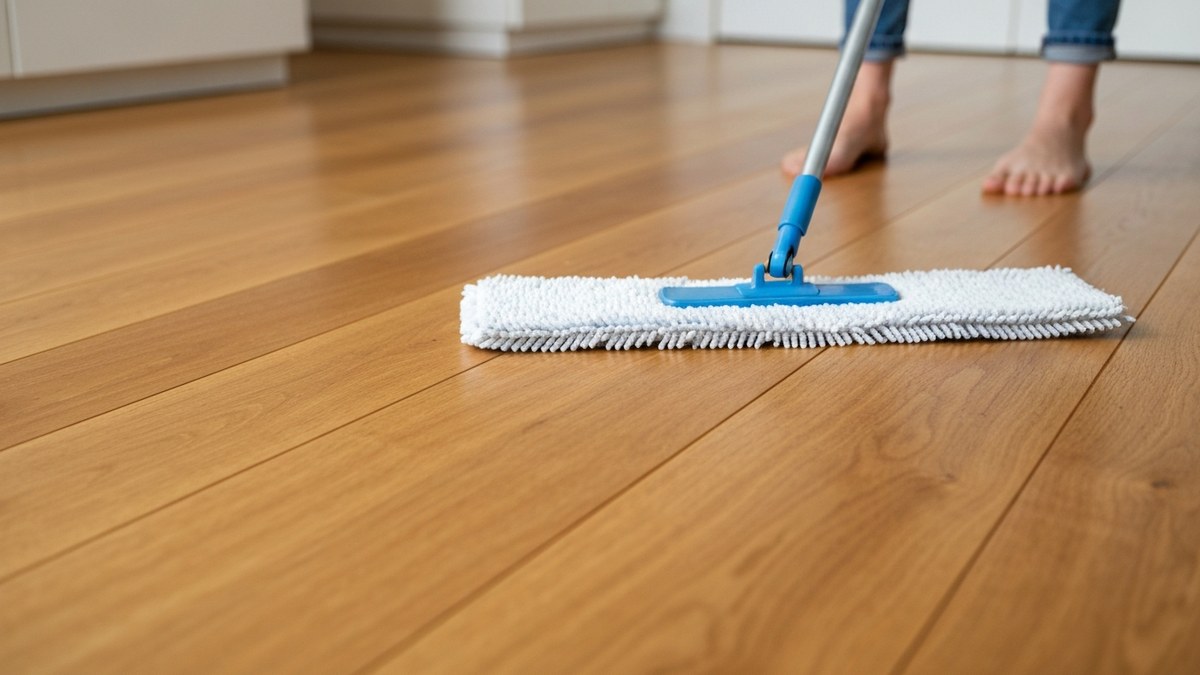
Cleaning is where most of the daily damage happens, so it is worth getting exact. The best way to clean hardwood floors is also the gentlest, and it comes down to a simple two-step rhythm: dry first, then damp.
Start dry, every time. Before any liquid touches the floor, remove the loose grit with a soft-bristle broom, a microfiber dust mop, or a vacuum set to its bare-floor mode with the rotating beater bar switched off. That spinning brush is designed for carpet and will scuff a wood finish. Microfiber is the quiet hero here — its fibers carry a slight static charge that grabs dust and pet hair that a broom just pushes around. For a busy household with a dog or kids, a 60-second dry pass through the main walkways every evening does more good than any monthly deep clean.
Then go damp — emphasis on damp, not wet. Once a week, mist a pH-neutral hardwood-specific cleaner onto the floor or onto a microfiber pad and wipe in the direction of the grain. The pad should feel barely moist; if it leaves a visible film of water behind, you are using too much. The floor should be dry to the touch within a minute or two. Standing water is the enemy, and a string mop in a bucket is the single worst tool you can reach for because it dumps far more liquid than the finish can shrug off.
A few cleaning specifics that come up constantly with our clients:
- Spills get wiped immediately, not eventually. Water, wine, pet accidents, olive oil — all of it. A spill that sits for ten minutes is a wipe-up; one that sits for an hour can be a stain you live with. Keep a microfiber cloth somewhere obvious in the kitchen so reaching for it is automatic.
- Use only a cleaner made for your finish. If your floors were professionally installed, ask the installer which product matches the finish; a polyurethane surface and a hardwax-oil surface want different care. When in doubt, a product labeled pH-neutral and “for finished hardwood” is the safe default.
- Spot-clean sticky messes with a slightly damp cloth and patience, never a scouring pad or a putty knife. Abrasive tools cut straight through the finish you are trying to protect.
What Never to Use on Hardwood Floors
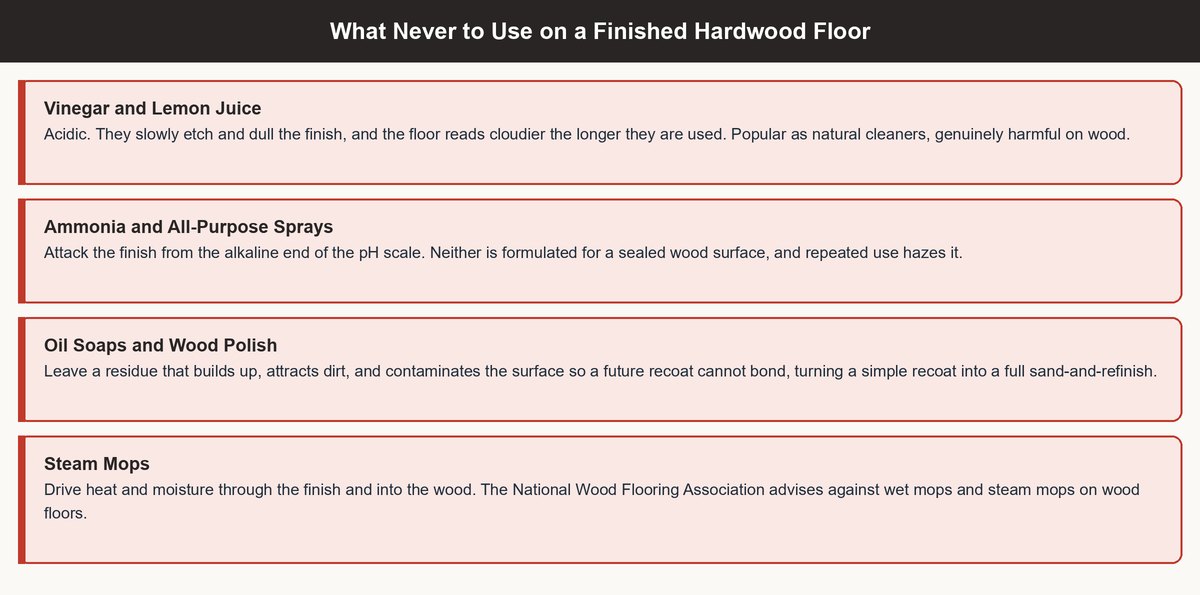
Reversing the damage from these products is far harder than avoiding them.
Vinegar and lemon juice top it. They get recommended endlessly as natural cleaners, and they are genuinely terrible for wood — the acid slowly etches and dulls the finish, and the more you use them the cloudier the floor gets. Ammonia and most all-purpose sprays do the same kind of chemical damage from the other end of the pH scale. Oil soaps and “wood polish” products leave a residue that builds up over time, attracts dirt, and — critically — contaminates the surface so badly that a future recoat will not bond to it. That residue can turn a simple recoat into a full sand-and-refinish.
Steam mops deserve their own warning because they are marketed as safe for everything. They are not safe for hardwood. Steam forces heat and moisture straight through the finish and into the wood, and over time that delaminates the finish and can warp the boards. No matter what the box says, keep the steam mop on tile and vinyl, never on wood. The same goes for wax on a polyurethane floor and any product you cannot confirm is meant for finished hardwood.
How to Protect Hardwood Floors From Daily Wear
Cleaning removes abrasives after they arrive. Protection stops them at the door and keeps furniture from doing damage you cannot scrub away. This is the half of hardwood floor maintenance that quietly extends a floor’s life by years.
The front line is mats and a shoe habit. A coarse mat outside each entry door grabs grit before it ever gets inside, and a softer mat just inside catches what slips past. In a foggy, sandy environment like the Outer Sunset or a home near the Marin coast, this matters even more — fine beach sand is brutally abrasive and rides in on every shoe. Many of our clients adopt a shoes-off rule in the main living areas, and honestly, nothing else protects a floor as cheaply or as effectively.
Furniture is the other big culprit. Every chair leg, table foot, and sofa base needs a felt pad on the bottom, and those pads need to be checked monthly because they peel off and wear flat without anyone noticing. When you move anything heavy — a fridge, a bookshelf, a dining table — lift it or slide it on furniture sliders rather than dragging it; a single drag across the room can gouge a line that only refinishing will erase. Office chairs with hard plastic casters are a slow disaster on wood; either swap to rubber wheels or put down a chair mat.
A few more protective habits worth building in:
- Keep area rugs in the highest-traffic lanes — hallways, the path from the garage door, the stretch in front of the kitchen sink. A rug takes the abrasion that would otherwise wear a stripe into your finish, and rotating it seasonally keeps the wear even.
- Trim pet nails and keep a towel by the door for rainy-season paws. Dog nails scratch finish over time, and wet paws tracking in deliver both moisture and grit at once.
- Manage sunlight on exposed floors. Strong, direct Bay Area sun will fade and amber unprotected wood over a few years, especially near big south- and west-facing windows. Sheer shades or UV-filtering window film keep the color even, so you do not end up with a bleached patch where a rug used to sit.
Keeping Hardwood Floors Shiny Without Damaging Them
Almost everyone wants to know how to keep hardwood floors shiny, and the honest answer surprises people: shine comes from a clean, intact finish, not from a product. A floor that looks dull is usually not lacking polish — it is carrying a haze of residue, fine scratches, or built-up cleaner. Strip those away with proper cleaning and the natural luster returns on its own.
If your floors genuinely look flat even when clean, the finish itself is wearing thin in the traffic areas, and the answer is a recoat (covered below) rather than a bottle of shine spray. Resist the temptation to reach for acrylic “mop-and-shine” or wax products on a modern polyurethane floor. They deliver a quick gloss for a week or two, then build into a cloudy, streaky film that is genuinely difficult to remove and, again, can prevent a proper recoat from ever bonding. The shortcut creates the exact problem it promised to solve.
The durable path to shine is unglamorous: dust often, damp-mop weekly, fix scratches early, and recoat on schedule.
How Often to Refinish Hardwood Floors
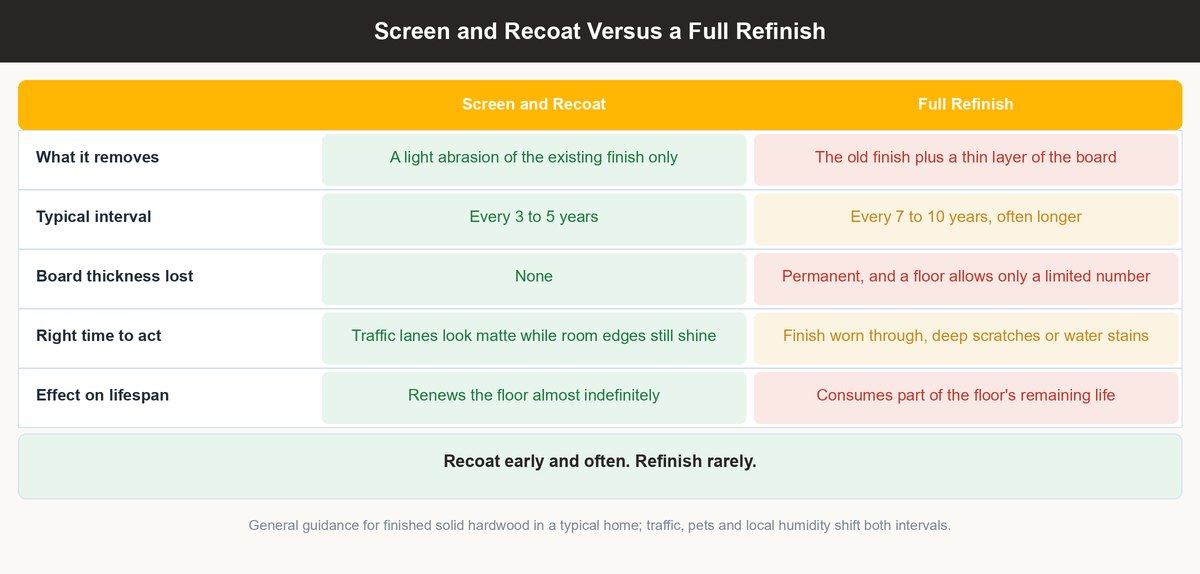
This is where smart maintenance pays off the most, because there are two very different procedures people lump together, and confusing them costs real money.
A screen-and-recoat (sometimes called a maintenance coat) is the light option. A pro lightly abrades the existing finish to give it tooth, then rolls on a fresh coat of finish over the top. No bare wood is exposed and none of the board’s thickness is lost. Done every 3 to 5 years, before the finish wears through to the wood, a recoat keeps a floor essentially renewed almost indefinitely. The National Wood Flooring Association describes recoating as the way a dulled floor is renewed, by applying a fresh coat of finish over the existing one, which is exactly why we push clients to schedule it proactively rather than waiting for visible damage.
A full refinish is the heavy option: sanding the floor down to raw wood, removing every trace of old finish along with a thin layer of the board, then staining and sealing from scratch. It is the only fix once the finish is worn through, the wood is stained, or there is deep scratching — but every refinish permanently removes thickness, and a solid hardwood floor can only take a limited number over its lifetime. Most floors need a full refinish only every 7 to 10 years, and floors that get recoated on schedule can stretch that interval far longer.
The takeaway is simple: recoat early and often, refinish rarely. The single most expensive mistake homeowners make is skipping recoats, letting the finish wear through, and forcing a premature full refinish that eats into the wood’s limited lifespan. Watch the high-traffic lanes — kitchen entries, hallways, the stretch in front of the sofa — because the finish always thins there first. When those areas start to look matte while the edges of the room still shine, it is recoat time, not refinish time, and acting then keeps you out of the sanding cycle.
Bay Area conditions tilt the timing, too. Homes in humid coastal zones like Half Moon Bay or the Richmond District deal with more moisture stress on the finish, while inland-heat areas like Livermore or Walnut Creek see more drying and UV exposure. Both shorten the comfortable interval between recoats, so if you live at either extreme, lean toward the shorter end of the 3-to-5-year window.
When to Call in a Professional
A good maintenance routine handles the day-to-day, but some situations genuinely call for a contractor. Deep gouges, water stains that have reached the wood, cupping or crowning from a moisture event, large worn-through traffic lanes, and any finish you are unsure how to recoat are all worth a professional assessment. Catching these early — before a recoat-able floor becomes a refinish-only floor, or before a moisture issue spreads — is almost always cheaper than waiting.
It also helps to start a floor’s life right. Many of the maintenance headaches we see trace back to the original job: the wrong finish for the household, a species that does not suit the room, or boards installed before the subfloor moisture was under control. If you are weighing new floors, understanding the realities of installing hardwood floors and matching the right product to each space pays off for the entire life of the floor. Our team handles everything from flooring installation services to maintenance recoats, and we are happy to advise on choosing the right flooring before a single board goes down.
If your floors are due for a recoat, showing early wear, or you simply want a professional eye on how they are holding up, reach out to Top Tier Building Services for a consultation. A short assessment now can add years to the floors you already have. Top Tier Building Services is a licensed California general contractor, CSLB #1146790.
FAQs
What is the best way to clean hardwood floors?
Dry-dust or sweep with a microfiber mop first to remove grit, then damp-mop weekly with a pH-neutral hardwood cleaner on a well-wrung microfiber pad. The floor should dry within a minute or two. Avoid string mops, buckets of water, and steam mops.
Can I use vinegar to clean hardwood floors?
No. Vinegar is acidic and slowly etches and dulls the floor’s finish, even when diluted. Over time it leaves the surface cloudy. Use a cleaner made specifically for finished hardwood instead.
How do I keep hardwood floors shiny?
Shine comes from a clean, intact finish, not a product. Dust often, damp-mop weekly with the right cleaner, and fix scratches early. If the floor still looks dull when clean, the finish is wearing thin and needs a screen-and-recoat rather than a shine spray.
How often should hardwood floors be refinished?
Most floors need a full refinish (sanding to bare wood) only every 7 to 10 years. A lighter screen-and-recoat every 3 to 5 years keeps the finish renewed and can push a full refinish out for decades.
Are steam mops safe for hardwood floors?
No. Steam drives heat and moisture through the finish and into the wood, which can delaminate the finish and warp the boards over time. Keep steam mops on tile or vinyl and use only damp microfiber on hardwood.
How can I protect hardwood floors from scratches?
Put coarse mats at entries, add felt pads to all furniture legs and check them monthly, use rugs in high-traffic lanes, trim pet nails, and never drag heavy items. Removing grit at the door and under furniture prevents most scratching.