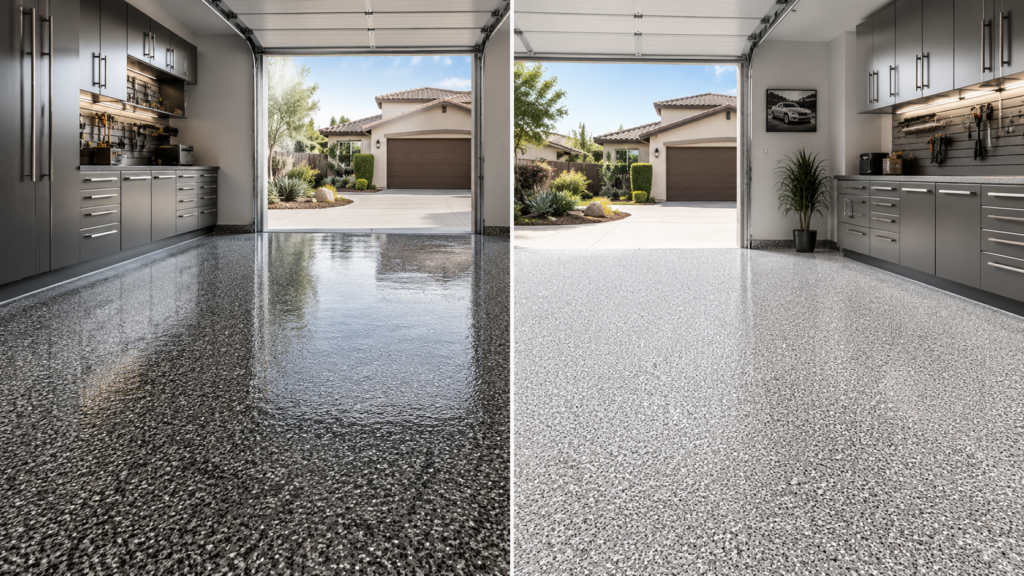
When upgrading your garage in the Golden State, the debate often boils down to two heavyweight contenders: Polyaspartic vs Epoxy Garage Flooring. While both systems provide a night-and-day difference compared to bare concrete, California’s unique climate—ranging from the cool, salt-heavy air of the Bay Area to the intense UV exposure in the Central Valley—demands a coating that can handle specific environmental stressors.
Choosing the right material isn’t just about aesthetics; it’s about matching the chemical properties of the coating to your specific use case. In this guide, we’ll dive deep into the technical differences to determine which is better for your California home.
Understanding Epoxy Coatings
Epoxy has been the industry standard for decades. It is a thermosetting resin that, when mixed with a hardener, creates a thick, durable plastic-like surface. It is renowned for its incredible compressive strength and its ability to level out minor imperfections in concrete.
However, epoxy has a few ‘Achilles’ heels’ in the California market. Standard epoxies are not UV-stable, meaning they will eventually amber or ‘yellow’ if exposed to direct sunlight. Furthermore, they have a longer cure time, often requiring 72 hours before you can drive a vehicle onto the surface.
What is Polyaspartic?
Polyaspartic is a subset of polyurea. It was originally developed in the 1990s to protect steel bridges from corrosion. In the context of garage flooring, it is often marketed as a ‘one-day’ coating because of its rapid cure time.
The chemical structure of polyaspartic allows it to be applied in a wider range of temperatures and humidity levels. It is also significantly more flexible than epoxy, which allows it to move slightly with the concrete during seismic micro-movements—a common occurrence in the San Francisco Bay Area.
Polyaspartic vs Epoxy: Technical Comparison
Why the California Climate Matters
In California, two main factors influence the Polyaspartic vs Epoxy decision:
The Cost Reality
Generally, polyaspartic materials are more expensive than epoxy. However, because polyaspartic can often be installed in a single day, labor costs can sometimes offset the material price. For a full breakdown of how these materials impact your project budget, see our Bay Area epoxy garage flooring cost analysis.
Conclusion: Which is Better?
If you are looking for a budget-friendly option for a dark garage with no sun exposure, epoxy is an excellent choice. Just be sure it is a true resin system and not an off-the-shelf coating—here is why most DIY garage floor paints fail. However, for most California homeowners looking for long-term durability, UV protection, and a quick turnaround, polyaspartic is the superior investment.