

Here is the uncomfortable truth about hiring a contractor. By the time you are sitting across a kitchen table comparing bids, the contractor has run this meeting hundreds of times and you have run it maybe twice in your life. That asymmetry, not bad luck, is why so many remodels go sideways. The good news is that the balance flips fast once you know the right questions to ask a contractor before hiring anyone. A contractor cannot rehearse their way past a homeowner who checks the license record before the meeting, asks how change orders get priced, and wants to know who is actually on site on a Tuesday afternoon.
This guide is the complete question set we would use on our own homes, built for California and specifically for Bay Area realities like pre-1978 housing, hillside lots, and HOA approval layers. For every question you will get the reason it matters and what a good answer actually sounds like, because a checklist without context is just a script a bad contractor can perform against.
Key Takeaways
- Verify the license on the CSLB website before the first meeting, and confirm the classification matches your project. A Class C specialty license does not cover a multi-trade remodel.
- California caps the down payment on a home improvement contract at $1,000 or 10 percent of the price, whichever is less. A contractor who asks for a third up front is telling you something.
- The $25,000 contractor bond is not project insurance. Ask for the general liability certificate and verify workers comp on the CSLB record separately, because each protects you from a different disaster.
- Vague bids are not cheaper bids. A one-page number without inclusions, exclusions, and allowances almost always grows after demolition, when you have the least leverage.
- Bay Area projects need extra questions about lead-safe certification, seismic and hillside experience, HOA approval paths, and city-specific permit timelines.
- Prepare your scope, photos, decisions, and budget range before asking for estimates. Prepared homeowners get tighter numbers and attract better contractors.
What This Guide Covers
- Why the Right Questions Beat the Lowest Bid
- The Four Question Groups That Cover Everything
- How to Verify a California Contractor License
- What Each License Class Really Covers
- The Three Protections and What Each One Shields
- Questions About the Business Behind the Bid
- Questions About Your Specific Project and Permits
- Questions About Money Payment Terms and Change Orders
- Questions About Communication and Problem Handling
- How to Compare Three Bids Side by Side
- Red Flags That Should End the Conversation
- What Bay Area Homes Add to the Question List
- What to Prepare Before You Ask for an Estimate
- Get Expert Eyes on Your Project Before You Sign
- FAQs
Why the Right Questions Beat the Lowest Bid

A bid is a compression of unknowns into a single number, and every contractor compresses differently. The low bid is very often not the cheapest way to do your project. It is the least-scoped description of it, and the missing scope comes back later as change orders, priced at a moment when your kitchen is already open to the studs and your leverage is gone. That is why the interview, not the bid comparison spreadsheet, is where the real money gets saved or lost.
Think about what a failed hire actually costs in the Bay Area. If a $120,000 remodel stalls at 60 percent because the contractor was underbid, understaffed, or unlicensed for part of the work, you are not just out the payments you made ahead of progress. You may be paying a second contractor a premium to take over someone else’s half-finished work, re-opening walls so inspectors can see what was covered, and in the worst cases paying twice for the same trade. The questions in this guide exist to surface those failure modes while they are still cheap to walk away from. That is the entire strategy, and it is why the interview deserves more preparation than most homeowners give the whole hiring process.
The Four Question Groups That Cover Everything
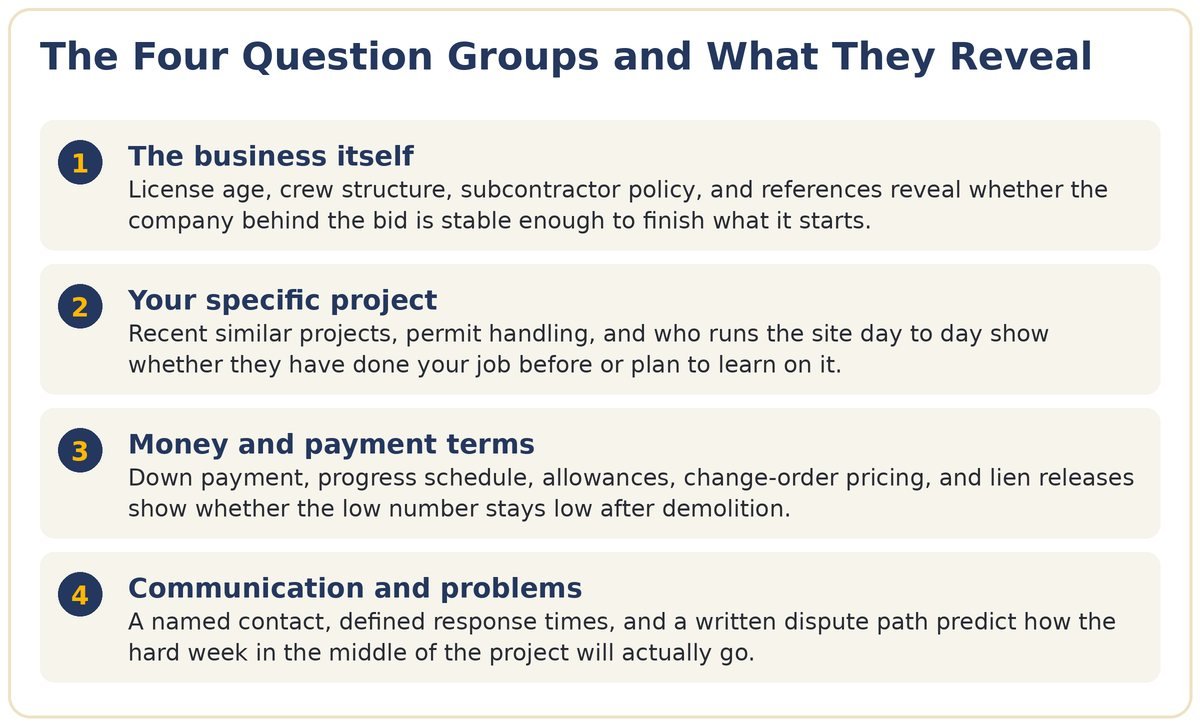
Homeowners who go in with a random list of twenty questions usually get twenty rehearsed answers and learn nothing. Structure beats volume. Every question worth asking falls into one of four groups, and each group is designed to expose a different failure mode before it can cost you money.
The first group tests the business itself, because a great craftsman running an unstable company will still leave you with an unfinished project. The second tests fit for your specific project, because a contractor can be excellent at decks and mediocre at structural remodels. The third tests money mechanics, because almost every ugly dispute is really a payment-terms dispute that was signed on day one. The fourth tests communication and problem handling, because something will go wrong mid-project, and how the contractor handles that week is decided by habits you can probe in one conversation. The sections below work through each group, and then through the Bay Area additions that generic national lists never cover.
How to Verify a California Contractor License
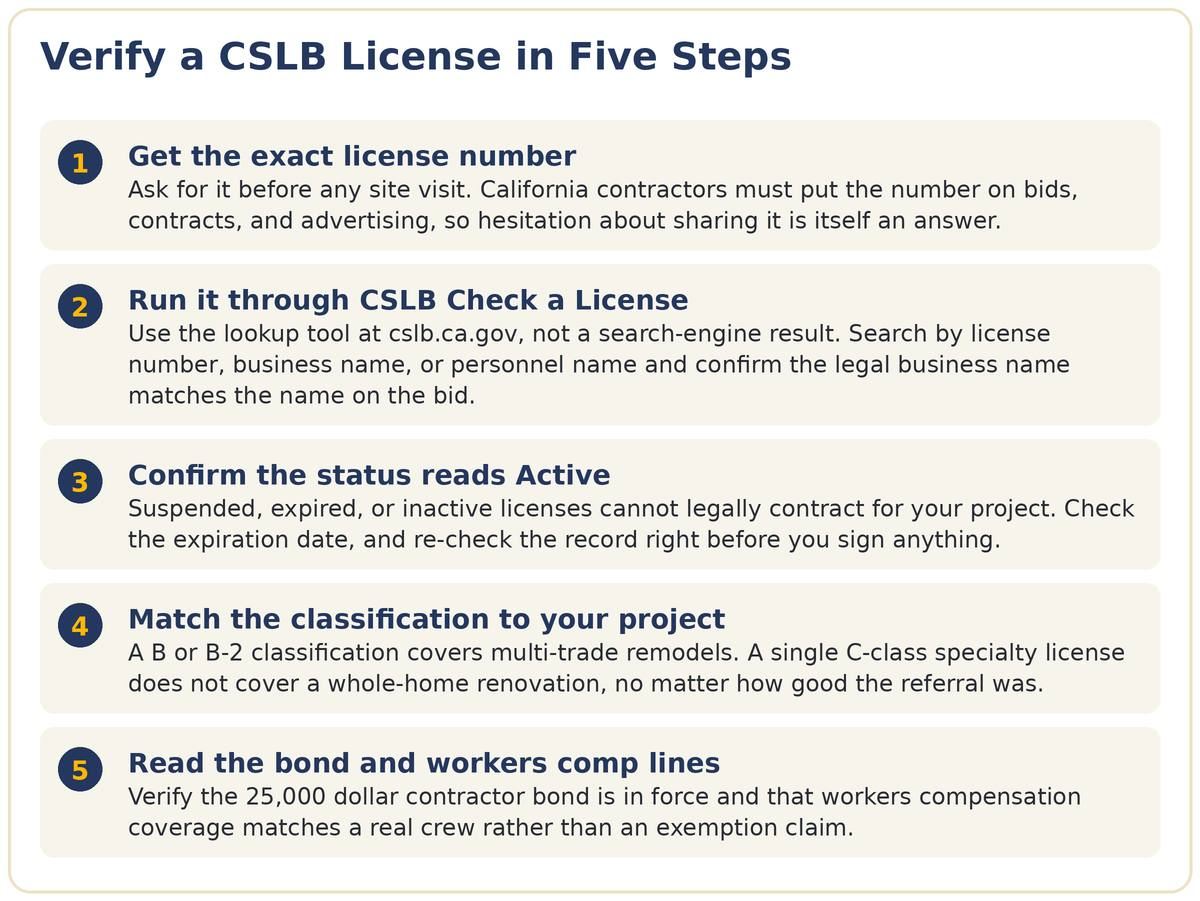
In California this is not a judgment call, it is a lookup. Every legitimate contractor bidding work over $1,000 in combined labor and materials must hold an active license from the Contractors State License Board, and the whole record is public. Run the license number through the CSLB Check a License tool before you ever meet, and again right before you sign, since suspensions happen mid-year. You can search by license number, business name, or personnel name.
Read the record like an underwriter, not a tourist. Confirm the legal business name on the record matches the name on the bid exactly, because “borrowing” a relative’s or former employer’s license number is a classic scheme and the mismatch is how you catch it. Confirm the status reads active, not expired or suspended. Check how long the license has been held, which entity holds it, and whether the bond and workers compensation lines are current. Then check that the classification actually covers your project, which is the part most homeowners skip and the next section unpacks.
What Each License Class Really Covers
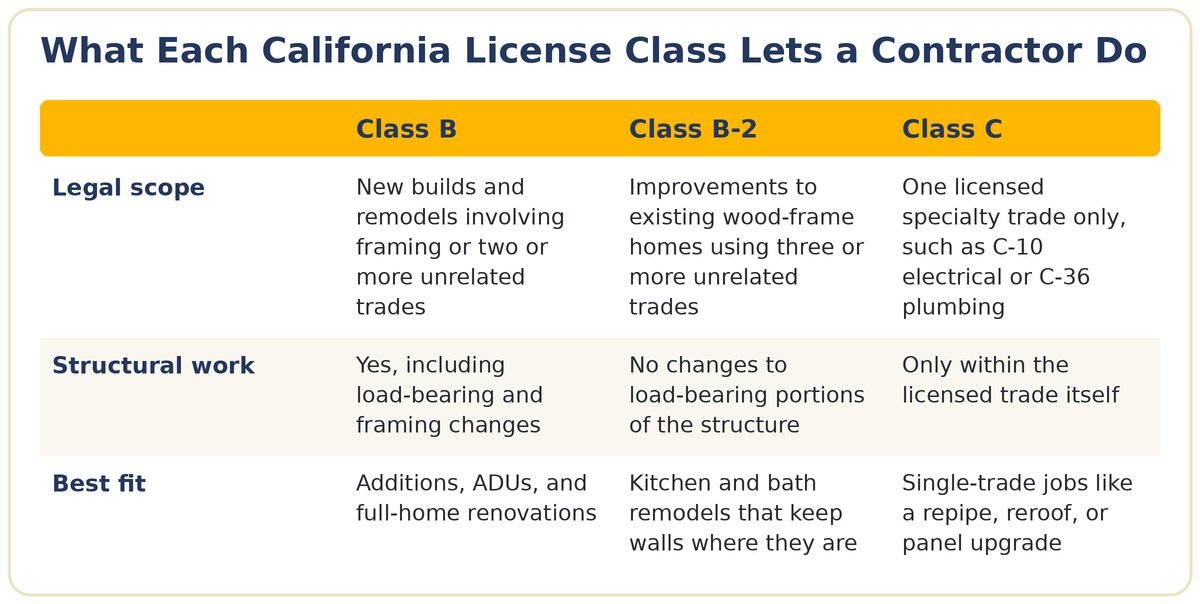
License classifications are where honest-looking bids quietly go wrong, because a licensed contractor is not necessarily licensed for your job. California issues a Class B general building license for projects involving framing or at least two unrelated trades, a newer Class B-2 residential remodeling license, and dozens of Class C specialty licenses for single trades like C-10 electrical or C-36 plumbing.
The distinctions carry real legal weight. A B-2 residential remodeling contractor can only take projects on existing wood-frame homes that involve three or more unrelated trades, and is expressly barred from structural changes to load-bearing walls, footings, foundations, and roof structures. That means the moment your remodel opens a load-bearing wall, a B-2 holder is the wrong hire no matter how good the referral was. A single C-class specialist cannot legally take a prime contract for a multi-trade remodel. If your project touches structure, you want a Class B, and if it is a design-heavy whole-home job you may be better served by an integrated team, which is exactly the trade-off we walk through in our guide to choosing a design-build firm in the Bay Area.
The Three Protections and What Each One Shields
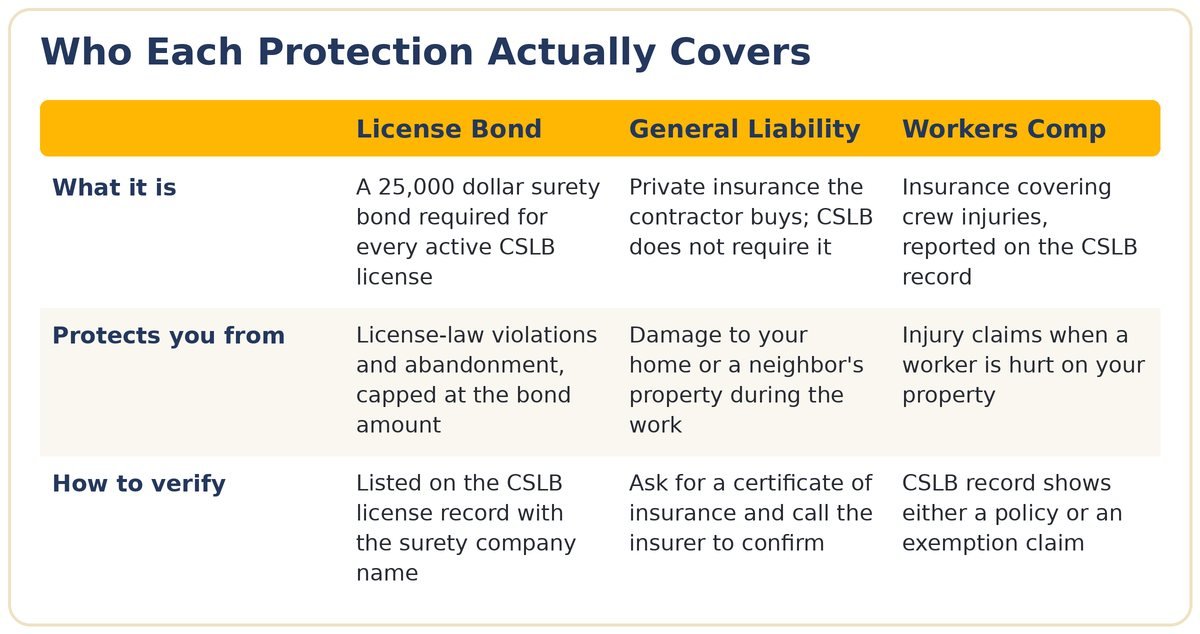
Homeowners hear “licensed, bonded, and insured” as one comforting phrase, but those are three different instruments protecting you from three different disasters, and verifying one does nothing for the other two. The license bond is a $25,000 surety bond that every active California contractor must carry, and it exists mainly to pay claims when a contractor violates license law or abandons a job. Notice the math, though. A $25,000 cap does not go far against a $150,000 remodel gone wrong, which is why the bond is a floor, never the safety net.
General liability insurance is the instrument that covers damage to your home or your neighbor’s property during the work, and CSLB does not require it, so you must ask. Request a certificate of insurance naming the policy and dates, and confirm it directly with the insurer rather than accepting a photocopy. Workers compensation covers crew injuries on your property, and it appears on the CSLB record as either a policy or an exemption claim. If a contractor claims the exemption while clearly running a crew of five, someone is being misclassified, and the injury lawsuit risk lands uncomfortably close to you as the property owner.
Questions About the Business Behind the Bid
How Long Have You Held This Exact License
What to Ask
Ask how long the contractor has held this specific license number, whether it has ever been under a different business name, and whether they have operated under other licenses before. Then compare every part of that answer against the public CSLB record you already pulled, including the original issue date.
Why It Matters
Years in business and years on this license are different facts. A contractor who has cycled through three dissolved companies and three license numbers has a track record that resets every time, which conveniently hides complaints, judgments, and bond claims. Continuity under one number is one of the strongest quiet signals of a stable business.
A Good Answer Sounds Like
A specific year, an unprompted acknowledgment of any name change with a mundane reason like restructuring, and zero defensiveness about you verifying it. Evasion, vagueness about dates, or surprise that you checked the record at all tells you the relationship will be managed, not transparent, from day one.
Who Does the Work and Who Gets Subbed Out
What to Ask
Ask which trades the contractor self-performs with their own crew and which get subcontracted, how long they have worked with each sub, and whether the electrical, plumbing, and HVAC subs hold their own C-class licenses you can verify independently on the CSLB site.
Why It Matters
Subcontracting is normal and often good, since a dedicated C-10 electrician usually beats a generalist. The risk is a contractor who is really a broker, subbing everything to whoever is cheapest that month. Unstable sub relationships are where scheduling collapses, quality varies room to room, and unpaid subs turn into mechanics lien exposure on your title.
A Good Answer Sounds Like
A clear split, named companies they have used for years, and no discomfort with you verifying the subs’ licenses. The worrying version is “I have guys for that,” with no names, no license numbers, and a subtle change of subject when you ask who exactly is pulling wire in your walls.
Which Recent Clients Can I Actually Call
What to Ask
Ask for two or three references from projects similar to yours completed in the last year, plus one from a project that hit a real problem. Then actually call them, and ask each one whether the budget held, who ran the site, and how disputes were handled.
Why It Matters
Every contractor has three glowing references from 2019. Recent references test the company as it exists today, with its current crew and current workload. The problem-project reference is the valuable one, because you are not hiring for the weeks when everything goes right, you are hiring for the week the subfloor turns out to be rotten.
A Good Answer Sounds Like
Names offered quickly, including one where the contractor says something honest like “we missed the timeline by three weeks and here is why.” A contractor who cannot produce a single recent local reference, or who only offers testimonials filtered through their own website, is asking you to take the biggest check of your year on faith.
Questions About Your Specific Project and Permits
What Similar Projects Have You Finished Nearby
What to Ask
Ask what projects of your exact type and scale the contractor has completed within the last two years, ideally in your city or county, and whether you can see one, either finished photos with addresses or a walkthrough of a comparable job.
Why It Matters
Contracting skill is less transferable than homeowners assume. A contractor who is excellent at bathroom remodels may have never managed a foundation-adjacent addition, and a tract-home specialist may be unprepared for a 1920s Berkeley bungalow where nothing is square and the framing predates modern code. Local recency also means current relationships with your city’s inspectors, which quietly smooths a project.
A Good Answer Sounds Like
Specific projects with specific challenges, told with detail only the person who managed them would know, like how they handled the change when the 1950s slab turned out thinner than drawings showed. Generic portfolio talk that never lands on a particular address or problem suggests the experience is thinner than the marketing.
Who Pulls the Permits and Schedules Inspections
What to Ask
Ask directly who applies for the building permit, whose name goes on it, who schedules and attends each inspection, and whether the bid includes permit and plan-check fees as a line item or leaves them out as your problem.
Why It Matters
This question doubles as a licensing integrity test. A properly licensed contractor pulls the permit under their own license as a routine cost of doing business. A contractor who asks you to pull an owner-builder permit is usually hiding a license or insurance problem, and the owner-builder route shifts legal responsibility for the work, and for injuries on site, onto you personally.
A Good Answer Sounds Like
An unhesitating “we pull it, we schedule inspections, fees are in the bid, and here is roughly how long plan check takes in your city.” The moment you hear “it will go faster and cheaper if the permit is in your name,” the interview should be effectively over, because you have just been asked to absorb their risk.
Who Runs My Site Day to Day
What to Ask
Ask who is physically responsible for your site on a normal working day, how many other active projects that person carries at the same time, and how often the owner or a senior project manager will personally walk the job.
Why It Matters
Most mid-project chaos is a supervision gap, not a skill gap. Subs show up to questions nobody can answer, small errors get covered by drywall instead of caught, and the schedule slips one unowned decision at a time. A named lead with a sane project load is the difference between a run project and a drifting one, which is the core argument of our Bay Area construction project management guide.
A Good Answer Sounds Like
A name, a role, and a number, as in “Miguel is your lead, he carries two jobs at a time, and I walk every site Friday.” Be wary of the contractor who personally answers every question in the sales meeting but cannot say who will answer them once the job starts, because that is when it matters.
Questions About Money Payment Terms and Change Orders

How Is the Payment Schedule Structured
What to Ask
Ask for the full payment schedule in writing before signing, including the down payment amount, what completed work triggers each progress payment, and how the final payment is held until punch-list completion. Then check the down payment against California’s legal cap.
Why It Matters
California law is unusually specific here. On a home improvement contract, the down payment may not exceed $1,000 or 10 percent of the contract price, whichever is less, under Business and Professions Code section 7159.5. Progress payments are also not allowed to run ahead of the value of work actually performed. A contractor asking for 30 percent up front is either ignorant of the law governing their own trade or deliberately breaking it, and both answers end the conversation.
A Good Answer Sounds Like
A milestone schedule tied to visible completed work, a down payment at or under the legal cap, and a meaningful final payment you hold until the last items are done. Payments tied to calendar dates rather than completed milestones are a quiet red flag, because they keep flowing even when the work does not.
How Do You Price Allowances and Change Orders
What to Ask
Ask which items in the bid are allowances, what dollar figure each allowance assumes, and exactly how a change order gets priced, approved, and signed before the related work proceeds. Ask what percentage markup applies to changed work, because there always is one.
Why It Matters
Allowances are where lowball bids hide. A bid that “includes tile” with a $4 per square foot allowance has really excluded the $14 tile you will actually choose, and the gap surfaces as a mid-project surprise. Unpriced change orders are worse, because verbal “we’ll work it out” changes become invoices you never agreed to, at a markup you never saw.
A Good Answer Sounds Like
Specific allowance figures benchmarked to products you would plausibly pick, and a firm rule that no changed work starts without a signed change order stating the price. If the answer to “what does an extra recessed light cost” is a shrug rather than a number, every future change on your project will be priced after the fact, in their favor.
Will You Provide Lien Releases as You Pay Subs
What to Ask
Ask whether the contractor will provide conditional lien releases from subcontractors and suppliers with each progress payment, and unconditional releases once those payments clear. Ask how they track that their subs and material suppliers are actually being paid on your job.
Why It Matters
Under California’s mechanics lien law, a subcontractor or supplier who goes unpaid by your general contractor can record a lien against your home even though you paid the general in full. Homeowners discover this at the worst possible moment, usually during a refinance or sale. The lien release paper trail is the only mechanism that closes this gap, and organized contractors treat it as routine paperwork.
A Good Answer Sounds Like
Immediate familiarity, something like “conditional releases come with every invoice, unconditional follow when checks clear.” A contractor who seems confused by the request, or waves it off with “that never happens with my subs,” is asking you to carry the payment risk of relationships you cannot see into.
Questions About Communication and Problem Handling

Who Is My Single Point of Contact
What to Ask
Ask who your one named contact is for the entire project, through what channel they communicate, whether there is a standing weekly update or walkthrough, and where decisions and changes get recorded so both sides can see the same running record.
Why It Matters
Projects with three half-contacts have zero contacts. When the tile setter, the project manager, and the owner each hold a different version of a decision, the wrong version ends up on your wall and nobody is accountable for it. A single named channel with a written record converts he-said-she-said disputes into a two-minute document check.
A Good Answer Sounds Like
A name and a system, like “Sarah is your contact, you will get a Friday summary of work done, decisions needed, and next week’s schedule, and every change lives in the shared log.” An answer like “you can always call my cell” sounds warm and accountable but is actually neither, because a phone call leaves no record and a busy site does not answer.
How Fast Do You Answer When Something Goes Wrong
What to Ask
Ask what the expected response time is for a routine question versus an urgent problem like an active leak, and then test it during the bidding phase by sending a question mid-week and quietly timing the response.
Why It Matters
Responsiveness during the sales phase is the ceiling, not the floor. A contractor courting your signed contract is as attentive as they will ever be, so a three-day silence now forecasts a mid-project communication pattern you will hate. Problems on a job site compound hourly, and an unreachable contractor turns a small leak into a drywall-and-flooring claim.
A Good Answer Sounds Like
A concrete standard, such as same-day acknowledgment for routine items and an emergency number for urgent ones, backed by your own bidding-phase experience of them actually meeting it. The rehearsed phrase “communication is our top priority,” unaccompanied by any mechanism, is a sentence every bad communicator also says.
What Happens When We Disagree About the Work
What to Ask
Ask how the contract handles disputes, what happens first when you believe work does not match the plans, whether the contract specifies mediation or arbitration before litigation, and how warranty claims are handled after final payment, including the warranty length and what it covers.
Why It Matters
Asking about disagreement before signing feels awkward, which is exactly why it works. A professional has a calm, practiced answer because disagreements are a normal part of construction. An amateur or an operator gets visibly uncomfortable, because their actual dispute process is attrition, waiting you out until you give up or pay.
A Good Answer Sounds Like
A sequence, in writing, such as document the issue, walk it together against the plans, fix legitimate misses at no charge, and mediate anything unresolved. On warranty, you want a stated term of at least one year on workmanship, and a story about a warranty call they actually honored last year, with a name you could call.
How to Compare Three Bids Side by Side

Get at least three bids for any significant project, but understand that the comparison only works if you force the bids onto the same scope. Give every bidder the identical written scope document and the identical plans, then compare what each bid includes rather than what each bid totals. A $95,000 bid that includes permits, dust containment, disposal, and realistic allowances is frequently cheaper in finished dollars than an $82,000 bid that includes none of those, and the table below shows where the gaps hide.
The pattern to notice is that vagueness always resolves in the contractor’s favor, never yours. An estimate is not just a price, it is a preview of how the contractor thinks, documents, and communicates. The contractor who writes the most detailed bid is showing you the same discipline they will bring to your schedule, your change orders, and your punch list.
Red Flags That Should End the Conversation

Most bad hires announce themselves in the first two meetings, and the signals are consistent enough that CSLB has been publishing warnings about the same handful for decades. The difficulty is never spotting the flag, it is that the flag usually arrives attached to the lowest number on the table, and the discount buys your silence. The table below is the shortlist we would treat as conversation-enders rather than negotiating points.
Notice that none of these flags is about craftsmanship, and that is the point. Homeowners screen for craft, which they are least qualified to judge, and skip screening for business integrity, which the public record and a structured interview make genuinely checkable. The portfolio photos tell you what a contractor did on their best jobs. The flags above tell you what happens on the worst ones, and you are hiring for both.
What Bay Area Homes Add to the Question List

Older Housing Stock and the Pre-1978 Rules
Why It Comes Up Here
A huge share of Oakland, Berkeley, Alameda, and San Francisco housing predates 1978, which triggers the federal lead Renovate Right rules, and much of it predates modern electrical and plumbing entirely. Opening walls in these houses routinely exposes knob-and-tube wiring, galvanized supply lines, and framing that has drifted far from square over a century of settling.
What to Ask For
Ask whether the firm is an EPA Lead-Safe Certified renovation firm, which is federally required for paint-disturbing work in pre-1978 homes, and how their bids handle discovery of knob-and-tube or galvanized pipe. The strong answer includes a contingency conversation up front rather than a shrug and “we’ll see what we find.”
Hillside Lots and Access That Changes the Price
Why It Comes Up Here
From the Oakland hills to Castro Valley and the Peninsula, hillside lots change the physics of a job. Material staging, debris removal, concrete pumping distance, retaining considerations, and even where a dumpster can legally sit all get harder, and bids from contractors who have not worked slopes routinely miss these costs by five figures.
What to Ask For
Ask specifically what hillside projects the contractor has completed, how this bid accounts for access and staging, and whether drainage and soil movement came up in their walkthrough. A contractor who walks the slope and starts talking about water before you raise it has done this before, which is exactly the experience you are paying for.
HOA and Condo Approval Paths Before Any Permit
Why It Comes Up Here
In condos and HOA communities across the Bay Area, the association’s architectural approval is a full extra permitting layer that runs before, and separately from, the city’s. Associations regulate work hours, elevator and corridor protection, insurance certificates naming the HOA, and sometimes which days contractors may park, and a contractor who learns this late stalls your project for weeks.
What to Ask For
Ask whether the contractor has worked under your association’s rules or ones like them, who prepares the HOA submission package, and whether their insurance can name the association as additionally insured. Firms that handle HOA and condo work as a practice area answer with a process, not a pause.
Permit Timelines That Differ by City
Why It Comes Up Here
Permit reality varies sharply across Bay Area jurisdictions, and a schedule that ignores this is fiction. A straightforward over-the-counter permit in one East Bay city can be a multi-week plan-check queue in San Francisco or San Jose, and seismic, energy code, and Title 24 documentation requirements add preparation time that must exist in the schedule before demolition day.
What to Ask For
Ask what the contractor’s recent permits in your specific city have actually taken, gate to gate, and how the contract schedule accounts for plan-check time. Recent, city-specific numbers are the tell. A contractor quoting the same permit timeline for Fremont and San Francisco has not recently pulled permits in both, and their schedule inherits that fiction.
What to Prepare Before You Ask for an Estimate

Estimates are only as accurate as the information they are built on, and unprepared homeowners get padded numbers because the contractor prices the uncertainty you brought into the room. Before you request bids, write a one-page scope describing each room and what changes, gather photos of the existing conditions, and make your major selections at least to the category level, because “mid-range quartz counters” prices very differently than “we haven’t thought about counters.” Decide your real budget range and share at least the shape of it. Withholding the budget does not protect you, it just guarantees the bids are scoped to a number you never agreed to.
Collect the documents that gate your project too. That means plans if you have them, your HOA’s architectural guidelines if you have an association, and anything you know about the house’s history, like a previous permit record, a sewer lateral replacement, or the electrical panel’s amperage. To make this stage systematic, we condensed it into a free download, the Bay Area Contractor Readiness Checklist, and built a companion walkthrough at our before you hire a contractor checklist page, where you can also have our team review your project’s readiness directly. Ten minutes with that checklist typically surfaces the two or three unresolved decisions that would otherwise surface mid-bid, or worse, mid-demolition.
Get Expert Eyes on Your Project Before You Sign
If you take one action from this guide, make it this. Run every question set above on at least two candidates, verify what you are told against the CSLB record, and never sign on the same day you receive a bid. And if you would like a second, professional set of eyes before you commit, we do that for Bay Area homeowners as a matter of course. Top Tier Building Services Inc. is a licensed Bay Area general contractor, CA License #1146790, based in Castro Valley and serving homeowners, HOAs, and property managers across Alameda County, Contra Costa County, and the greater Bay Area. Have Top Tier review your project through the readiness review on our campaign page, or contact us directly at 510-470-1870 or sales@toptierbuildingservices.com. We will tell you what your scope is missing, what your bids are hiding, and whether we are the right fit to build it, in that order.
FAQs
How do I verify a contractor license in California?
Use the CSLB Check a License tool at cslb.ca.gov and search by license number, business name, or personnel name. Confirm the status is active, the business name matches the bid exactly, the classification fits your project type, and the bond and workers compensation lines are current. Re-check the record right before signing, since license statuses change mid-year.
How many questions should I actually ask before hiring a contractor?
Coverage matters more than count. Make sure you hit all four groups, the business itself, your specific project, money and payment terms, and communication and problem handling. Twelve well-chosen questions across those four areas will surface more risk than forty random ones, because each group is designed to expose a different failure mode.
How much can a contractor legally ask for as a down payment in California?
On a home improvement contract, the down payment is capped at $1,000 or 10 percent of the contract price, whichever is less, under Business and Professions Code section 7159.5. Progress payments also may not run ahead of work actually completed. A demand for 25 or 30 percent up front violates the cap and is a serious warning sign.
What is the difference between a Class B and a B-2 contractor license?
A Class B general building contractor can take projects involving framing or two or more unrelated trades, including structural work. A B-2 residential remodeling contractor works only on existing wood-frame homes, needs three or more unrelated trades per project, and cannot legally alter load-bearing walls, foundations, or roof structures. If your remodel touches structure, you need a Class B.
Does my contractor need workers compensation insurance?
If the contractor has any employees, California requires workers compensation coverage. Several classifications, including concrete and HVAC, must carry it regardless of employees, and a universal requirement for all licensed contractors takes effect January 1, 2028. Check the CSLB record, and be skeptical of a contractor claiming a no-employee exemption while running a visible crew.
What should I prepare before asking a contractor for an estimate?
Prepare a one-page written scope, photos of existing conditions, category-level selections for major finishes, your budget range, and any gating documents like HOA guidelines or existing plans. Prepared projects get tighter, more comparable bids. Our free Bay Area Contractor Readiness Checklist condenses this preparation into a single printable page.