

Natural stone is the one finish in your house that is never supposed to be replaced — it can outlive the building if the people who grind, polish, and seal it know their craft. Restoration is subtractive: every machine pass removes stone that does not grow back. That is why the questions to ask a stone restoration company matter more than the photos on its website. The photos show their best day; the answers show their method.
Searching “stone restoration near me” returns two businesses wearing the same vocabulary: professionals who cut the stone back to a factory finish, and floor-care crews who mop on a glossy coating and call it polishing. Both leave shine; only one has fixed anything. Stakes are lopsided: foot traffic dulls stone slowly and reversibly; a bad crew damages it fast — grind unevenly and the floor picks up waves visible in raking light, use an acid-based “polish” on calcite and the whole surface etches at once, let a coating build up and the floor yellows into a stripping job. Each failure costs more to undo than the restoration itself, and removed stone is gone for good.
That asymmetry makes this interview the highest-leverage hour of the project: strong companies answer in specifics, weak ones in reassurance. We are a Bay Area general contractor that restores natural stone, and this is the interview we would run for our own family.
Key Takeaways
- Ask first whether your marks are etching or staining — opposite problems with opposite fixes; quoting without distinguishing them is guessing.
- Real restoration hones and polishes the stone itself with diamond abrasives; wax or topical gloss is a coating that wears off and builds up.
- A test spot before the full quote is standard among serious restorers — it proves the achievable finish and sets the job’s standard.
- California caps down payments at $1,000 or 10 percent, whichever is less, and jobs of $500 or more require a verifiable CSLB license.
- Marble, limestone, and travertine etch because they are calcite; granite mostly shrugs off acids; engineered quartz cannot be refinished like natural stone.
- Print the Stone Restoration Readiness Checklist and make every bidder answer the same questions, side by side.
What This Guide Covers
- The Five Minute Paper Check That Comes Before Any Stone Question
- Diagnosis Questions That Show Whether They Can Read Your Stone
- Method Questions That Separate Restoration Pros From Floor Waxers
- Jobsite Questions About Dust Slurry and Living Through the Work
- Pricing Questions and the Per Surface Logic Behind the Numbers
- Countertop Questions for Granite Marble and Engineered Stone
- Sealing and Maintenance Questions That Predict How Long the Shine Lasts
- When Restoration Beats Replacement and When to Walk Away
- Put the Checklist in Your Pocket Before the First Walkthrough
- Book a Stone Assessment You Can Actually Compare
- FAQs
The Five Minute Paper Check That Comes Before Any Stone Question
Any California job of $500 or more in labor and materials requires a state contractor license. Ask for the number and run it through the CSLB license check — it shows whether the license is active, bonded, and covered by workers’ compensation. Check the number they gave you, not the name on the van.
Workers’ comp matters in this trade — grinders, wet floors, dust — and an uninsured injury in your home can reach your homeowner’s policy. Some “stone polishing” outfits position themselves as cleaning services precisely to stay outside licensing — fine for them, bad for you.
Diagnosis Questions That Show Whether They Can Read Your Stone

The marks homeowners lump together are opposites. A stain soaked in — oil, wine, rust — and sits as a darker patch a poultice draws out. An etch dissolved the surface — any acid, from lemon juice to the wrong cleaner — and reads as a lighter, dull mark only honing removes.
Is This Etching or a Stain and How Can You Tell
Why It Matters
Poultice work is chemistry; etch repair is mechanical honing. Misdiagnose and you pay for a treatment that cannot work — no poultice ever lifts an etch, because the surface itself is corroded, not filled.
A Strong Answer Sounds Like
A walkthrough of your actual marks — a dark ring under a plant pot read as a stain, dull splashes near the coffee maker read as etching — with the fix each one gets, narrated reflexively.
Walk Away If
Every mark gets the same answer, usually “our polish takes all that out,” or the job is quoted from photos without separating damage types. That script is how etched marble gets sold a wax job.
Will You Restore a Test Spot Before Quoting the Whole Floor
Why It Matters
One small area taken through the full process proves what no promise can — the finish this stone can achieve and what it takes. Old floors hide coatings, lippage, and wear that change the price.
A Strong Answer Sounds Like
An offer to hone and polish a closet corner or single tile, often free or credited, before the number locks. The spot protects them too — an agreed standard, in your light, on your stone.
Walk Away If
The company quotes sight-unseen with a guaranteed mirror finish, or waves the test off because “we do this every day.” Refusing to demonstrate on ten square feet is a strange posture from someone asking to machine two thousand.
One check works before anyone arrives.
Method Questions That Separate Restoration Pros From Floor Waxers
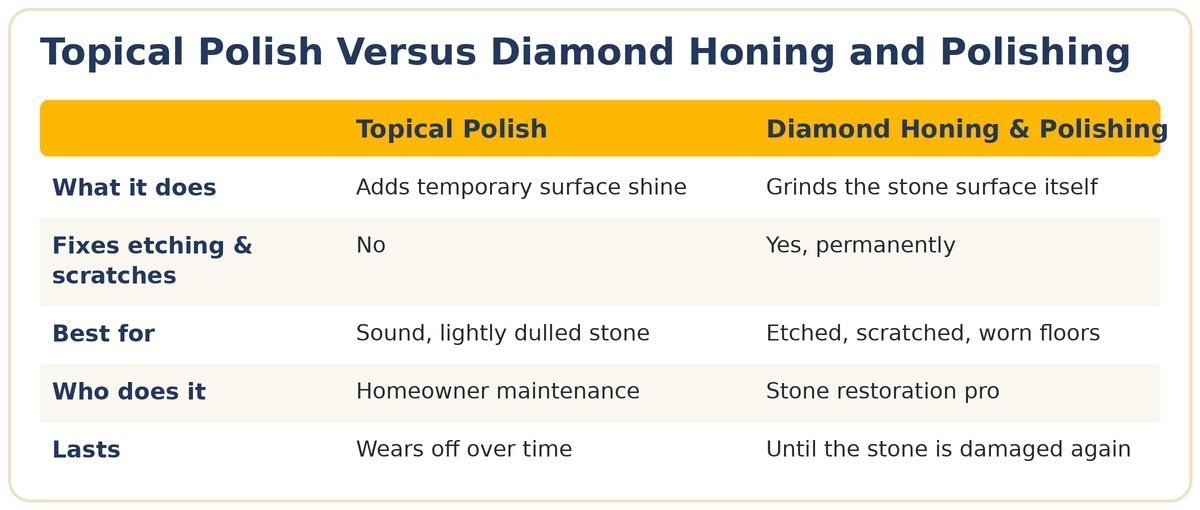
“Polishing” is the most abused word in this industry. To a restoration professional it means cutting the stone with diamond abrasives until optically flat, then refining to the target sheen. To a janitorial crew it means a sacrificial wax or acrylic that scuffs, yellows, and needs stripping — the line the Natural Stone Institute consumer guidance draws.
Will You Hone and Polish the Stone Itself or Coat It
Why It Matters
A coating hides damage; honing removes it. Etches, scratches, and wear live in the stone’s surface, so topical gloss laminates shine over them and adds a scuff-strip-recoat treadmill. Diamond restoration leaves nothing to peel.
A Strong Answer Sounds Like
“Hone” and “polish” used correctly, a named diamond process, a straight answer on when a topical is legitimate — almost never on marble floors — and a finish conversation about honed matte versus mirror gloss.
Walk Away If
The pitch is a proprietary “polish solution,” a high-speed buffer, and same-day gloss at a price undercutting everyone. That is a coating job in restoration language; the recurring “maintenance polishing” it locks in is the real product.
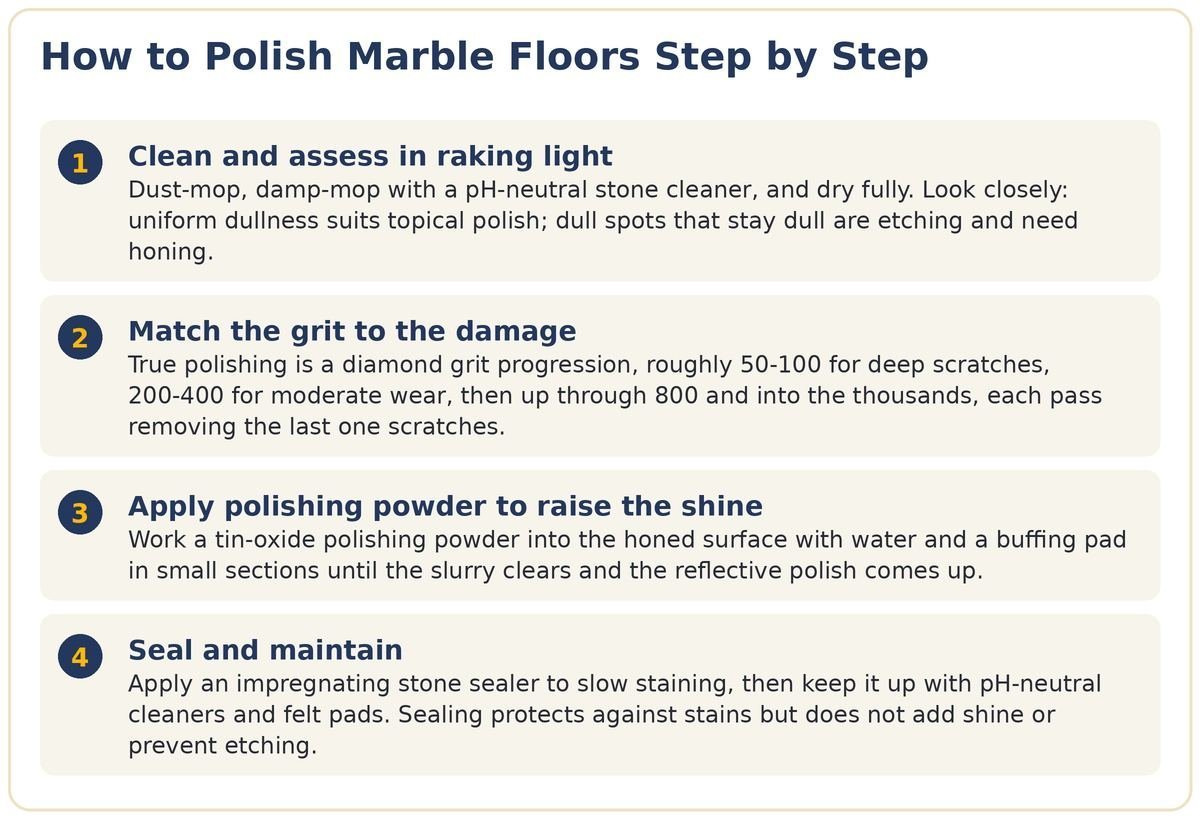
What Grit Sequence and Finish Level Does My Floor Need
Why It Matters
Diamond work is a progression — coarse grits cut damage and flatten, finer grits erase the previous grit’s scratches, compounds raise the gloss. The starting grit is the judgment call: too fine leaves damage in, too coarse wastes stone.
A Strong Answer Sounds Like
A conditional answer keyed to the test spot — light uniform wear may take two fine steps, while deep etching and lippage means cutting coarse and working up the run. Asking your sheen preference first is a bonus signal.
Walk Away If
There is no sequence — just a machine and a product — or an identical process for every floor. Press on crystallization too: the acid-and-steel-wool shortcut divides the industry, so it should be an explained option, never the default.
Jobsite Questions About Dust Slurry and Living Through the Work
Grinding stone in an occupied home produces fine dust or wet slurry; containment is where low bids quietly save money.
How Will You Contain Dust and Slurry in an Occupied Home
Why It Matters
Dry grinding without extraction sends mineral dust into every duct and cabinet. Wet grinding makes abrasive slurry that stains grout and wicks into carpet; hardening slurry does not belong in drains or landscaping, and mishandled washwater can breach storm-drain rules.
A Strong Answer Sounds Like
A named plan — wet process with slurry rings and wet vacs, or HEPA-filtered extraction on dry steps — plus masking for adjacent rooms, cabinet and baseboard protection, slurry hauled off site, and clarity on final cleanup.
Walk Away If
The answer is “we keep it pretty clean” with no equipment named, or slurry disposal has never crossed their mind. A crew without a containment plan prices a job that ends at the stone’s edge; the rest becomes your problem.
Pricing Questions and the Per Surface Logic Behind the Numbers
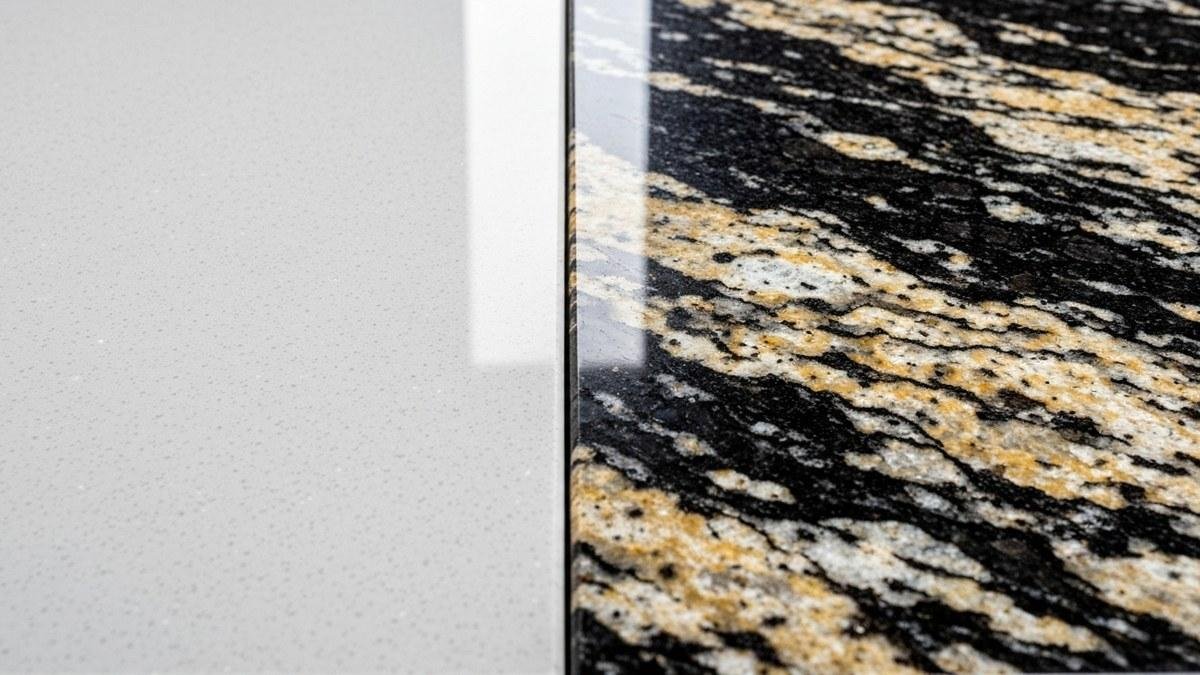
Floors are usually priced per square foot, scaled by damage and steps; countertop work — including granite countertop repair and etch removal on marble islands — is often per job, because setup dominates. The ranges below are illustrative of what Bay Area homeowners commonly see, not quotes; condition, access, and finish level move every number — hence the test spot.
How Do You Price Each Stone and What Moves the Number
Why It Matters
Marble, limestone, and travertine are calcite — efficient to hone, which is also why acids etch them. Granite is a harder silicate demanding more abrasive time. Terrazzo is stone chips in a cement or epoxy matrix. Identical pricing across them is a tell.
A Strong Answer Sounds Like
A breakdown naming your stone and its consequences — travertine quotes asking about open holes and fill, terrazzo quotes discussing patching before grinding, granite quotes pricing its slower cut honestly. Specialists reveal themselves by pricing the differences.
Walk Away If
One flat rate covers every stone, or the bidder cannot say what your surface is. A process safe on granite can be too aggressive for limestone, and an acid product that brightens one stone quietly etches the other.
Countertop Questions for Granite Marble and Engineered Stone
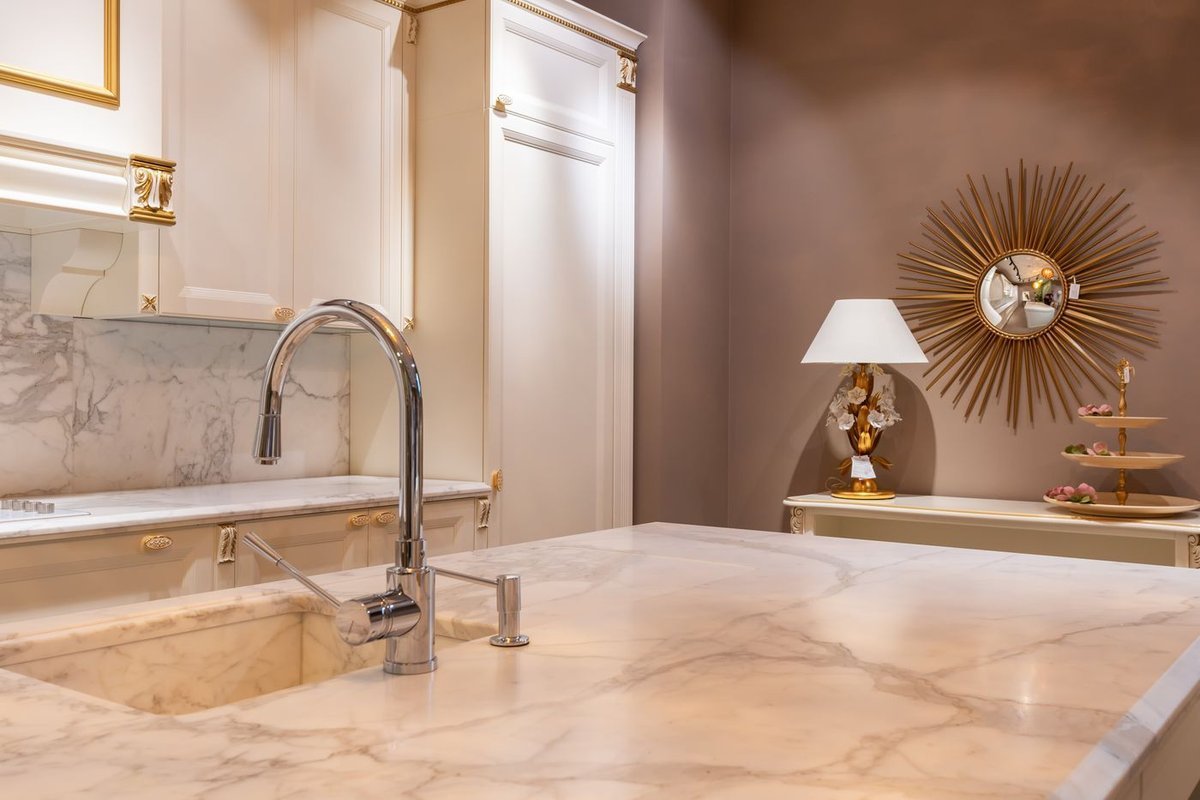
Countertops concentrate the hard cases — chips at the sink cutout, cracks near the dishwasher, opened seams, etched islands — and judgment saves the most here, since a repairable chip costs a fraction of a new slab plus tear-out and installation.
Who Repairs Chips Cracks and Seam Gaps in Countertops
Why It Matters
Countertop repair is close-up work — color-matched fills, seam re-jointing, blended spot re-polishing. The decisive detail: engineered quartz is roughly nine parts stone to one part resin, and resin scorches under heat and abrasives natural stone shrugs off.
A Strong Answer Sounds Like
Direct experience with your exact material, a described fill-and-blend chip repair, and an unprompted flag if the counter is engineered quartz, with honest limits — plus sheen matching so the patch does not read as a glossy island.
Walk Away If
Floors and counters are treated as one job with the same machines, or nobody asks whether the counter is natural or engineered. Discovering mid-job that your “granite” is quartz means burned resin — a replacement slab, not a buff-out.
Sealing and Maintenance Questions That Predict How Long the Shine Lasts
The trade’s most persistent myth lives here: an impregnating sealer slows absorption, buying time against stains — it does not make stone stainproof, adds no shine, and cannot stop etching, which attacks the surface the sealer lives below.
Which Sealer Goes On and What Does It Actually Protect Against
Why It Matters
The sealer talk is an honesty test. Impregnating penetrating sealers are the standard for polished interior stone; topicals bring back the coating cycle. What it cannot do matters most — “sealed” marble that etches under a lemon is working as designed.
A Strong Answer Sounds Like
A named impregnating product, a reseal interval framed as use-dependent, and the unprompted admission that sealing slows stains but cannot stop etching — the myth conceded before you ever ask about it.
Walk Away If
The sealer is pitched as a force field — stainproof, etch-proof, maintenance-free — or an annual sealing contract is pushed without testing need. Overselling protection is the tell of a company planning to be gone before the first lemon finds the island.
What Maintenance Plan Keeps the Finish From Failing Early
Why It Matters
Cleaning decides how long the finish lasts, and the most common damage we see is self-inflicted — vinegar and harsh cleaners dull polished calcite one mopping at a time, a slow-motion etch nobody connects to the bottle.
A Strong Answer Sounds Like
A written care sheet — pH-neutral cleaner, walk-off mats, felt pads, fast wipe-ups — and a cycle where a light re-polish every few years costs a fraction of full restoration. Our guide to maintaining natural stone floors covers the homeowner’s half.
Walk Away If
Aftercare never comes up, or the advice is “any floor cleaner is fine.” A restorer indifferent to what touches the floor after they leave is pricing their next visit, not protecting your finish.
One limit deserves its own line.
When Restoration Beats Replacement and When to Walk Away

Restoration usually wins on money: repolishing an existing floor costs a fraction of demolition, disposal, new material, and installation — and for period homes with stone no longer quarried, the original floor is irreplaceable at any price. Replacement earns its cost when the stone has structural problems restoration cannot reach.
When Would You Tell Me to Replace Instead of Restore
Why It Matters
It invites the company to argue against its own invoice. Real limits exist — tiles cracked through from a failed substrate, stone ground too thin by past work, hollow-sounding delamination, moisture from below. Restoring over these decorates a failing base.
A Strong Answer Sounds Like
A short specific list like that one, ideally with a job they declined, and a willingness to tap-test and check the substrate before promising anything. Knowing where restoration stops earns trust inside its boundaries.
Walk Away If
Everything is restorable and nothing gets inspected first. The mirror image fails too — the replacement-happy remodeler who has never restored stone and quotes tear-out for damage a honing pass would erase.
Put the Checklist in Your Pocket Before the First Walkthrough
Make every bidder answer the same questions, in the same order. Print the one-page Stone Restoration Readiness Checklist and bring it to every walkthrough — the facts to gather about your stone, plus these ten questions in short form, with room to write each company’s answers side by side, where a vague answer rarely survives next to a grit-by-grit one.
Earlier in the process — unsure what your stone is or whether restoration is the right call — start with our Before You Restore Your Stone page — it pairs with the checklist and this guide as a complete pre-hire kit.
Book a Stone Assessment You Can Actually Compare
Ask these ten questions of every bidder, write the answers down, and the right company usually identifies itself — the one reading your etches out loud, offering the test spot unprompted, and saying plainly what a sealer will not do.
We are happy to be interviewed with the whole list. Top Tier Building Services Inc. is a Castro Valley based general contractor serving the Bay Area — licensed, bonded, and insured, with workers’ compensation coverage, under California General Contractor License #1146790. Call 510-470-1870, email sales@toptierbuildingservices.com, or request an estimate — or start with the checklist and our natural stone polishing and restoration page, and call when the answers start mattering.
FAQs
What questions should I ask a stone restoration company first?
Start with the two that filter fastest: their California license number, verifiable on the CSLB site in minutes, and whether your marks are etching or staining. One confirms they can legally do the work; the other shows whether they diagnose stone or sell a one-size process.
How much does stone restoration cost per square foot?
For floors, Bay Area homeowners commonly see per-square-foot pricing in the low single digits for light re-polishing, climbing into the low teens with deep etching, lippage, or multiple abrasive steps. Countertop work is usually per job. Every figure is condition-dependent; a test spot and written scope beat numbers quoted from photos.
Can etched marble be repaired without replacing it?
Yes, in almost all cases. Etching is surface damage — acid dissolving a thin layer of the calcite — so honing removes the damaged layer and repolishing restores the sheen. Light etching sometimes responds to marble polishing powder; deep or widespread etching calls for professional diamond work.
Is marble polishing the same as waxing?
No. True marble polishing refines the stone itself with diamond abrasives until flat and reflective. Waxing applies a sacrificial gloss coating that scuffs, yellows, and eventually needs stripping — cheaper on day one, costlier every year after, while the damage underneath stays untouched.
How often should natural stone be resealed?
There is no fixed schedule — it depends on porosity, sealer, and use. Drip water on the stone: if it beads or sits unchanged the sealer works; if the stone darkens within minutes it is due. Kitchen counters come due far sooner than guest-room floors.
Do stone restoration companies need a license in California?
If the job is $500 or more in labor and materials, California requires an active CSLB contractor license — restoration jobs almost always clear that bar. Verify the number, bond, and workers’ comp status on the CSLB’s free check. Crews framing the work as “cleaning” to dodge licensing are answering your risk question for you.