
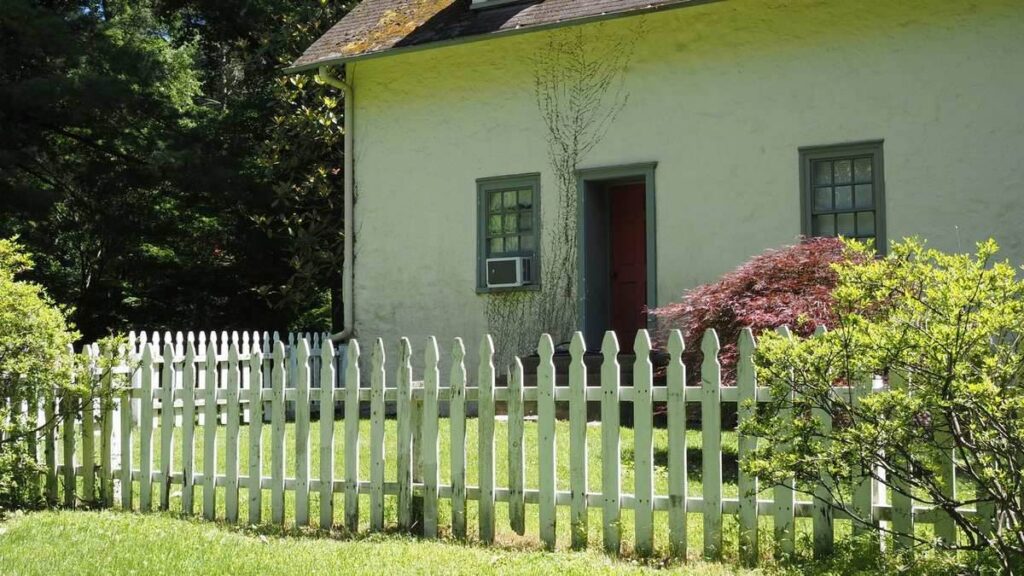
A fence that photographs beautifully may be standing on posts you could push over by hand. The fence repair decision is made at the ground line, not at the broken board — wood fences fail from the bottom up, in spots you cannot see from the patio, so a proper assessment probes each post at grade before anyone talks price.
The diagnosis takes a screwdriver, a level, and half an hour, and turns “what will this cost?” into “here is what the quote should contain.” Run the ten checks, then apply the decision math. This guide pairs with our gates and fencing service page.
Key Takeaways
- Wood fences fail from the ground line up — probe every post at grade with a screwdriver before pricing anything.
- Posts set the same day in the same soil age as a group; the count of soft posts drives the repair-or-replace call.
- Repairs price per item and replacement prices per foot — once roughly a quarter to a third of the posts fail, the two numbers converge fast.
- California Civil Code section 841 presumes neighbors share boundary-fence costs equally, but only after a written 30-day notice.
- Print the Fence Repair Readiness Checklist before you call anyone — the checks and phone questions on one page.
What This Guide Covers
- Run These 10 Checks Before You Decide Anything
- What Fence Repairs Typically Cost
- How the Per-Section and Per-Foot Math Decides
- What Repair-Grade Materials Should Go Back In
- What California's Good Neighbor Fence Law Actually Says
- When a Storm Drops the Fence Overnight
- When Walking Away From Repair Is Right
- Print the Checklist Before Anyone Quotes You
- Get a Straight Answer From a Licensed Fencing Contractor
- FAQs
Run These 10 Checks Before You Decide Anything
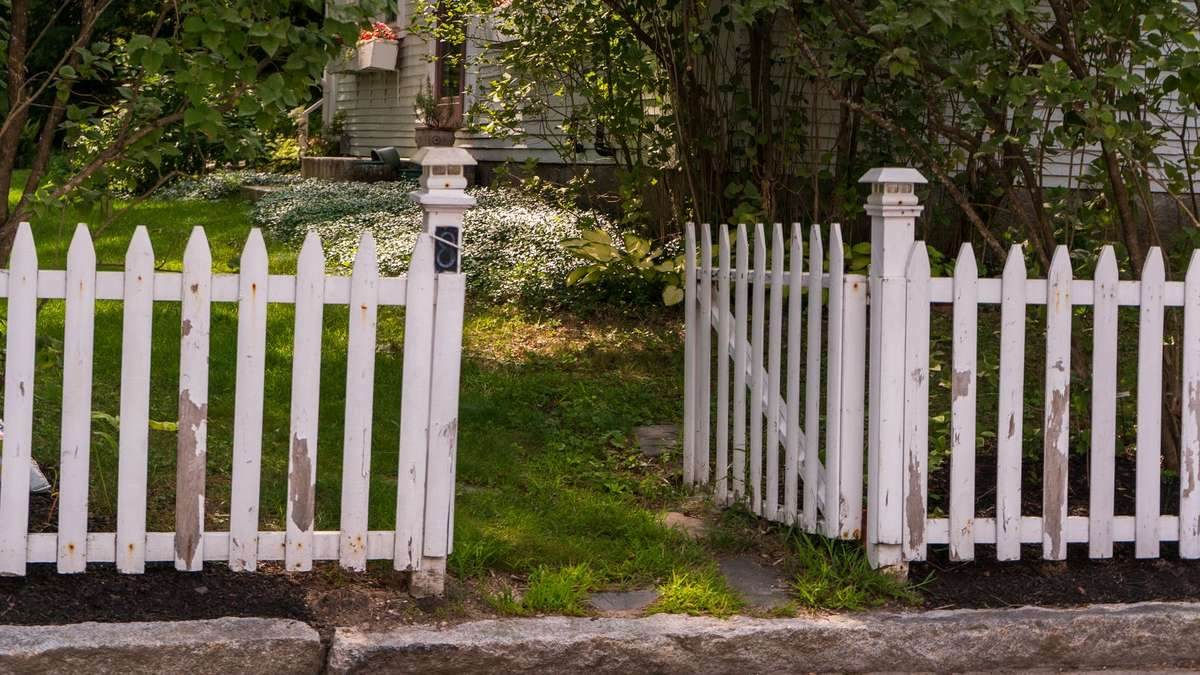
Work the list in order — posts first, because everything else hangs on them — and record what you find per post and per section; that record becomes the honest comparison for every quote you collect.
Probe Every Post at the Ground Line
What to Check
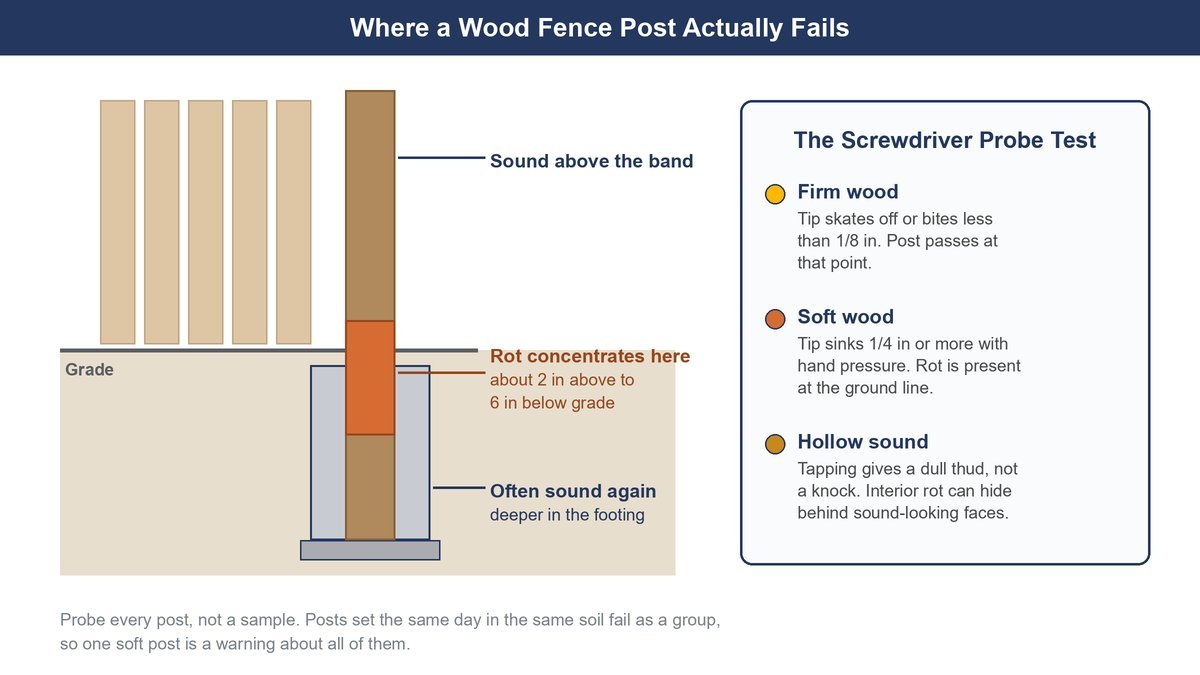
Push a flathead screwdriver into each post at the soil or concrete line, plus an inch above and below, on every accessible face. Firm wood resists; rot lets the tip sink a quarter inch or more with hand pressure.
What It Tells You
The ground line is the wet-dry cycle zone where fungus works fastest, so posts can be solid at eye level and gone at grade. The probe count, not the look of the boards, is the strongest predictor of the decision.
Rock Each Post and Read the Footing
What to Check
Grip each post at chest height and push firmly along the fence line and across it. A sound post barely moves; note any post that shifts at the ground, and any gap or crumbled ring where post meets concrete.
What It Tells You
Movement with solid wood means the footing failed — undersized, shallow, or heaved — and setting a new post the same way buys the same failure. Soft wood plus movement is rot, and the post is done regardless of the footing.
Sight the Line for Lean and Sag
What to Check
Stand at one end and sight down the top of the fence like a rail. Note where the line dips or drifts off plumb, then hold a level against the posts in that stretch to find where the lean starts.
What It Tells You
A uniform lean across many sections usually means wind load on shallow footings or a soil problem; an isolated lean traces to one or two failed posts. The distinction decides between a post swap and a structural rebuild.
Check the Rails Where They Meet the Posts
What to Check
Inspect the horizontal rails at each post connection — end grain soaks up water, so rot starts inside the joint. Lift each rail gently; movement, crushed fibers, or fasteners pulling free mean the connection has quit even if the rail body is sound.
What It Tells You
Failed rail ends on sound posts is one of the best repair-side findings — hangers and new rails are cheap and durable. Rails sagging across multiple sections usually mean the boards are carrying weight the structure no longer holds.
Read Weathering Against Rot on the Boards
What to Check
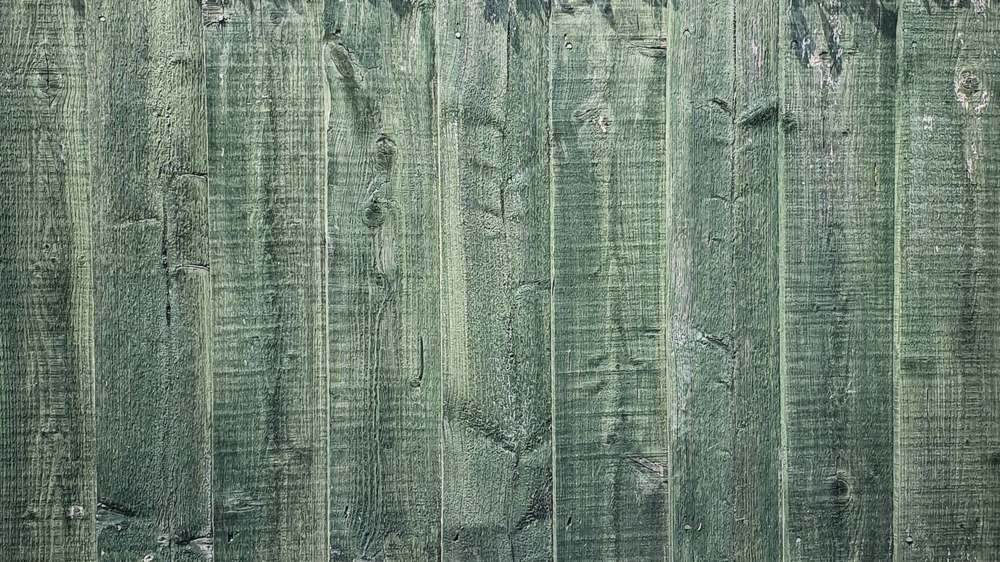
Gray, rough, even discoloration is weathering — cosmetic and stain-reversible. Probe anything soft, dark in patches, or sprouting fungus, especially board bottoms near soil or sprinkler reach, and count boards that are cupped, split through, or missing.
What It Tells You
Boards are the loudest part of a fence and the least structural. Tired boards on sound posts can be re-faced for a fraction of replacement; new boards nailed to soft posts are a cosmetic loan repaid with interest.
Inspect the Hardware for Rust and Pull-Out
What to Check
Look at hinges, latches, rail hangers, and visible fasteners for red rust, streaking, and heads that have popped or pulled through. A black or white crust around a fastener head is corrosion’s early stage.
What It Tells You
Plain steel corrodes against the copper compounds in modern pressure-treated lumber, so hardware can fail decades before the wood. Rusted hardware on sound wood is a cheap, high-value repair — and a flag to ask what new work will be fastened with.
Swing the Gate and Watch the Latch
What to Check
Open the gate, release it mid-swing, and watch. Check whether the latch aligns, the far corner drags, and the hinge post moves when the gate loads it — a sagging frame shows as a parallelogram.
What It Tells You
The gate is the fence’s fuse — it carries live load all day, so it fails first. A dragging gate on a plumb post is a hardware or bracing fix; a hinge post that leans under load is a post problem no latch adjustment cures.
Look for Soil and Sprinkler Contact
What to Check
Walk the line for mulch, planter beds, or graded soil piled against boards, and for irrigation heads that wet the fence every cycle. Note vegetation holding moisture against the wood and any downspout discharging along the line.
What It Tells You
Boards touching soil rot from the bottom edge up, years ahead of schedule, and a sprinkler misting one section daily prints a rot map along the line. These are causes — fix them or the repair inherits the same fate.
Count the Failing Sections Against the Whole
What to Check
Total the findings: posts that failed the probe or push test, sections that lean, rails and boards gone. Express it as a fraction of the run — three posts of thirteen — rather than a list of complaints.
What It Tells You
The fraction is the decision input. Damage clustered in one stretch — a fallen limb, one wet corner — argues repair. Failure distributed along the whole line means the fence is aging as a system, and this year’s repairs are a down payment on next year’s.
Separate Storm Damage From Slow Failure
What to Check
After wind damage, look at where the breaks happened. Panels blown off sound posts, cracked boards, and popped fasteners are impact damage. For posts snapped cleanly at the ground line, inspect the broken cross-section for dark, spongy wood.
What It Tells You
Sound pressure-treated posts rarely shear at grade; wind finds rot that was already there. That widens the repair scope — the “surviving” neighbors are from the same cohort — and changes the insurance conversation, since policies treat wind damage and rot very differently.
One habit sharpens every check above.
What Fence Repairs Typically Cost
Illustrative Bay Area planning ranges, not quotes — access, soil, material choice, and haul-away move every number; only a written estimate counts. The ladder’s shape matters more than any single figure: everything above the post line is minor money.
Post replacement costs what it does because breaking out the old footing is small-scale demolition — and the anchor row is why replacement quotes arrive per linear foot while repair quotes arrive per item.
How the Per-Section and Per-Foot Math Decides
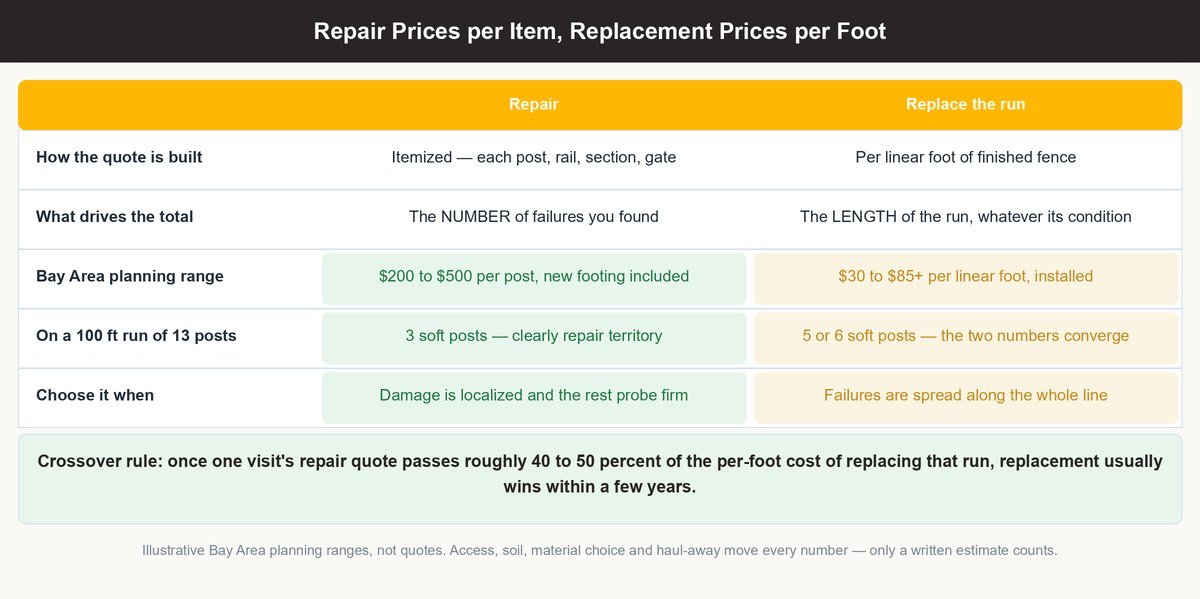
Repair pricing is itemized, so it scales with the number of failures; replacement pricing is per foot, so it scales with length regardless of condition. On a 100-foot run with thirteen posts, three failed posts at a few hundred dollars each is clearly repair territory. The same fence with five or six soft posts is approaching half the cost of a new pressure-treated fence — for a result that still has old boards, old rails, and seven more posts of the same vintage.
That last clause is the key: posts set the same day, in the same soil, at the same treatment level age as a cohort — this year’s three failures sit on the same curve as next year’s five. A useful rule: when one visit’s quote crosses roughly 40 to 50 percent of the per-foot cost of replacing that run, replacement usually wins within a few years; failures spread along the line weight the math further that way. Repair earns its keep when damage is localized, the posts pass the probe, and the style is worth preserving.
What Repair-Grade Materials Should Go Back In
A repair is only as durable as what goes into the hole. For posts, the spec that matters is ground-contact pressure-treated lumber — a tag reading Use Category UC4A or better certifies treatment for wood in soil contact. Above-ground-rated stock in a footing is the classic reason a “new” post fails within a handful of years.
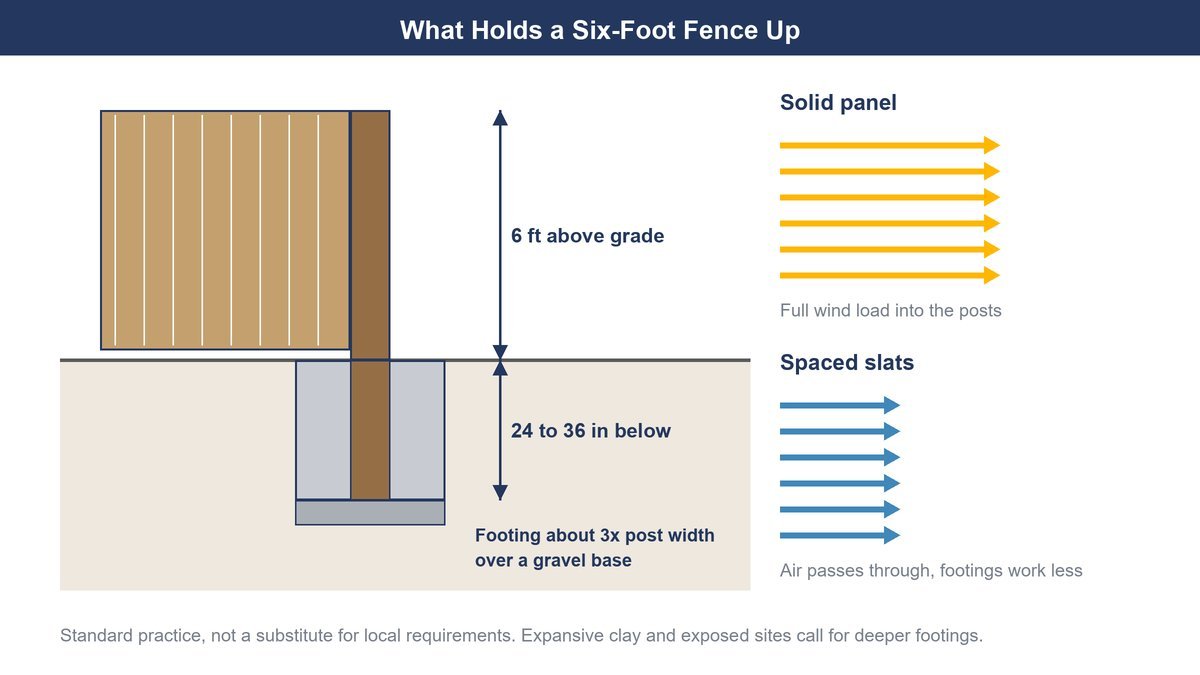
Footing depth follows the fence, not the shovel: a common standard for a six-foot fence is 24 to 36 inches below grade — roughly a third of the post’s height — in a hole three times the post’s width, over gravel so the end grain never sits in a puddle, with the concrete crowned to shed water away from the wood. Fasteners and hangers should be hot-dipped galvanized or stainless, rated for treated lumber. In the East Bay hills, where winter-saturated clay heaves shallow footings, skimped depth is how a repaired fence returns to lean.
What California’s Good Neighbor Fence Law Actually Says
If the fence sits on a shared boundary, California Civil Code section 841 — the Good Neighbor Fence law — presumes adjoining owners benefit equally from it and are equally responsible for the reasonable costs of building, maintaining, and replacing it. The presumption is real leverage with a procedure attached: before starting work you must give each affected neighbor at least 30 days’ written notice, and a neighbor can rebut the equal split in court by showing it would be unjust — financial hardship, say, or a project priced beyond what the situation calls for.
The practical translation: talk first, paper second, build third. A neighbor who sees your probe notes and a clear written notice usually splits the bill; one handed an invoice after the fact has legal room to refuse. Keep the project reasonable and keep copies of everything.
When a Storm Drops the Fence Overnight
Photograph everything before you move a single panel — breaks, lean angles, the limb still on the fence — because insurer and neighbor will both want the scene, not the cleanup. Make it safe without rebuilding: lean panels back, rope off anything unstable, and resist nailing a blown panel to posts you have not probed — then read the breaks the way check ten describes, because rot revealed by wind widens the scope beyond the visible gap.
On insurance: fences typically fall under other-structures coverage, commonly capped near ten percent of the dwelling limit; standard policies generally cover sudden wind and exclude gradual rot — read yours before assuming. If the fence is shared, start the section 841 conversation the same week: with a 30-day notice clock, a neighbor cost-share and a fast rebuild cannot both happen unless the paperwork starts now.
When Walking Away From Repair Is Right
Some findings end the repair conversation regardless of price. Untreated posts set directly in soil — common in older DIY fences — put every post on the same countdown, and replacing them one by one is the most expensive way to build a new fence. A failure fraction past a quarter to a third of the posts lands on the wrong side of the math above. A discontinued board profile means every patch reads as a patch, and a fence predating current height or corner-visibility rules may need rebuilding to today’s standards once permits enter the picture.
Material and style choices — board orientation, species, toppers, how fence meets gate — are covered in our guide to choosing materials and style for your gate and fence, and our automatic gates and fencing service page shows how we build the replacement so the next probe test comes back firm.
Print the Checklist Before Anyone Quotes You
The Fence Repair Readiness Checklist compresses everything above onto one printable page — the ten checks in order, blanks for the facts an estimator will ask — fence length, post count, probe results, gate behavior — plus the questions worth asking back. Vague answers survive phone calls; they do not survive paper.
Before booking anyone, spend two minutes on the state’s CSLB license check to confirm the license, bond, and workers’ compensation status of whoever will swing a post-hole digger on your property.
Get a Straight Answer From a Licensed Fencing Contractor
Run the checks, write down the count, and every quote you collect becomes comparable — including ours. Top Tier Building Services Inc. is a Castro Valley based general contractor building and repairing fences and gates across the Bay Area — licensed, bonded, and insured, with workers’ compensation coverage, under California General Contractor License #1146790. Call 510-470-1870, email sales@toptierbuildingservices.com, or request a visit — we will probe the posts with you, show you what we find, and put repair and replacement numbers side by side in writing.
FAQs
How much does fence repair cost?
For wood fences locally, small repairs — boards, rails, gate hardware — commonly run $150 to $450 per visit, while post replacement with a new footing commonly runs $200 to $500 per post. Full replacement runs roughly $30 to $85+ per linear foot by material — planning ranges only; insist on a written itemized estimate.
Should I repair or replace my fence?
Count the posts that fail a screwdriver probe at the ground line. Failures under roughly a quarter of the posts, clustered in one area, favor repair; failures spread along the line, or a repair quote near half the per-foot cost of replacement, favor replacing the run.
Who pays for a fence between neighbors in California?
California Civil Code section 841 presumes adjoining owners benefit equally from a boundary fence and share reasonable costs equally. You must give each affected neighbor 30 days’ written notice describing the problem, solution, estimated cost, split, and timeline — and a court can adjust the split if an equal share would be unjust.
How deep should fence posts be set?
A common standard for a six-foot fence is 24 to 36 inches below grade — roughly one-third of the post height — in a hole three times the post width, over gravel, with the concrete crowned to shed water. Expansive clay and windy sites justify the deeper end.
Why do fence posts rot at the ground line?
The few inches above and below grade stay in a constant wet-dry cycle with plenty of oxygen — exactly the conditions decay fungi need. Deeper wood is wetter but oxygen-starved, and higher wood dries quickly, so rot concentrates in that narrow band.
Does homeowners insurance cover fence storm damage?
Often, under the policy’s other-structures coverage, commonly capped near ten percent of the dwelling limit. Sudden wind damage is generally a covered peril on standard policies, while gradual rot and deterioration are excluded — which is why photographing breaks before cleanup matters. Check your own policy’s terms and deductible first.