Here is the number most homeowners actually want first. The cost to install tile floor runs about $10 to $50 per square foot installed, according to national cost-guide data from HomeGuide. Materials account for roughly $2 to $30 of that. Labor accounts for $8 to $20. A typical 200-square-foot floor lands between $2,000 and $10,000, with the national average near $6,000.
Notice something in those numbers. The tile itself is the part everyone shops for, yet it is often the smaller half of the bid. Two homeowners can buy the exact same boxes of porcelain and get quotes thousands of dollars apart. The difference is almost never the tile. It is the hours. It is what the crew finds under the old floor. It is how many cuts the layout forces.
This guide breaks the bid into its real line items so you can read a quote the way a contractor writes one. We install tile and stone floors across the East Bay every week, so we will also flag where regional labor rates and older housing stock change the math.
Key Takeaways
- Expect $10 to $50 per square foot installed, with most straightforward porcelain and ceramic floors landing in the middle of that band.
- Labor runs $8 to $20 per square foot and is the most variable line, moved by tile size, layout pattern, and room shape rather than by the tile’s price tag.
- Old floor removal adds $2 to $7 per square foot, and subfloor repair or replacement adds roughly $2.20 to $4.75 more where it is needed.
- Small rooms cost more per square foot than big open ones, which is why bathroom floors run $400 to $8,000 and kitchens $1,300 to $9,200.
- The cheapest insurance on the whole project is a line-item bid from a licensed contractor, with demo, prep, materials, and labor priced separately.
What This Guide Covers
- What a New Tile Floor Costs Right Now
- Why the Labor Line Decides the Bid
- The Four Line Items Inside Every Tile Bid
- Subfloor Prep Is Where Bids Really Grow
- Bathroom and Kitchen Floors Price Differently
- Tile Material Changes the Per Square Foot Math
- Where You Live Moves the Number
- How to Keep a Tile Bid Under Control
- Get a Real Number for Your Floor
- FAQs
What a New Tile Floor Costs Right Now
The honest answer is a range, because tile pricing is really three prices stacked together. The tile and setting materials run $2 to $30 per square foot. Labor runs $8 to $20. Removal of whatever is there now adds $2 to $7 more. Stack those and you get the $10 to $50 installed band that national data supports.
Project totals scale from there. A 50-square-foot laundry room or entry might run $500 to $2,500. A 200-square-foot main area typically lands between $2,000 and $10,000. Push past 300 square feet of mid-grade porcelain and you are usually in five figures once demo and prep join the bid.
Why the Labor Line Decides the Bid
Tile is a commodity. Anyone can price a box of ceramic at a supply house within a few dollars. Labor is not a commodity. It is a skilled-trade hourly rate multiplied by how long your specific floor takes, and that is where bids truly separate.
Three things stretch the hours. First, tile size. Very small tile and mosaic mean more pieces per square foot. Very large tile means careful handling and a floor flat enough to support it, which we cover below. Second, the pattern. A straight grid lays fast. Herringbone, Versailles, and diagonal layouts multiply the cuts, and every cut is minutes at the saw. Third, the room itself. A rectangle is quick. A floor broken up by cabinets, closets, doorways, and a toilet flange forces fitted cuts at every edge.
This is why the same tile can cost $12 per square foot installed in one house and $25 in another. You are not paying for the tile twice. You are paying for the geometry.
The Four Line Items Inside Every Tile Bid
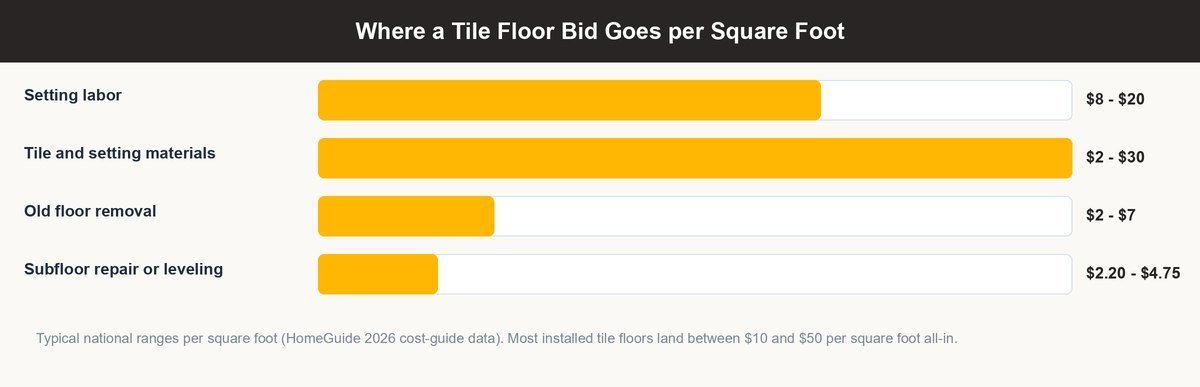
A trustworthy tile quote is really four smaller quotes. Here is what each one covers and the range each should land in, so you can spot the line that is out of step.
Old Floor Removal and Haul Away
What Demo Actually Involves
Tile removal costs $2 to $7 per square foot because old thinset bonds to the slab or subfloor and has to be ground or chipped off, bagged, and hauled. Carpet tear-out is far cheaper at under $2 per square foot. If a bid buries demo inside one lump sum, ask for it broken out, because it is also the line you can sometimes take on yourself.
Subfloor Repair and Leveling
The Line Nobody Can Price Blind
No contractor knows the subfloor’s condition until the old floor is up, so this line often appears as an allowance. Replacing damaged subfloor runs about $2.20 to $4.75 per square foot on the affected area. An honest bid states the assumption in writing and prices the overage per square foot up front, instead of surprising you mid-job.
Tile and Setting Materials
More Than the Boxes of Tile
The materials line covers the tile plus everything that bonds it, which is where $2 to $30 per square foot comes from. Thinset, backer board or uncoupling membrane, leveling clips, grout, and sealer ride along with every job. Budget tile with quality setting materials outlasts premium tile set over the wrong prep, so this is a poor line to squeeze.
Setting Labor and Finish Work
Where the Skilled Hours Live
The $8 to $20 per square foot labor line covers layout, cutting, setting, grouting, and sealing, and it rewards experience you can see for decades. Flat joints, full mortar coverage, and straight grout lines are all set in a single working session. Grout that is mixed or timed wrong fails early, which is exactly the work worth paying a proven crew to do right.
Subfloor Prep Is Where Bids Really Grow
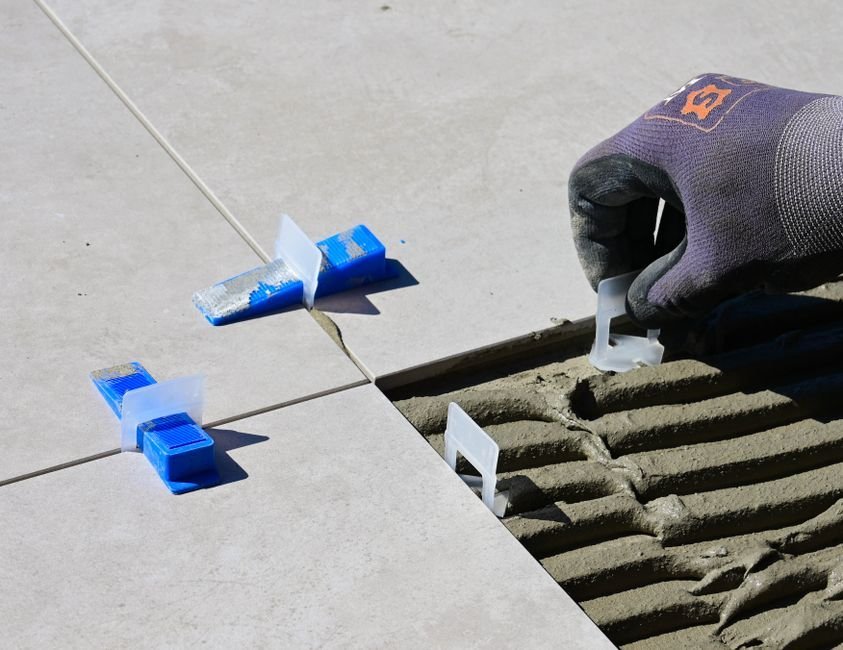
Ask any tile setter where budgets go sideways and you will hear the same word. Underneath. Tile is rigid. It does not bend, so it demands a base that does not bend either. Water damage near an old toilet, a slab that dips, or a plywood deck with popped fasteners all have to be corrected before the first tile is set.
Flatness is a written standard, not a preference. Industry standards published by the Tile Council of North America allow only small deviations, and the allowance tightens as tile gets bigger. That matters right now because large-format tile is what most homeowners are choosing. The floor that carried 12-inch squares fine may need leveling compound before it can honestly carry 24-inch planks.
Leveling clips like the ones above control lippage between neighboring tiles while the thinset cures. What they cannot do is fix a wavy floor. Flattening happens first or the clips just lock the waves in place. On our own flooring projects, subfloor preparation and leveling, along with moisture testing, is standard scope rather than an upsell, and any bid you accept should treat it the same way.
Bathroom and Kitchen Floors Price Differently
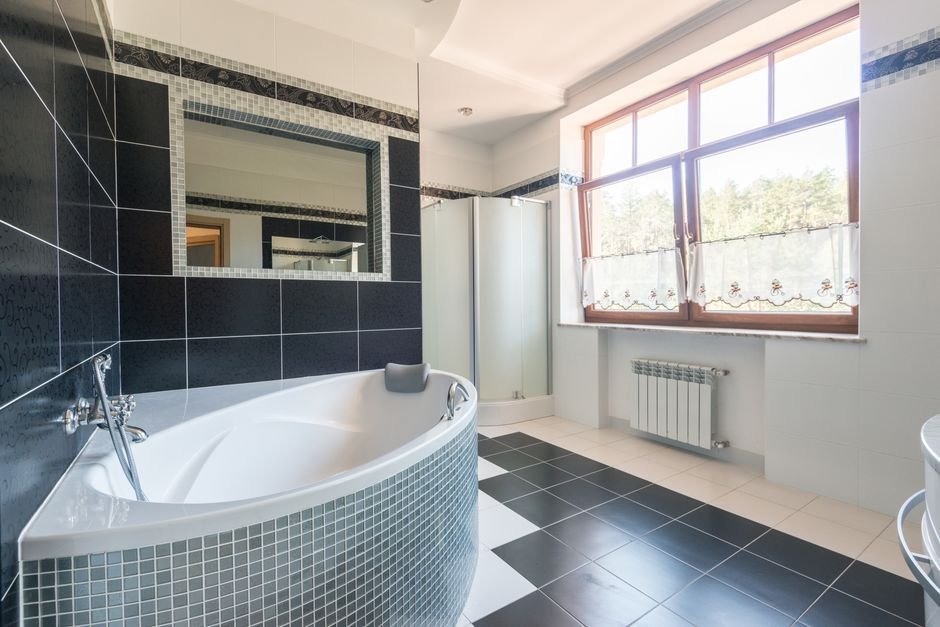
Room type moves the number more than most people expect, and not in the direction intuition suggests. Small rooms cost more per square foot, not less.
A bathroom floor concentrates everything slow about tile work into a few dozen square feet. The toilet comes out and gets reset. Cuts wrap the tub, the vanity, and the door casing. The same fixed setup time gets spread over far fewer feet. Kitchens add their own friction, since appliances have to move and the finished floor has to meet cabinets and thresholds cleanly.
If your tile project is walls or a shower rather than a floor, treat that as its own scope with its own math. Wet-area work adds waterproofing steps that floor pricing does not include.
Tile Material Changes the Per Square Foot Math

The material you pick sets the floor of your budget before labor is even discussed. These installed ranges include labor and give a fair sense of how the tiers stack.
Porcelain earns its premium in kitchens, baths, and entries because it absorbs almost no water and shrugs off traffic. Natural stone is beautiful and permanent, but it adds ongoing sealing to the ownership cost, and soft stones like marble scratch in gritty entryways. Ceramic remains the value pick for most bedrooms and low-splash areas.
Where You Live Moves the Number
Every range above is a national figure, and your zip code tilts it. Materials barely change by region, since a box of porcelain costs what it costs. Labor changes a lot. In high-wage metro areas, the labor line, not the tile line, carries the premium, and here in the Bay Area that effect is as visible as anywhere in the country. A floor that prices mid-band nationally can land in the upper half of the range in Oakland, Fremont, or San Jose simply because skilled-trade hours cost more.
Older local housing stock adds its own twist. Pre-war homes around Berkeley and Alameda often hide plank subfloors and out-of-level framing that newer suburbs do not, which feeds the prep line we covered above. Straight tile replacement is finish work and usually does not trigger a building permit, but the moment a project grows into plumbing moves or structural subfloor repair, permit rules apply and they differ city by city. Confirm with your local building department before demo, not after.
How to Keep a Tile Bid Under Control
You have more leverage over this number than the ranges suggest. Most of it is spent before anyone kneels on the floor.
Pick a standard tile size and a simple layout if budget is the priority, since a straight-set 12-by-24 porcelain floor is dramatically cheaper per hour than a herringbone of the same tile. Handle the tear-out yourself if you are able, because demo is real savings at $2 to $7 per square foot and requires sweat rather than skill. Get every bid broken into demo, prep, materials, and labor so you can compare the lines instead of the totals. Confident DIYers can go further, and our step-by-step guides on how to tile a floor and how to grout tile show exactly what the labor line buys, which is also the best way to decide whether you want to buy it.
Finally, verify the license. California lets you check any contractor’s license on the CSLB site in under a minute, and an unlicensed bargain bid stops being a bargain the first time a subfloor problem appears.
Get a Real Number for Your Floor
Ranges get you oriented, but your floor has an exact number, and it depends on what is under the old flooring, the tile you choose, and the layout you want. Top Tier Building Services installs tile and natural stone flooring across the East Bay and greater Bay Area, with subfloor preparation, leveling, and moisture testing as standard scope on every job. We are licensed (CSLB #1146790), bonded, and insured, and our flooring team prices bids the way this guide reads them, line by line. Reach out for a free estimate and get a number you can hold a bid to.
FAQs
How much does it cost to install tile floor per square foot?
Expect $10 to $50 per square foot installed. That breaks into roughly $2 to $30 for tile and setting materials and $8 to $20 for labor. Most straightforward ceramic and porcelain floors land in the middle of the band, while natural stone, glass, and complex patterns push toward the top.
What is the labor cost to install tile floor only?
Labor alone runs about $8 to $20 per square foot nationally. The rate climbs with small mosaic tile, large-format tile, diagonal or herringbone patterns, and choppy rooms with many cuts. In high-wage regions the labor line can sit above the national band even for a simple layout.
How much does it cost to install tile floor in a bathroom?
A bathroom floor typically runs $400 to $8,000 depending on size, tile choice, and what the demo reveals. Bathrooms cost more per square foot than open rooms because the toilet is removed and reset, and cuts wrap the tub, vanity, and doorway.
How much does it cost to install tile floor in a kitchen?
Kitchen floors typically run $1,300 to $9,200 at 130 to 184 square feet. Appliance moves, cabinet edges, and thresholds add fitting time, and kitchens are a natural fit for mid-range to premium porcelain, which nudges the materials line up.
Is it cheaper to install a tile floor yourself?
Yes, on paper, because you save the $8 to $20 per square foot labor line. In practice you take on tool costs, a learning curve, and the risk that an out-of-flat subfloor turns into cracked grout. DIY works best on small, simple, dry-area floors over a sound, flat base.
Why do tile installation bids vary so much between contractors?
Mostly scope, not greed. One bid includes demo, subfloor allowances, and materials while another quotes labor only over an assumed perfect floor. Layout assumptions and subfloor allowances differ too. Ask every bidder for the same four lines, demo, prep, materials, and labor, and the spread usually shrinks fast.