When it comes to high-end home renovations in the Bay Area, standard gray garage floors are increasingly being replaced by something far more dramatic. Metallic epoxy garage floors have become the gold standard for homeowners looking to transform a utilitarian space into a luxury showroom. But with a price tag that sits above traditional flake systems, many ask: is the investment worth it?
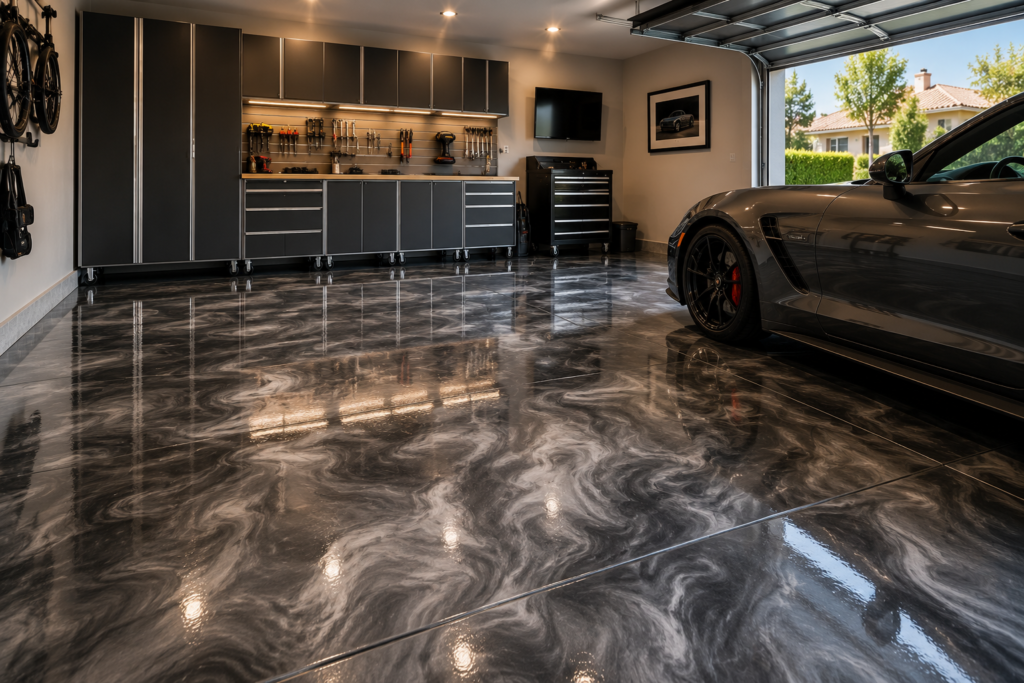
Unlike standard coatings, metallic systems are a form of art. By suspending metallic pigments in clear resin, installers create floors that mimic the look of flowing lava, hammered metal, or swirling marble. In this guide, we will analyze the technical benefits, the unique installation requirements, and the long-term value to help you decide if this high-end upgrade fits your project.
What Exactly is Metallic Epoxy?
Metallic epoxy is not a single material but a specialized application technique. It involves adding tiny, pearlescent metallic pigments into 100% solids epoxy. During the curing process, these pigments are manipulated—either by the installer’s hand or through chemical reactions—to create a three-dimensional depth that is impossible to achieve with paint or flakes.
Are Metallic Epoxy Garage Floors Worth the Higher Cost?
To answer this, we have to look at the ‘three pillars’ of value: durability, aesthetics, and property appreciation.
Technical & Financial Breakdown
Why the Price is Higher: The Labor Factor
The higher cost of metallic systems isn’t just due to the pigments. It is the labor. Unlike a flake floor where the chips hide imperfections, metallic floors are unforgiving. The concrete must be ground to a perfect finish, and the installer must act as an artist, using solvents or air tools to ‘move’ the metallic veins into the desired pattern. This level of craftsmanship is reflected in the final invoice.
Metallic Floors in the Bay Area
In California, luxury buyers often look for ‘indoor-outdoor’ transitions. Metallic epoxy allows for a seamless flow from a modern interior to a showroom-quality garage. However, because these floors are high-gloss, we always recommend an anti-slip additive in the final topcoat to ensure safety during the rare rainy Bay Area days.
Full pricing ranges for metallic systems are included in our Bay Area epoxy flooring cost guide. Understanding the difference between a standard coat and a luxury finish is key to setting a realistic budget.
Conclusion
If your goal is pure utility, a standard flake system is likely the better choice. But for those who view their garage as an extension of their home’s design—or as a showcase for their vehicles—metallic epoxy is worth every cent of the premium. It is the intersection of industrial strength and fine art.