
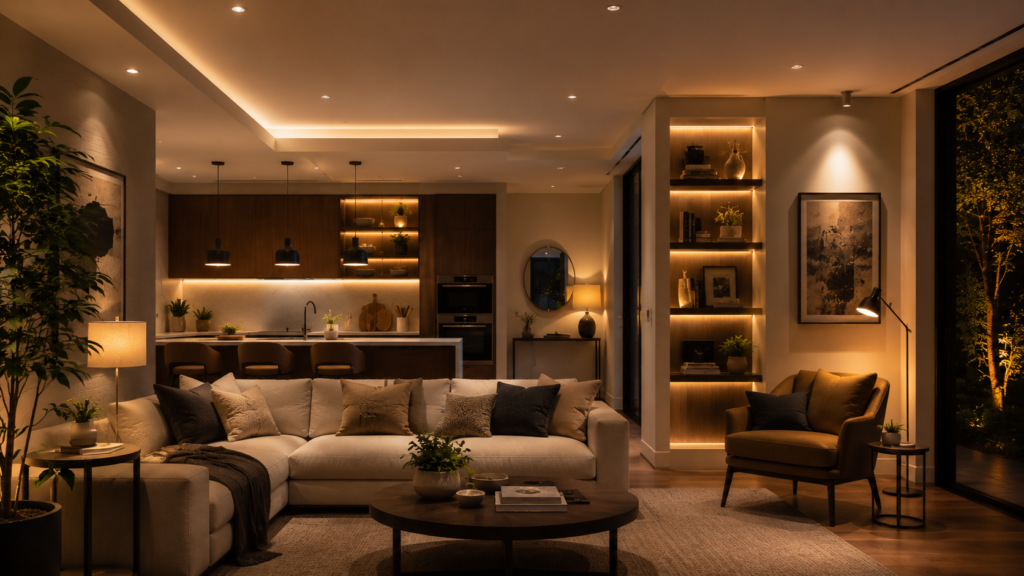
A well-lit room almost never comes from a single fixture. Layered lighting — the design technique behind every space that looks effortless on a magazine page — combines three layers: ambient (the general wash that lets you move through the room), task (focused light for what you’re doing), and accent (the finishing notes that draw the eye to art, texture, or architecture). If you’ve ever wondered why your living room feels flat with one bright ceiling light, this is the answer. Learning how to layer lighting in a home is the single biggest upgrade most homeowners can make without touching the walls. This guide walks through each layer, room by room, and the mistakes that quietly ruin otherwise beautiful spaces. For broader context, see our complete Bay Area lighting design guide.
TL;DR: The Three Layers in One Sentence Each
- Ambient is the soft, blanket-like light that fills the room — recessed downlights, surface fixtures, daylight.
- Task is higher-output, focused light for a specific activity — under-cabinet strips, pendants over an island, vanity sconces, reading lamps.
- Accent is narrow-beam, directional light that highlights art, texture, or architecture — picture lights, track heads, integrated cabinet lighting, toe-kick.
The trick isn’t picking one — it’s putting all three on dimmers and letting them work together.
The Ambient Layer: Your Base Coat
Ambient lighting is the foundation — the light you barely notice, soft and diffused, coming from multiple sources rather than one fixture overhead. For most rooms that means wide-beam recessed downlights (60° or wider) spaced for overlap, surface-mounted fixtures with frosted lenses, or indirect light bounced off a ceiling. Daylight counts too — on a good Bay Area afternoon, it’s the best ambient source you’ll ever install.
Two numbers matter. Color temperature for residential ambient should sit between 2700K and 3000K — warm enough to feel like home, not a dentist’s office. And lumens, not watts, is how you measure brightness now that LEDs have made wattage meaningless. A 9W LED at 800 lumens replaces a 60W incandescent.
Ambient alone is rarely enough. A room lit only with recessed cans feels flat — bright at the floor, dark at the walls.
The Task Layer: Light Where You Actually Need It
Task lighting illuminates surfaces where you do something specific. It runs at higher lumens than ambient — generally 300 to 500 lumens at the work surface — using medium beam angles (25° to 40°) that put light where it’s wanted without spilling across the room.
A few examples done right:
- Under-cabinet LED strips mounted toward the front of the cabinet so light falls on the counter, not the backsplash.
- Pendants over a kitchen island, hung 30–36 inches above the countertop to light the surface without blinding people across from them.
- Vanity sconces at face height (60–66 inches off the floor) on either side of the mirror — never overhead. Overhead vanity light casts shadows under the eyes, nose, and chin.
- Desk and reading lamps sized to the task, with shades that direct light down.
Task layers can run slightly cooler than ambient — 3000K to 3500K suits kitchens, baths, and offices. Anything 4000K or above reads as commercial; reserve it for garages and utility rooms.
The Accent Layer: The Finishing Notes
Accent lighting is what makes a room look designed — directional, narrow, intentional. Light placed to draw the eye to art, a fireplace surround, a millwork detail, or a textured wall.
The defining number is beam angle. Accent fixtures use narrow beams of 5° to 15° that concentrate light into a tight pool. The rule most designers use: accent should be three to five times brighter than the surrounding ambient light. Anything less and the eye doesn’t notice.
Common moves: adjustable track heads aimed at artwork, picture lights above framed pieces, low-voltage lighting inside glass-front cabinets, toe-kick strips along islands and vanities, and LED tape in a cove or millwork reveal.
Accent is also where smart home lighting controls earn their keep. A scene button that brings ambient to 30%, task off, and accent to full is the difference between a kitchen at 7 p.m. and an evening room you want to sit in.
A Room-by-Room Application
Layering works the same way everywhere, but the fixtures change.
Kitchen. Ambient from recessed downlights or integrated ceiling cove lighting. Task from under-cabinet strips and pendants over the island. Accent from toe-kick strips, in-cabinet lighting behind glass doors, and an occasional spot on art or a hood. Kitchens are used in three completely different modes — cooking, eating, hanging out — and only layered light can serve all three. Our team handles kitchen lighting during full house renovations and dedicated lighting design and electrical projects.
Bath. Ambient from one overhead or two recessed cans. Task from vanity sconces at face height — the most important fixture in any bathroom. Accent from toe-kick under the vanity, niche lighting in the shower, or a small spot on textured tile. A well-planned bathroom remodel handles all three in one drawing.
Living room. Ambient from recessed cans, surface fixtures, or table lamps. Task from focused reading lamps. Accent from picture lights or LED tape behind a TV or built-in.
Bedroom. Ambient from a dimmable overhead. Task from bedside reading lights — wall-mounted swing arms save nightstand space. Accent minimal and warm (2700K). Avoid cool-temperature light here; it interferes with sleep.
Outdoor. Ambient from low path lighting and wall sconces. Task at entries and grill areas. Accent from uplit trees, downlit façade detail, and grazing light across stone — usually planned as part of the larger landscape and outdoor design.
Common Mistakes That Flatten a Room
- One ceiling fixture per room. A single overhead is ambient with nothing else — no task, no accent. The room reads flat.
- No dimmers. Every light source should be on a dimmer or scene control. Full-brightness ambient at 9 p.m. is the most common lighting mistake in residential design.
- Mixed color temperatures. A 2700K table lamp next to a 4000K recessed can looks like a mistake. Pick a temperature per room and stay within 500K of it.
- Vanity light from above only. Always face-height, always on both sides of the mirror if the wall allows.
- Recessed cans tight against the walls. Pull cans 2–3 feet off the perimeter, or use proper wall washers for light on walls.
How Top Tier Handles This
When we plan lighting on a remodel, the layered design happens during the drawing phase, not after the drywall is up. We work backward from how each room will actually be used — where the prep counter is, where the reading chair lives, where the art will hang — and place fixtures accordingly, with each layer on its own dimmer leg.
All of our work meets Title 24 §150.0(k) — California’s high-efficacy requirement for permanently installed residential lighting. Modern LEDs satisfy this easily; the discipline is in the layout. Our design-build team coordinates lighting with finishes, millwork, and the architectural plan so the layers actually integrate.
Common Questions About Layered Lighting
What Is Layered Lighting?
Layered lighting combines three types of light — ambient (general), task (focused for activities), and accent (directional, for highlighting features) — in the same room so it can serve multiple uses and shift mood across the day.
How Many Recessed Lights Do I Need in a Kitchen?
A common starting rule is one 4-inch recessed downlight per 16 to 25 square feet of ceiling, spaced for overlap and pulled 2–3 feet off the walls. But that’s only the ambient layer — a kitchen still needs under-cabinet task lighting and island pendants to function well.
Should I Use the Same Color Temperature Everywhere?
Stay within a tight range per home — 2700K to 3000K for living, sleeping, and dining spaces; 3000K to 3500K for kitchens, baths, and offices. Mixing 2700K and 4000K in the same sightline looks like a mistake.
What’s the Difference Between Task and Accent Lighting?
Task lighting illuminates a surface for an activity using a medium beam at higher lumen levels. Accent lighting highlights an object or architectural detail using a narrow beam at three to five times the ambient brightness. Task is functional; accent is decorative.
Plan the Layers Before the Drywall
Lighting is one of the few systems where doing it right costs about the same as doing it wrong — the difference is in the planning. If you’re remodeling and want a design that actually layers, we’d welcome the chance to walk your space and sketch where the ambient, task, and accent should land before the boxes get cut.
By Top Tier Building Services Inc.
Licensed Bay Area General Contractor License #1146790 serving homeowners, HOAs, and property managers from Castro Valley. Top Tier delivers design-build, renovation, and maintenance services across 14 specialty trades.