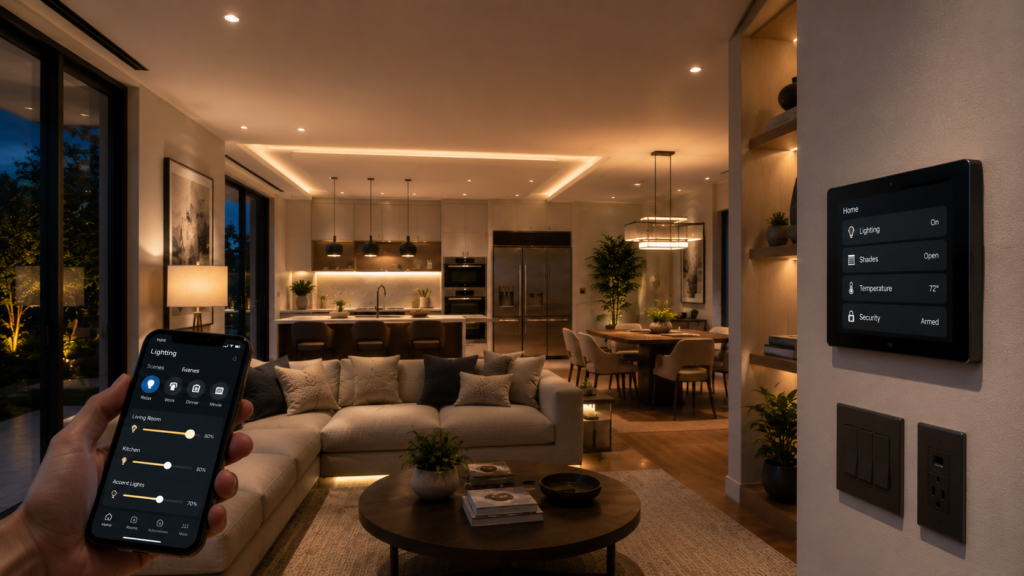
If you’re planning smart home lighting upgrades in 2026, here’s the short answer: smart switches are the sweet spot for most Bay Area homes, smart bulbs make sense in two or three accent spots, and a whole-home Lutron RA3 or Control4 system only pays off in larger luxury homes where buyers expect it. The bigger question isn’t which app to use — it’s whether your panel, wiring, and circuits can support what you want over the next decade. Smart lighting works best when it rides on top of a clean, modern electrical foundation. This guide walks through the three main approaches, the upgrades worth pairing with them, and where the real ROI lands by home value. For the broader picture, see our Bay Area lighting design guide.
TL;DR: A Three-Tier Recommendation
- Basic ($500–$2,000): Replace switches in the rooms you actually use at night — kitchen, living, primary bedroom, hallway — with Lutron Caseta or Kasa smart dimmers. Add a $35 hub or use Matter-over-Wi-Fi. Done.
- Mid ($3,000–$8,000): Whole-home Lutron Caseta or Leviton Decora Smart across all main switches, plus smart smoke/CO detectors, USB outlets in heavy-use rooms, and surge protection at the panel.
- Premium ($15,000–$50,000+): Lutron RA3, Crestron, or Control4 with motorized shades, scene-based control, and integration with audio, security, and HVAC. Worth it in Atherton, Saratoga, Palo Alto, and similar markets.
The mid tier is what we install most often. It covers 90% of what people actually want from smart lighting without the price tag of a full automation system.
The Three Approaches, Honestly Compared
Smart Bulbs (Philips Hue, LIFX, Nanoleaf)
The cheapest way in. A starter Hue kit runs $150 or so. Each bulb is independently addressable, color-tunable, and controllable from an app or voice assistant.
The downside is the wall switch. If a guest or housekeeper flips the switch off, the bulb is dead — the app can’t reach it. You end up taping switches in the “on” position or replacing them with smart switches anyway, which defeats the savings. Smart bulbs work well for accent zones: a reading nook, a feature wall, a kid’s room where color-changing is the point. They’re not a great whole-home solution.
Smart Switches and Dimmers (Lutron Caseta, Leviton Decora Smart, Kasa)
Replace the wall switch itself. Standard bulbs stay in the fixtures. The switch handles on/off, dimming, and scene control, and it talks to Apple HomeKit, Amazon Alexa, Google Home, or Samsung SmartThings.
This is what we recommend for most homes. Reliability is excellent — Lutron’s Clear Connect protocol rarely drops. Guests just use the switch like a normal switch. You can layer in automations (sunset triggers, vacation patterns, motion) without anyone needing to learn an app.
Installed cost in the Bay Area runs roughly $120–$280 per switch including the device and labor, depending on whether the existing box has a neutral wire (older homes often don’t, which limits brand choices).
Whole-Home Systems (Lutron RA2 Select, RA3, Crestron, Control4, Savant)
Centralized systems with a processor, scene keypads instead of standard switches, and integration with shades, audio, security, and HVAC. Programming is done by a certified dealer.
A Lutron Caseta whole-home installation lands in the $3,000–$8,000 range for an average Bay Area house. Stepping up to Lutron RA3 or Control4 puts you in the $10,000–$40,000+ range, often more for larger custom homes with motorized shades.
These systems are beautiful when they work — one keypad by the front door shuts the whole house down as you leave, another by the bed runs a “good morning” ramp. But they require commitment: changes go through your dealer, and replacing a failed processor a decade out can be a project.
What to Upgrade Alongside the Lighting
Smart switches sit on top of your existing electrical. If the underlying system is dated, this is the right moment to address it. The trades overlap, the walls are already open, and the inspector is already on site. We coordinate this kind of bundled work through our lighting design and electrical service.
Panel upgrade. Many Bay Area homes built before 1990 still have 100-amp service. If you’re adding an EV charger, a heat pump, or an induction range — or planning to in the next five years — a 200-amp panel is the cleaner long-term move. Permit, inspection, and labor typically run $3,500–$6,500 depending on meter location and PG&E coordination.
EV charger circuit. A dedicated 240V/40–60A circuit for a Level 2 charger is straightforward when the panel has the capacity. Adding it during a remodel is far cheaper than retrofitting later.
USB and USB-C outlets. Bedroom nightstands, kitchen counters, home offices. Small upgrade, daily-use payoff.
Smart smoke and CO detectors. Interconnected, app-notified, and code-compliant. Required in many remodel scopes anyway.
Whole-home surge protection. A $300–$600 device at the panel that protects every connected device in the house. Cheap insurance when you’re adding thousands in smart electronics.
Architectural lighting layout. If you’re opening walls or ceilings, this is the moment to plan layered lighting properly. Our layered lighting design guide covers how to combine ambient, task, and accent layers without overdoing it.
The ROI Question — An Honest Take
For most Bay Area homes in the $1M–$2.5M range, smart switches add modest resale value. Buyers expect dimmers and a few smart features but don’t pay a premium. Where these upgrades do earn back is the panel work — a modern 200A panel with EV-ready capacity is now a checklist item for many buyers.
Whole-home automation is a different story. In luxury markets — Atherton, Saratoga, Hillsborough, parts of Palo Alto and Los Altos — listings without Lutron RA3 or Control4 look dated. In a $700K Hayward bungalow, the same system reads as overbuilt and rarely returns its cost.
The honest answer most contractors won’t say out loud: don’t install premium automation for resale. Install it because you’ll use it daily for the next ten years.
How Top Tier Handles This
We don’t push the most expensive system. We start with how you actually live in your home — which rooms need scene control, which need plain reliable dimming, where you’d genuinely use voice or schedules. Then we match the tier. For a recent Castro Valley project, that meant Caseta across the main floor, Hue strips behind the kitchen island for accent, and a 200A panel upgrade to support a future heat pump. No central processor, no dealer dependency. Top Tier is licensed, bonded, and insured (CA License #1146790), and we coordinate this work as part of broader design-build and full house renovation projects so the trades sequence properly.
Common Questions About Smart Home Lighting Upgrades
Are Smart Bulbs or Smart Switches Better?
Smart switches for whole-home reliability; smart bulbs for two or three accent zones where color or independent control matters. Mixing both is fine — Lutron Caseta dimmers paired with a few Hue bulbs in feature spots is a common, well-working setup. Just don’t put smart bulbs behind every switch in the house. Guests and kids will flip switches off and complain.
Is Lutron Worth the Price Over Cheaper Brands?
For most homes, Lutron Caseta is worth the modest premium over Kasa or Leviton — better reliability, easier programming, broader integration. Lutron RA3 is worth it in larger homes (3,500+ sq ft) or when you’re integrating shades, audio, and security. In a smaller home with simpler needs, Kasa or Leviton Decora Smart will do the job at roughly half the device cost.
What Electrical Upgrades Make Sense in 2026?
If your panel is under 200A and over 25 years old, upgrade it — especially if you’re planning an EV, heat pump, or induction range. Add whole-home surge protection, USB outlets in heavy-use rooms, and smart smoke/CO detectors. Pre-wire for a Level 2 EV charger even if you’re not buying the car yet.
Do Smart Lights Add Resale Value?
Modestly, in mid-market homes — buyers expect dimmers and a few smart features but don’t pay a meaningful premium. In luxury Bay Area markets ($3M+), a Lutron RA3 or Control4 system is closer to table stakes and its absence can hurt the listing. The panel upgrade tends to return more than the lighting itself.
Does Title 24 Apply to Smart Switches?
Yes. California’s Title 24 §150.0(k) requires high-efficacy LED lighting in most residential spaces, and any smart dimmer you install must be rated to work with the LED fixtures it controls. The major brands (Lutron, Leviton, Kasa) publish compatibility lists. Our Title 24 lighting requirements guide covers what applies in remodels versus new construction.
────────────────────────────────────────────────────────────
Thinking about smart home lighting upgrades or a panel-and-lighting refresh together? Top Tier Building Services Inc. plans these projects around how you actually live — recommending the tier that fits the home, not the most expensive on the shelf. We’d be glad to walk through your options.
────────────────────────────────────────────────────────────
By Top Tier Building Services Inc.
Licensed Bay Area General Contractor License #1146790 serving homeowners, HOAs, and property managers from Castro Valley. Top Tier delivers design-build, renovation, and maintenance services across 14 specialty trades.