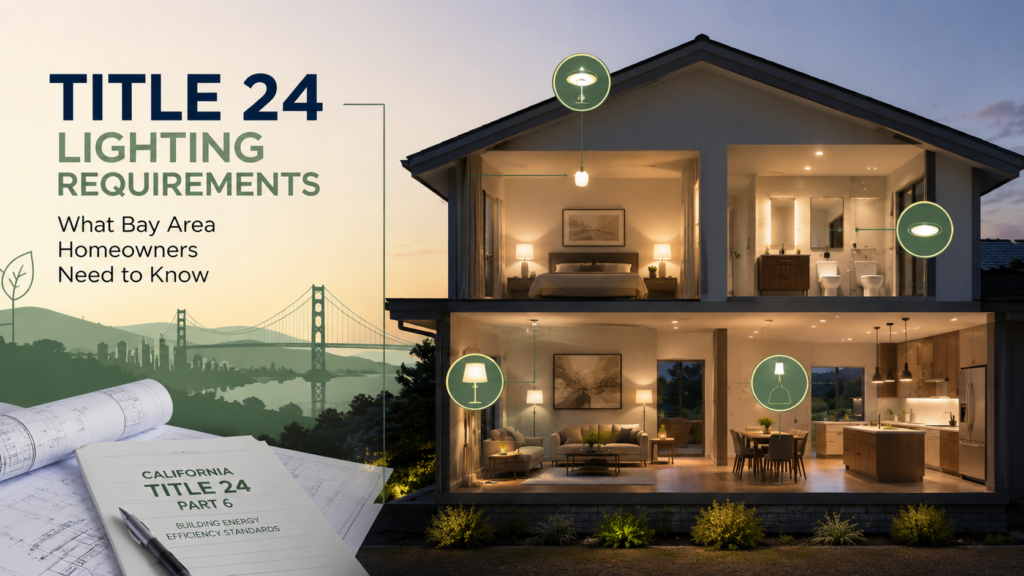
If you are renovating, replacing fixtures, or building new in California, the short version is this: nearly every permanently installed light in your home now needs to be high-efficacy (in practice, an LED), and several rooms also require occupancy or vacancy sensors. The rules live in Title 24, Part 6 — California’s Building Energy Efficiency Standards — and they apply to homes from Castro Valley to Fremont the same way they apply to the rest of the state. This guide translates the regulation into plain English: what you have to do, what triggers a permit, where Bay Area cities differ in interpretation, and where homeowners most often run into trouble at inspection. For the broader picture of how lighting fits into a whole-home project, see our Bay Area lighting design guide.
The Top Five Title 24 Lighting Rules in Plain English
Before the detail, here is what most homeowners actually need to remember:
- All permanently installed fixtures must be high-efficacy. In practice, that means LED. Incandescent and most halogen are out.
- Bathrooms must have either all high-efficacy fixtures or a vacancy sensor that shuts the lights off when the room is empty.
- Kitchens have a 50% rule — at least half the total installed wattage must be high-efficacy.
- Garages, laundry rooms, and utility spaces need motion sensors that turn the lights off automatically.
- Outdoor lighting needs a photocontrol (auto-on at dusk, off at dawn) or a motion sensor, and the fixtures themselves still have to be high-efficacy.
That is the bulk of what Title 24, Section 150.0(k) requires of a typical home lighting upgrade. The rest of this guide explains what those terms actually mean and where the rules trip people up.
What “High-Efficacy” Actually Means
“High-efficacy” is the regulatory language. The practical translation is LED. A few halogen products technically qualify, but the inspection-friendly answer is to use LED for every permanently installed fixture in the house.
There is a second layer here worth knowing about: JA8, short for Joint Appendix 8. JA8 is California’s certification that an LED meets specific color quality, dimming, and rated-life standards. When a fixture or lamp is labeled “JA8 compliant” or “JA8-2019 compliant,” it has been tested and listed. For most residential rooms — kitchens, bathrooms, living areas — your fixtures need to be JA8-compliant. Outdoor lamps generally do not require JA8, but they still need to be high-efficacy.
What counts as “permanently installed”? Title 24 is specific: anything attached to walls, ceilings, or columns; track lighting; lighting inside permanently installed cabinets (under-cabinet, in-cabinet); lighting attached to ceiling fans; lighting integral to exhaust fans; and lighting integral to certain garage door openers. Plug-in table lamps and freestanding floor lamps are not regulated — buy whatever bulb you like for those.
Room-by-Room Requirements
Kitchens
Kitchens get the 50% wattage rule. Add up the total wattage of all permanently installed lighting (recessed cans, pendants, under-cabinet, anything hardwired) and at least half of that total has to come from high-efficacy fixtures. In a modern remodel, this is almost automatic — most homeowners are putting in LED recessed cans and LED under-cabinet strips anyway. The rule mostly catches projects where someone wants decorative incandescent pendants over the island.
Bathrooms
Every permanently installed fixture in a bathroom must be high-efficacy, or the lighting must be controlled by a vacancy sensor. A vacancy sensor is a specific type of motion control: it requires you to flip the switch on manually, then it turns off automatically when the room empties. It is not the same as an occupancy sensor, which turns on automatically when you walk in. For bathrooms, Title 24 specifically wants vacancy sensing so the light is not triggered by someone walking past the door.
Garages, Laundry Rooms, and Utility Spaces
These rooms need high-efficacy fixtures and a motion sensor that shuts the light off when the space is unoccupied. The reasoning is straightforward — these are the rooms most likely to have a light left on for hours by accident.
Outdoor Lighting
Outdoor lighting attached to the house needs two things working together: the fixtures themselves must be high-efficacy, and the controls must include either a photocontrol (turns lights on at dusk and off at dawn based on ambient light) or a motion sensor. A timer alone does not satisfy the requirement. For a layered approach to exterior illumination, see our notes on layered lighting design.
Closets, Hallways, and Other Rooms
Closets larger than 70 square feet need lighting controls. Hallways are covered under the general rule — high-efficacy fixtures, dimmer or sensor controls where applicable. Smaller closets and small storage spaces are generally fine with a basic LED fixture on a switch.
What Triggers a Permit
A common question: do I need to pull a permit for a lighting change? The general rule across most Bay Area jurisdictions:
- Like-for-like fixture swap, same location, same circuit: generally no permit, though local rules vary.
- Adding new fixtures, new circuits, or relocating wiring: yes, an electrical permit is required.
- Whole-room or whole-house remodels: the lighting work folds into the larger building permit.
- Recessed-can retrofits (replacing old cans with new LED cans): typically permitted, especially if any wiring is touched.
Castro Valley and the rest of unincorporated Alameda County route lighting work through the county building department. Oakland, Hayward, San Leandro, Pleasanton, and Fremont each have their own permit counters, fee schedules, and inspector preferences. The state law is identical; the local interpretation varies. A licensed contractor familiar with the East Bay will know which city wants what kind of documentation.
Where Bay Area Homeowners Run Into Trouble
A few patterns we see at inspection or during resale:
- Mid-project fixture swaps. Homeowner picks out a beautiful decorative pendant that turns out to be an unrated halogen. Inspector flags it. Fixture has to be replaced.
- Missing vacancy sensor in a remodeled bathroom. Easy to forget when the rest of the bathroom is using high-efficacy fixtures already — but the rule still requires the sensor if any fixture is not high-efficacy. The safer path is to specify a vacancy sensor regardless.
- Outdoor fixtures without photocontrol. Especially common when a homeowner adds porch or path lights as part of a landscaping project without realizing those fall under Title 24.
- JA8 not specified. A contractor installs LED fixtures that are not JA8-listed. They are technically high-efficacy, but the inspector wants the JA8 documentation and the project stalls.
- Discovered at resale. Non-compliant work done without a permit shows up during a buyer’s inspection or a city resale report. It can complicate closing and force corrective work.
How Top Tier Handles Title 24
Title 24 compliance is not a separate step in our process — it is built into how we plan the lighting design and electrical layout from the first meeting. We specify JA8-listed LED fixtures by default, design the control scheme (dimmers, vacancy sensors, photocontrols) to match the room types, and coordinate with the local building department for permits and inspections. For larger projects that include lighting as one piece of a full house renovation or bathroom remodel, the Title 24 compliance documents are folded into the broader permit package. Top Tier holds CA General Contractor License #1146790, and we work across Castro Valley, Hayward, San Leandro, Oakland, Pleasanton, and Fremont regularly enough to know each city’s quirks.
Common Questions About Title 24 Lighting Requirements
What Is Title 24?
Title 24, Part 6 is California’s Building Energy Efficiency Standards. It is updated every three years by the California Energy Commission. The current version is the 2022 Energy Standards. Section 150.0(k) is the part that covers residential lighting.
Do LED Fixtures Meet Title 24?
Most do, but not all. To satisfy Title 24 inside the home (kitchens, bathrooms, living spaces), LEDs need to be JA8-listed — meaning they have been certified for California’s color quality, dimming, and rated-life standards. Look for “JA8 compliant” on the packaging or the manufacturer’s spec sheet.
Do I Need a Vacancy Sensor in My Bathroom?
Only if any permanently installed fixture in that bathroom is not high-efficacy. If every fixture is a high-efficacy LED, you can use a regular switch. In practice, many homeowners install a vacancy sensor anyway because it is a small added cost and gives flexibility for future fixture changes.
Does Title 24 Apply to a Single Fixture Replacement?
If you are doing a true like-for-like cosmetic swap on the same circuit in the same location, most jurisdictions do not require a permit and the practical compliance burden is minimal. If you are changing the circuit, adding a fixture, or doing the swap as part of a larger remodel, Title 24 applies in full and the new fixture needs to be high-efficacy.
How Much Does Title 24 Compliance Documentation Cost?
For most residential projects, paperwork is prepared by a HERS (Home Energy Rating System) consultant or by the licensed contractor on the job. Costs range from roughly $300 for a small project to $1,500 or more for a whole-house build, depending on scope.
Planning a lighting upgrade and not sure how Title 24 will affect your plans? Top Tier Building Services Inc. walks Bay Area homeowners through the compliance side — fixture selection, controls, permits, inspection — so the regulation never becomes a surprise. We are happy to review your project and tell you exactly what the code will require.
By Top Tier Building Services Inc.
Licensed Bay Area General Contractor License #1146790 serving homeowners, HOAs, and property managers from Castro Valley. Top Tier delivers design-build, renovation, and maintenance services across 14 specialty trades.