
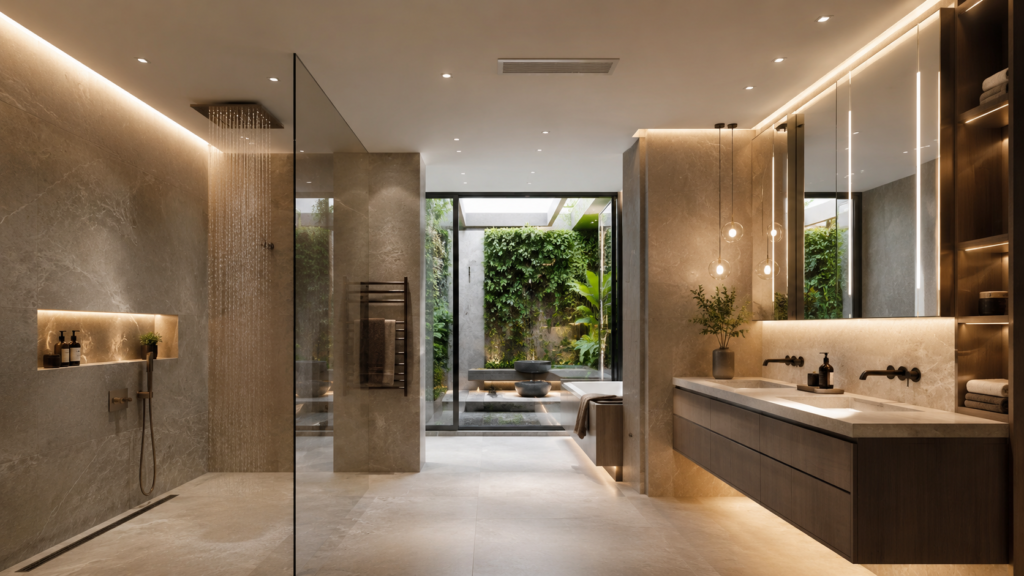
The hallmark of a high-end master bathroom remodel is an environment that pleases the senses while functioning flawlessly under intense environmental conditions. In modern open-concept wet rooms, two of the most critical—yet frequently miscalculated—elements are mechanical ventilation and layered lighting design. Without precise engineering in these areas, an otherwise beautiful suite will suffer from persistent fogging, accelerated moisture wear, and uninspired, flat illumination.
Balancing structural safety with high-end ambient design requires an integrated approach. Before choosing decorative fixtures or positioning vanity mirrors, your mechanical systems must sync with your core floor plan to establish adequate airflow paths and safe electrical zoning. Aligning these elements with thoughtful custom bathroom design and space planning creates a space that is both structurally sound and perfectly illuminated. This guide outlines the atmospheric engineering required to optimize your master suite’s climate and visual appeal.
1. Mechanical Ventilation: Calculating CFM Requirements
Standard, off-the-shelf exhaust fans are entirely inadequate for open-concept wet rooms or steam suites. To prevent condensation from dwelling on porous materials, design-build teams use precise calculations to calculate cfm for master bathroom suites based on volumetric airflow requirements:
• The Area-Based Calculation: The standard Home Ventilating Institute (HVI) guideline mandates a minimum of 1 CFM per square foot of bathroom area for rooms under 100 square feet. For a luxury 12×15 master bathroom (180 square feet), ventilation should be sized based on the specific plumbing fixtures installed: 50 CFM per standard shower, 50 CFM per toilet enclosure, and 100 CFM for a jetted whirlpool tub.
• Continuous vs. Intermittent Ventilation: For ultimate moisture management, high-efficiency systems utilize continuous, low-sone multi-speed fans. These units run quietly at a baseline rate (e.g., 30 CFM) to maintain steady air exchange and ramp up to maximum speed (e.g., 110 CFM) when smart relative humidity (RH) sensors detect a rapid moisture spike.
2. Safe Electrical and Illumination Zoning
Water and electricity require strict physical and mechanical separation. When engineering lighting layouts over wet zones, compliance with national electrical codes (such as NEC regulations) dictates where specific fixtures can safely exist:
When selecting fixtures for Zone 1, always verify the product documentation for explicitly labeled led wet location rated shower lights to maintain structural code compliance.
3. Layered Lighting Architecture for Bathrooms
A luxury master bathroom should never rely on a single grid of overhead recessed cans, which cast harsh shadows across the face. Instead, premium spaces implement a balanced, layered lighting layout for bathrooms:
- 1. Task Lighting: Crucial for grooming zones, task lighting is best achieved by placing vertical wall sconces on either side of the vanity mirror at eye level (approximately 60–66 inches from the finished floor). This cross-illumination cancels out shadows underneath the eyes and chin.
- 2. Ambient Lighting: This layer provides the baseline illumination for the room. It is achieved through soft, hidden LED plaster-in cove lighting along the ceiling perimeter or drop ceilings, mimicking natural daylight filtering into the space.
- 3. Accent Lighting: Accent lighting adds depth and drama. Low-voltage LED strip lights tucked beneath floating vanities or behind floating mirrors create a weightless, glowing effect that doubles as a gentle nightlight.
4. Atmospheric Engineering: Fan Sone Ratings & Automation
A serene, spa-like experience can be ruined by a loud, vibrating exhaust fan. Ventilation noise is measured in sones; a standard builder-grade fan operates at a loud 3.0 to 4.0 sones. Premium master suites specify ultra-quiet ventilation units rated at 0.3 to 0.5 sones—making them virtually undetectable to the human ear.
To keep the space running efficiently without manual monitoring, these high-efficiency fans are paired with fully automated controls. In-wall condensation sensors track relative humidity and ambient temperature simultaneously, automatically engaging the fan during a shower and keeping it running for exactly 20 minutes post-use to exhaust lingering microscopic moisture from the room’s envelope.
Conclusion
High-efficiency ventilation and precisely zoned lighting design are the unsung heroes of high-end master bathroom architecture. By calculating exact CFM needs, opting for ultra-quiet low-sone units, and layering task, ambient, and accent lighting, you protect your structural investment while creating an inviting, functional sanctuary. True luxury is found where impeccable design meets high-performance engineering, ensuring your master suite remains bright, beautiful, and moisture-free for years to come.