
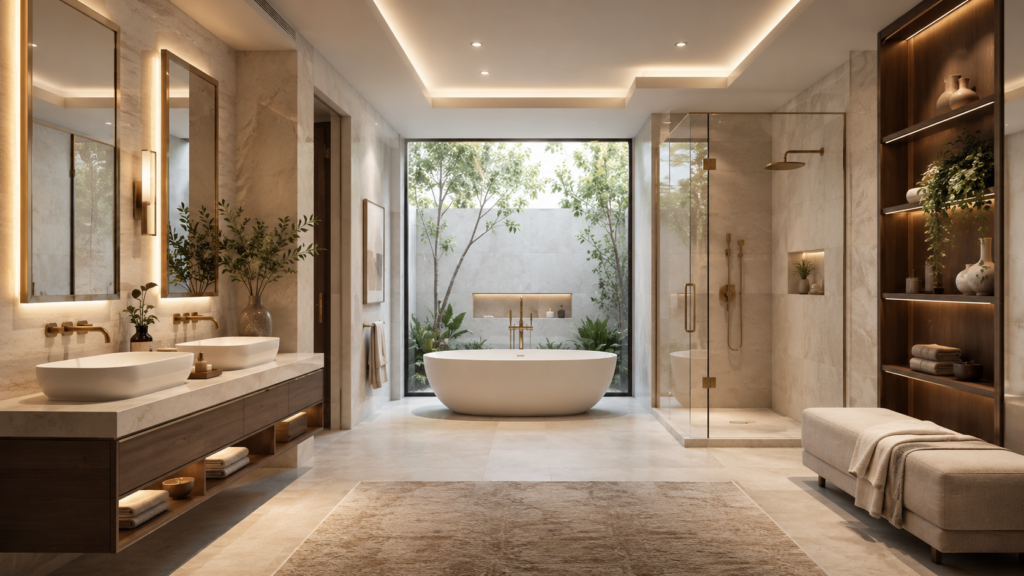
A luxury bathroom remodel is no longer just a functional upgrade; it is an architectural investment in wellness, spatial design, and daily ritual. In high-end residential design, a premium bathroom is defined not by the cost of its brassware, but by the precision of its layout. True luxury requires navigating the intricate friction point between aesthetics and rigid spatial dynamics.
Whether you are working within an existing footprint or orchestrating a massive structural addition, mastering custom bathroom design and space planning is the definitive baseline for a flawless execution. This guide breaks down the spatial formulas, clearance blueprints, and architectural zoning principles required to design a sanctuary that functions as beautifully as it looks.
1. Spatial Benchmarks: Sizing and Structural Footprints
Before moving walls or specifying finishes, you must benchmark your available square footage against luxury layout expectations. While a standard full bathroom operates efficiently within 40 to 60 square feet, a premier custom master suite demands significantly more breathing room to accommodate multi-fixture configurations.
When designing a luxury master bathroom, targeting a minimum layout of 120 square feet prevents the room from feeling cramped once premium spatial additions—such as a freestanding soaking tub or a multi-head zero-entry shower—are introduced.
2. The Core Spatial Formulas: Clearances & NKBA Guidelines
A major pitfall in high-end remodeling is failing to account for physical human ergonomics. To build an elite space, we design to the rigorous standards set by the National Kitchen & Bath Association (NKBA) and international residential codes (IRC). While code dictates the bare legal minimums, luxury design relies on optimal clearances to establish an effortless spatial flow.
The Grooming Zone (Vanity Space)
The Shower & Bath Zones
The Private Water Closet (Toilet Placement)
3. Architectural Functional Zoning
An elite space planning strategy categorizes the bathroom into distinct wet and dry functional zones. This tactical segregation simplifies your plumbing layout, optimizes mechanical ventilation pathing, and balances visual site lines from the master bedroom entrance.
• The Dry Zone: This comprises the grooming vanity, linen towers, makeup stations, and integrated dressing areas. Keeping the dry zone structurally insulated from steam and direct splash zones protects custom wood veneers, specialized lighting mirrors, and electrical infrastructure.
• Sight Line Management: Never design a layout where the toilet is the first element visible through an open master bedroom doorway. Instead, use your space planning map to anchor a custom double vanity or a sculptural soaking tub as the central visual focal point upon entry.
4. Plumbing Relocation and Structural Preparation
Transitioning from a basic layout to a custom master floor plan frequently requires comprehensive plumbing relocation and structural prep. Moving heavy fixtures requires severe engineering oversight:
5. Mechanical Infrastructure: Ventilation & Electrical Codes
The invisible mechanics of luxury space planning dictate how long the space remains pristine. High-end finishes fail quickly if underlying climate and electrical infrastructure are ignored.
• High-Efficiency Ventilation: To permanently halt mold and moisture buildup, custom bathrooms must utilize dedicated, ducted exhaust ventilation systems. Sizing your exhaust fan requires calculating the room’s total volume. The standard rule of thumb is providing 1 CFM (Cubic Feet per Minute) per square foot of bathroom area, but you should increase this by 50 CFM if incorporating a dedicated steam shower.
• Safe Electrical Layouts: Electrical space planning must prioritize strict National Electrical Code (NEC) compliance. All countertop and wet-zone adjacent receptacles require Ground Fault Circuit Interrupter (GFCI) protection. Furthermore, recessed shower light fixtures must be wet-rated, and switches should sit at least 3 feet away from the edge of the tub or shower zone to guarantee safe operational access.
Conclusion
Executing a flawless custom bathroom remodel rests entirely on the foundational work done during the space planning phase. By adhering to optimal NKBA clearance dimensions, establishing clean functional zones, and managing the engineering realities of plumbing relocation and structural prep, you create a space that stands the test of time. True luxury isn’t chosen from a showroom floor—it is engineered behind the walls through meticulous architectural planning.