
You picked luxury vinyl plank because it looks like wood, shrugs off spills, and seemed affordable. Then the first quote came back far higher than the price you saw online. Here is the short answer on LVP flooring cost. National cost guides put installed LVP at about $6 to $16 per square foot. A flooring store in nearby Santa Cruz shows whole-house jobs there working out to about $9 to $23 per square foot, once removal, prep, and trim are in. The sources are linked in the sections below.
The gap between those two numbers is the whole story. The online figure mostly prices planks going down on a flat, clean, dry floor. Real homes rarely have that floor. Old tile has to come out. A slab has to be tested for moisture. Dips need leveling, stairs are priced one step at a time, and baseboards come off and go back on. Each of those is a separate line, and together they can double a quote. This guide prices every line, so you know which ones your home will need before anyone starts tearing up the old floor.
Key Takeaways
- National guides put installed LVP (luxury vinyl plank) at about $6 to $16 per square foot. A Santa Cruz flooring store’s all-in house examples work out to about $9 to $23.
- The plank’s wear layer, the clear top coat measured in mil, drives the material price. Busy rooms need at least 12 mil.
- Tearing out old tile, leveling a floor, sealing out slab moisture, and stairs are each priced on their own. Together they can double a basic quote.
- Concrete slabs need a moisture test before planks go down. Condos and HOA buildings often require sound-rated underlayment and board approval first.
- A 1,000-square-foot job runs about $6,000 to $16,000 on national numbers before prep and stairs. Local all-in examples run higher.
- Compare quotes line by line. Two quotes only match when both include removal, prep, trim, and stairs.
What This Guide Covers
- What LVP Flooring Costs per Square Foot by Plank Grade
- Why LVP Cost Guides Disagree by Thousands of Dollars
- Whole-House LVP Cost for 500 to 2,000 Square Feet
- The Prep and Finish Work That Can Double an LVP Quote
- Bay Area Conditions That Raise LVP Flooring Cost
- Is LVP Worth the Money Compared With Other Floors
- How to Read an LVP Quote Before You Sign
- Planning Your LVP Floor With Top Tier
- FAQs
What LVP Flooring Costs per Square Foot by Plank Grade
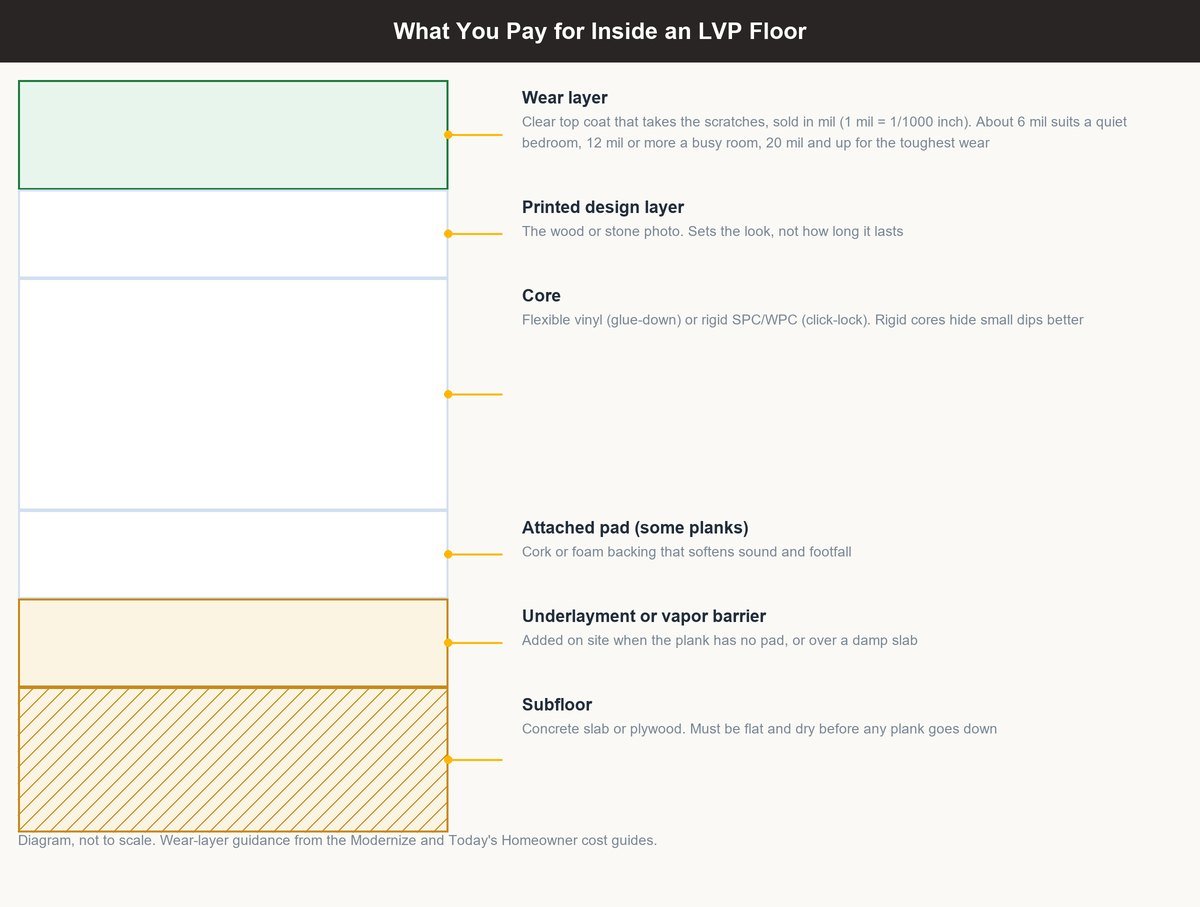
Start with the plank, because it sets the base price. The home-services site Modernize puts LVP at $4 to $10 per square foot for materials and $2 to $6 for labor. That adds up to about $6 to $16 installed, in its August 2026 update. Basic vinyl plank, a thinner product, comes in lower at about $4 to $13 installed.
What you pay for inside the plank is mostly its wear layer. That is the clear top coat that takes scratches from shoes, chairs, and pets. It is measured in mil, and one mil is a thousandth of an inch. Modernize says a thin layer around 6 mil fits a quiet bedroom. Today’s Homeowner advises at least 12 mil for busy rooms and 20 mil or more for the toughest wear.
The core matters too. Flexible vinyl planks are glued down and show every bump in the floor below. Rigid-core planks, sold as SPC (stone-plastic composite) or WPC (wood-plastic composite), click together and float over the floor. They hide small dips better and cost more.
These ranges cover the planks only. Labor, removal, and prep come next.
Why LVP Cost Guides Disagree by Thousands of Dollars
Search for LVP prices and you will find answers that look wildly different. Today’s Homeowner says $3.50 to $11 per square foot installed. Modernize says $6 to $16. The cost site Homewyse puts vinyl tile at $9.16 to $13.63 per square foot in May 2026. Nobody is lying. Each guide is pricing a different job.
The first reason is what each number includes. Some guides price only planks and labor. Homewyse also counts supplies, equipment, a two-hour labor minimum, and hauling away the old floor. The second reason is the product. A few guides blend sheet vinyl, thin plank, and thick rigid-core plank into one average.
The third reason is location, and it matters most here. National numbers average cheap labor markets with expensive ones. Warehouse Direct Flooring Outlet in Santa Cruz says local labor runs 20% to 40% above online calculators. It prices local labor at about $5 to $14 or more per square foot, versus $2 to $6 nationally on Modernize. Higher living costs, insurance, fuel, and dump fees all feed that gap. The same pressures apply across the Bay Area.
So the honest way to read any online number is to ask three questions. Does it include removal? Does it include prep and trim? Is it a national average or a local price?
Whole-House LVP Cost for 500 to 2,000 Square Feet
People searching for LVP prices often ask about a specific size. The table below uses two sources. The national column applies Modernize’s $6 to $16 installed range, and Modernize lists the same $3,000 to $8,000 for 500 square feet. The local column uses the Santa Cruz store’s three example jobs for a 1,200-square-foot house. Those came to about $11,300, $18,400, and $27,500 or more with removal, disposal, prep, and baseboards included. That is roughly $9.40 to $22.90 per square foot, scaled to each size below.
Treat the local column as a planning range, not a bid. Small jobs often cost more per square foot, because setup and minimum charges do not shrink with the room. Today’s Homeowner gives a lower 1,000-square-foot figure of $5,000 to $9,000 for LVP. That fits a simple job on a ready floor.
The Prep and Finish Work That Can Double an LVP Quote
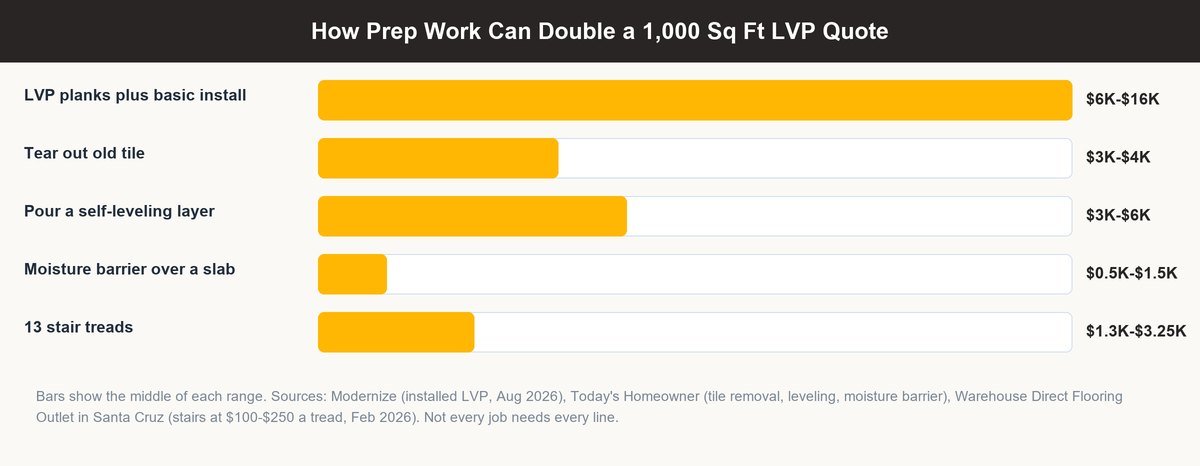
This is where most quotes jump. Each item below is priced on its own, and most homes need at least two of them. The chart shows how fast they add up on a 1,000-square-foot job.
Removing and Hauling Away the Old Floor
What the Removal Line Covers
Carpet comes up fast, so it costs about $1 to $2 per square foot. Tile and glued-down wood take far longer, at about $3 to $4. Tile has to be broken up, scraped, and hauled away, and the thin layer of mortar under it often comes up in chunks.
How It Changes the Total
On a 1,000-square-foot job, tile removal alone can add $3,000 to $4,000. That is half of a low-end quote before a single plank goes down. Some installers float LVP over flat, solid tile to skip this cost, but only if the plank maker’s instructions allow it.
Leveling a Floor That Dips or Humps
Why Flatness Matters So Much
LVP is thin, so it follows every high spot and dip in the floor below. Click-together planks can flex at their joints over a low spot. Over time that strain can break the locking edges. Plank makers set a flatness limit in their install guides, and installers check it with a long straightedge.
What Leveling Usually Costs
Spot patching runs about $1 to $3 per square foot. A full pour of self-leveling compound, a liquid cement that spreads itself flat, runs about $3 to $6. A whole-floor pour on a 1,000-square-foot slab can add $3,000 to $6,000, which is why the leveling line is worth checking first.
Repairing a Damaged Wood Subfloor
What Turns Up Under Old Floors
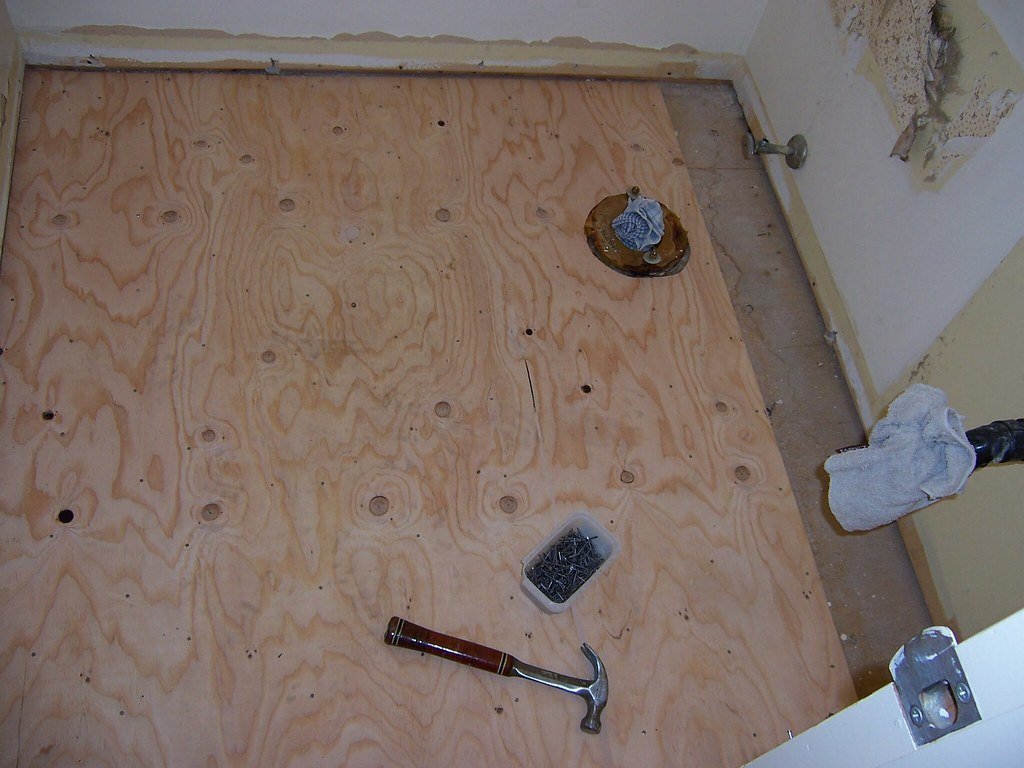
In a raised-floor home, the wood subfloor can be soft near toilets, tubs, dishwashers, and exterior doors. That softness usually means an old leak. Planks cannot go over rotted wood, because the soft spot keeps sinking and the planks above it break loose.
What the Repair Usually Costs
Patching small areas costs about $1 to $3 per square foot. Replacing plywood runs about $3 to $5. Our subfloor replacement cost guide walks through bigger repairs, including the joists underneath. A fair quote names a price per sheet for any rot found once the old floor is up.
Stairs Priced One Step at a Time
Why Stairs Cost So Much More
Every step needs a cut tread, a riser, and a nosing, the rounded front edge your foot lands on. Each piece is cut and glued by hand, and the nosing must be locked in tight so nobody slips. That is slow work, so installers price stairs per step rather than per square foot.
What a Staircase Adds
The Santa Cruz store prices stairs at $100 to $250 per tread, depending on how complex they are. Open sides and custom nosing push toward the top of that range. A straight run of about 13 steps adds roughly $1,300 to $3,250, even though the steps cover very little floor area.
Baseboards, Quarter Round, and Doorway Transitions
What Finish Work Includes
Floating floors need a small gap at every wall so the planks can expand. Baseboards or a thin strip called quarter round hide that gap. Transition strips bridge the change in height at doorways, where LVP meets tile or carpet.
What Finish Work Usually Costs
Modernize puts trim and transitions at $1 to $3 per linear foot. New baseboard runs about $8.96 to $13.71 per linear foot installed, per Homewyse. The Santa Cruz store’s mid-range example budgets about $1,500 for new basic baseboards in a 1,200-square-foot house. Reusing good baseboards keeps this line small.
Bay Area Conditions That Raise LVP Flooring Cost
Labor is the first reason Bay Area quotes run above national averages, as the section on cost guides showed. The building itself adds the rest. A good installer checks for each of the conditions below before quoting.
Slab Homes and Moisture Testing
Why a Slab Needs Testing
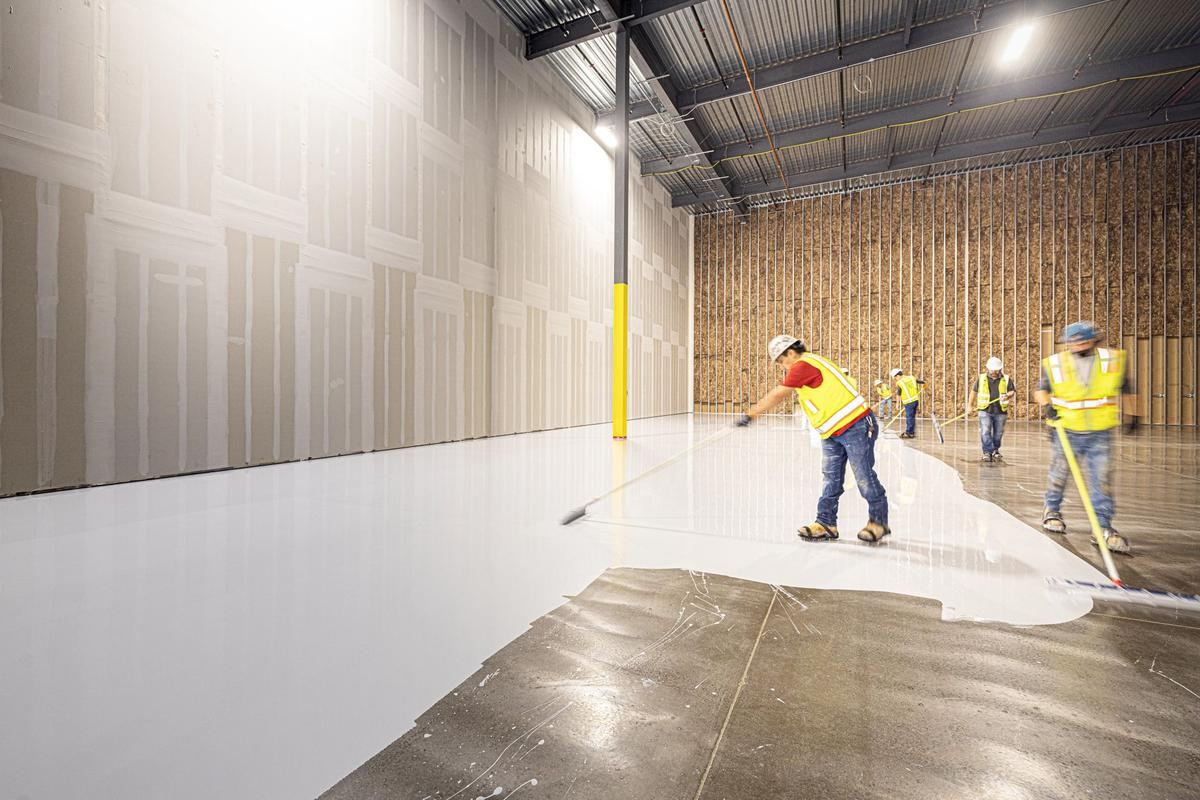
Concrete slabs pull moisture up from the ground below. Many ground-floor condos, townhomes, and single-story homes in the region sit on slabs. Vinyl does not let that moisture escape, so it can collect under the planks and loosen glue, feed odors, or void the warranty.
How the Test Works
The common method, ASTM F2170, places small humidity probes in holes drilled into the slab. The probes are usually read after at least a day. The plank maker’s install guide sets the limit the slab must meet. A moisture barrier or cleaning adds about $0.50 to $1.50 per square foot.
Condo and HOA Sound Rules
What Your HOA May Require
Hard floors carry footstep noise to the unit below. Many condo HOAs around the Bay Area require a sound-rated underlayment and board approval before work starts. The ratings are IIC (Impact Insulation Class) for footsteps and STC (Sound Transmission Class) for voices and TV noise.
How It Changes the Price
The California Building Code asks new floors between units to reach IIC 50 and STC 50 in lab tests. Many HOAs write a similar number into their rules. A sound mat costs more than a basic foam pad, so ask for it as its own line. Our condo remodeling team prepares HOA submittal packages and installs approved sound-control systems.
Older Floors That May Contain Asbestos
Why Age Changes the Plan
Some older vinyl and asphalt floor tiles, sheet-vinyl backing, and the black glue under old tile can contain asbestos. Only a lab test of a small sample can tell. The EPA warns never to sand or try to level asbestos flooring or its backing.
How It Can Save Money
The same EPA page says that when asbestos flooring needs replacing, covering it with new flooring is the better choice when possible. A floating LVP floor over old tile can do exactly that. If the old floor must come out, a licensed asbestos professional handles it, and that cost belongs in your budget early.
Indoor Air Rules for Vinyl Floors
What California Requires
California’s green building code, CALGreen, has a rule for resilient floors, the family LVP belongs to. Section 4.504.4 requires at least 80% of that floor area to meet limits on VOCs, the chemical vapors some new products give off. The rule is written for new homes and additions, so a floor swap in an existing house usually falls outside it.
Why It Still Helps You Shop
The easiest proof of low emissions is a FloorScore label. FloorScore certifies that a floor meets California’s own emissions test standard, known as Section 01350. Asking for FloorScore planks costs little or nothing extra, and it matters most in bedrooms and nurseries.
Is LVP Worth the Money Compared With Other Floors
For most homes, yes, with one condition. LVP is worth it when the floor underneath is ready for it, or when you budget to make it ready. It is waterproof on its surface, warm underfoot compared with tile, and kinder to dropped glasses. A good plank with a 12 to 20 mil wear layer holds up well to kids and pets.
It is a weaker choice when you want a floor that can be refinished. Real hardwood can be sanded and refinished many times. LVP cannot, so a deep gouge means replacing planks. See our guide to the cost to install hardwood floors if that matters to you. If you are torn between LVP and laminate, our vinyl plank vs laminate comparison covers water, scratches, and noise. Tile lasts longest in wet rooms, and our tile floor installation cost guide prices that path.
Doing it yourself saves the labor line, about $2 to $6 per square foot nationally on Modernize. Click-lock planks go down much like laminate, and our guide to installing laminate flooring shows the steps. The savings disappear fast if the floor needs leveling, a slab needs testing, or stairs are involved. Those are the jobs that most often go wrong.
How to Read an LVP Quote Before You Sign
Most surprise costs come from lines that were never on the quote. Use this list to make every bid comparable.
- Name the plank. Every quote should list the same brand, product line, wear layer in mil, and core type.
- Check the square footage. Ask for the measured area and the waste allowance, written separately.
- Find the removal line. It should name the old floor type and include haul-away.
- Find the prep line. Leveling, patching, and subfloor repair need a price or a per-unit rate.
- Ask about the slab. If you have concrete floors, ask which moisture test will be run and what happens if it fails.
- Count the stairs and trim. Stairs should be priced per tread. Baseboards should say new or reused.
- Ask about HOA rules. In a condo, confirm the underlayment meets your board’s sound rating before you sign.
- Check the license. Look up the contractor on the state license board’s lookup page before you sign.
Planning Your LVP Floor With Top Tier
Top Tier Building Services is a licensed general contractor, CSLB #1146790, based in Castro Valley. Our flooring installation team installs luxury vinyl plank and laminate across Alameda, Contra Costa, and Santa Clara counties. Subfloor prep and leveling, moisture testing and vapor barriers, and transitions and trim are part of the service, not surprise add-ons. Every quote lists those lines by name, with a unit price for anything that only shows up once the old floor is out, such as subfloor rot.
Ready to price your floor? Contact us for a free, itemized flooring estimate.
FAQs
How much does it cost to install 1,000 square feet of LVP flooring?
On national numbers, about $6,000 to $16,000 for planks and installation, based on Modernize’s $6 to $16 per square foot. Local all-in examples from a Santa Cruz flooring store work out to roughly $9,400 to $22,900 with removal, prep, and baseboards. Tile removal, leveling, and stairs can push it higher.
How much is LVP for a 2,000 square foot house?
National installed pricing works out to about $12,000 to $32,000 for 2,000 square feet. A Santa Cruz flooring store puts a 2,000-square-foot job at about $18,000 to $19,000 for a budget project, $30,000 to $32,000 for mid-range, and over $45,000 for a luxury one. Prep needs and stairs decide where you land.
How much does it cost to install 1,500 square feet of LVP?
National installed pricing runs about $9,000 to $24,000 for 1,500 square feet. Scaled from the Santa Cruz store’s all-in examples, a local job lands around $14,100 to $34,400. Expect the top of the range if old tile has to come out or the floor needs a full leveling pour.
Is LVP flooring worth the money?
For most homes, yes. LVP resists water, handles pets and kids well, and costs less to install than many hardwood and tile options. It cannot be refinished, so pick a wear layer of at least 12 mil for busy rooms. It is worth the most when the floor under it is flat and dry.
What is the labor cost to install vinyl plank flooring?
Modernize puts national labor at about $2 to $6 per square foot. A Santa Cruz flooring store prices local labor at about $5 to $14 or more, and says local rates run 20% to 40% above online calculators. Glue-down planks, stairs, and heavy prep raise labor further.
Can LVP flooring be installed over tile?
Often, yes, if the tile is flat, solid, and well bonded, and the plank maker’s instructions allow it. Deep grout lines may need filling first. Skipping tile removal can save about $3 to $4 per square foot, but it raises the floor height at doorways and appliances.