
Ask three contractors to quote venetian plaster on the same wall and you can get $9 a square foot, $28 a square foot, and $60 a square foot. None of them is necessarily wrong. They are quoting different products that the market decided to give one name. One is a lime mineral finish that hardens for decades. One is an acrylic coating with marble dust in it, sold in a paint store bucket. That gap is the most useful thing to understand before you sign anything, and a one-word product name on the bid does not tell you which one you are buying.
That confusion is what produces walls that do not turn out the way the sample board promised, when the wrong product gets substituted for the one that was pictured. This guide covers interior residential work.
Key Takeaways
- Venetian plaster describes two unrelated products. Real lime plaster is slaked lime putty and marble dust. Synthetic venetian plaster is acrylic resin with marble filler, and it behaves like paint.
- Installed pricing spans roughly $8 to $90 per square foot depending on which one you buy and how many burnished passes the finish takes.
- Material is 10 to 20 percent of the bill. You are paying for hand time, substrate prep, and an applicator who cannot rush.
- Lime plaster keeps hardening for years because it absorbs carbon dioxide and turns back into limestone. Acrylic plaster is as hard on day one as it will ever be.
- The honest weakness is repairability. A patch rarely blends, so you refinish a whole wall plane, corner to corner.
What This Guide Covers
- What Venetian Plaster Actually Is Underneath the Marketing
- The Three Finishes People All Call Venetian Plaster
- What Venetian Plaster Costs per Square Foot Installed
- Why Venetian Plaster Costs So Much When Lime Is Cheap
- How Venetian Plaster and Stucco Actually Differ
- Venetian Plaster Walls Versus Limewash on the Same Wall
- Whether Venetian Plaster Is Durable Enough for Real Rooms
- The Honest Pros and Cons Before You Sign Anything
- Getting a Straight Answer on Your Own Walls
- FAQs
What Venetian Plaster Actually Is Underneath the Marketing
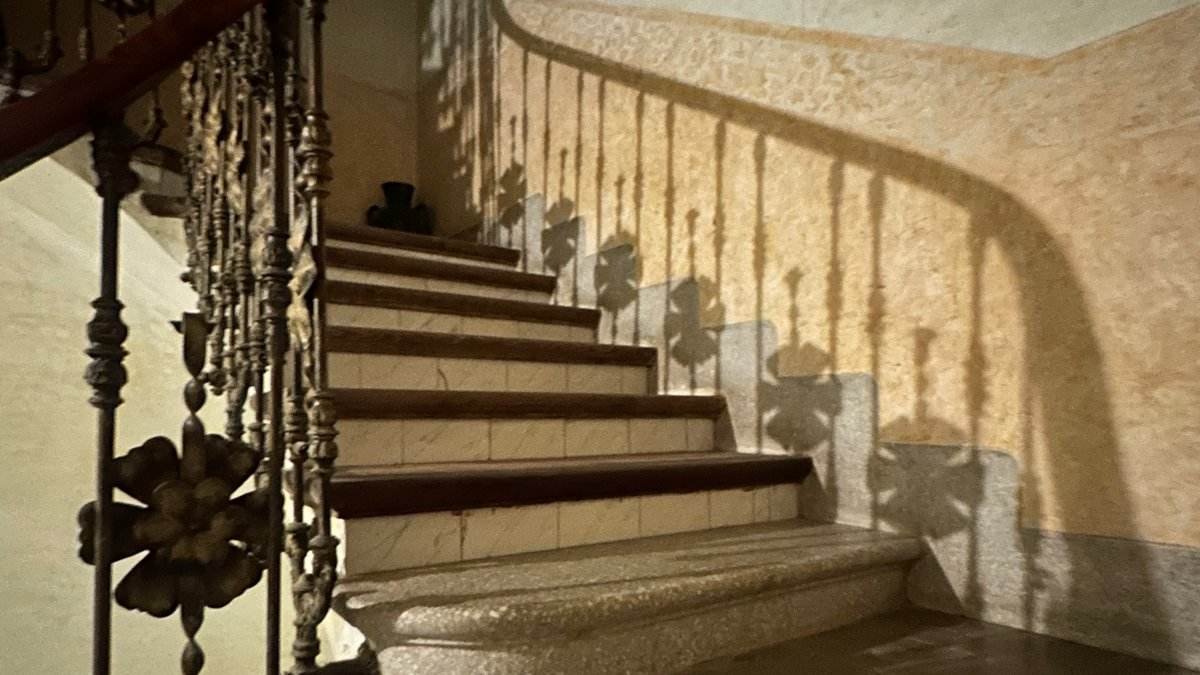
Real venetian plaster starts as limestone that has been burned, slaked in water, and aged as a putty. Crushed marble or limestone dust is blended in for body and light. It goes on in very thin passes with a flexible steel trowel, and the finished build is usually one to three millimeters, about the thickness of two business cards. It is less a coating on the wall than a mineral skin worked into it.
The behavior that matters follows from the chemistry. Slaked lime is calcium hydroxide. Exposed to air, it slowly pulls carbon dioxide out of the room and converts back into calcium carbonate, the mineral limestone is made of. That process is carbonation, and it is why a lime wall in an old building is harder than one finished last spring. The Romans wrote this down two thousand years ago.
Synthetic venetian plaster does none of that. It is an acrylic dispersion with marble dust as filler. The water leaves, the resin coalesces into a plastic film, and that is the end of the story. It ages like paint, because it is paint with texture.
The Three Finishes People All Call Venetian Plaster
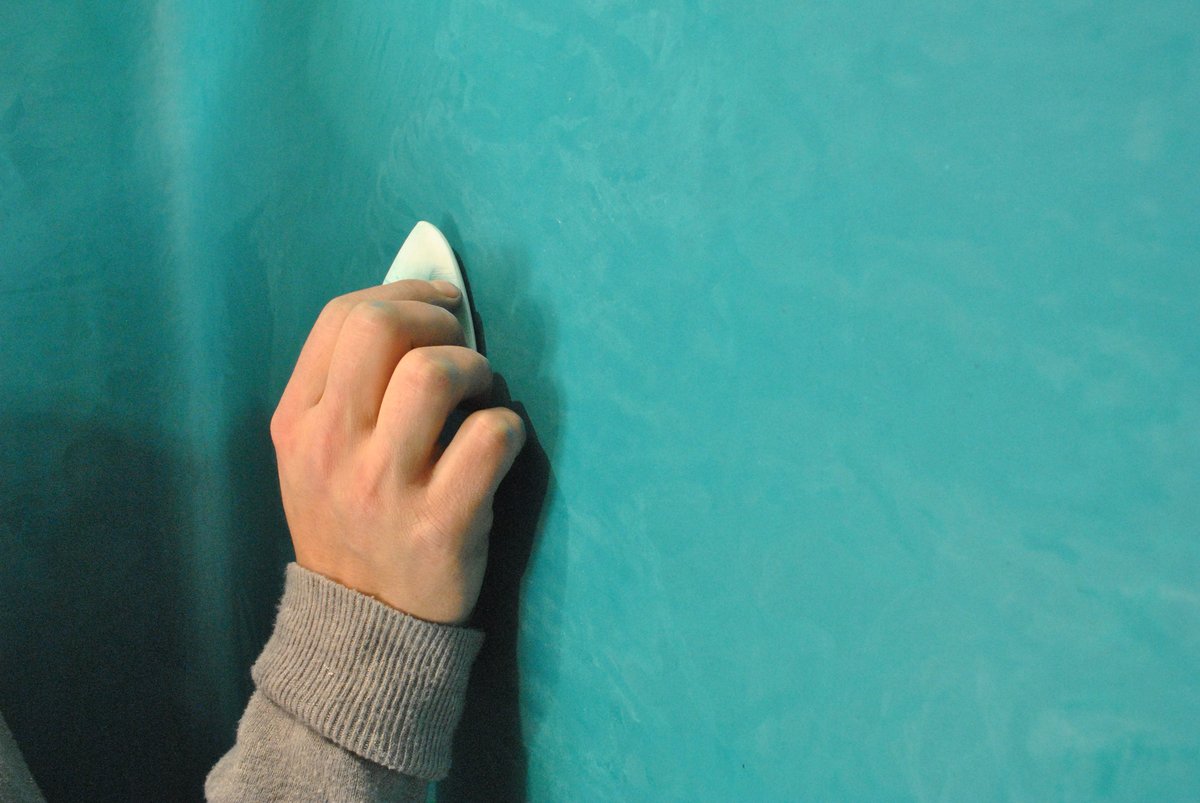
These are not grades of one product. They are different materials with different lifespans, and the price ladder in the next section maps straight onto them.
Marmorino Gives You Matte Stone Depth
What Is Actually in the Bucket
Marmorino is lime putty carrying a coarser crushed marble aggregate. The grit is deliberate. It gives the surface a fine tooth that catches light unevenly, producing the cloudy depth people associate with old European walls.
Why the Surface Reads as Stone
Because the aggregate is visible and the sheen is low, your eye reads variation instead of one flat color. Two coats over a prepared wall usually suffice, and it hides minor substrate imperfection far better than a high polish.
Where Marmorino Earns Its Keep
Living rooms, hallways, stairwells, any wall taking raking light. It is also the sensible choice in older Oakland and Berkeley houses whose walls will never be perfectly flat, because a matte mineral surface forgives what gloss advertises.
Grassello Is the High Polish Everyone Photographs
Aged Lime Putty Milled Very Fine
Grassello di calce is the same lime, aged longer and ground much finer, with little visible aggregate. That fineness lets the surface be compressed to a marble-like sheen. It is also why the wall behind it must be close to perfect.
Burnishing Is What Creates the Sheen
Nothing is added to make it shine. The applicator works back over the last coat with the flat of the trowel, under pressure, while the material sits at exactly the right stage of set. Miss that short window and only recoating fixes it.
The Rooms Where It Belongs
Powder rooms, entry walls, fireplace surrounds, anywhere a small area of high impact justifies the money. Doing a whole open plan floor in burnished grassello is how a $9,000 finish becomes a $30,000 one without looking better.
Acrylic Plaster Is Paint Wearing the Same Name
A Resin Film With Marble Dust
Sold in five gallon buckets under decorative-finish brand names, applied with a plastic or steel blade in two coats, usually by a painter rather than a plasterer. The marble dust is real, but the binder is acrylic, so the wall is a textured paint film.
Why It Costs a Third as Much
Two coats instead of four to six passes, no burnishing window to hit, no mineral primer, and a far larger pool of people who can apply it. Every one is a labor saving, which is why the price gap is real rather than a prestige markup.
When Acrylic Is the Right Call
A rental turnover, a room you expect to redecorate in five years, or any budget where the real alternative is flat latex rather than lime. It is a legitimate product; the name on the quote is what makes it look like the other one.
What Venetian Plaster Costs per Square Foot Installed
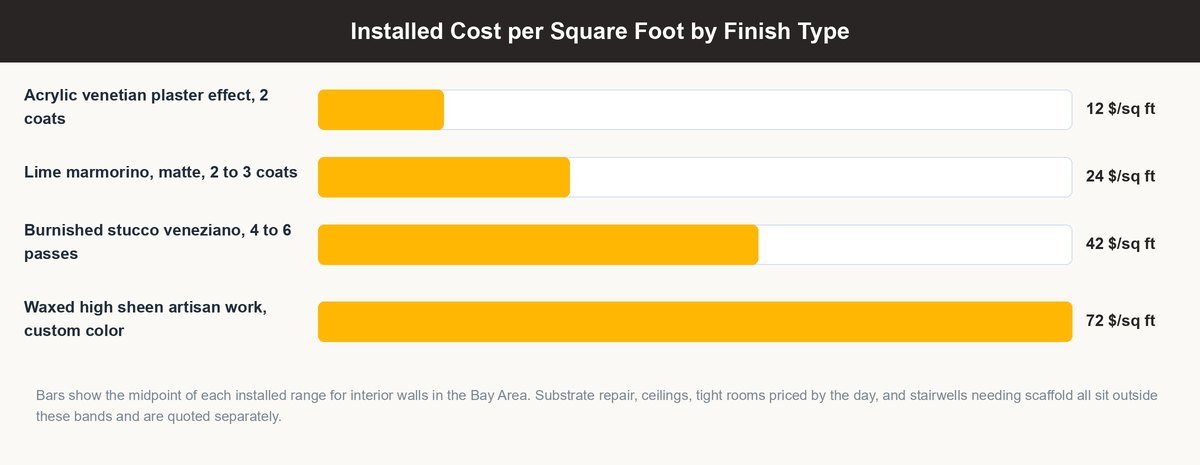
The ranges below are what interior wall quotes typically land at here, priced on finished wall area rather than floor area. They are working 2026 Bay Area figures rather than a published price index, so use them to sanity check a bid, not to replace one. Small rooms get priced by days on site instead of by area, which is why a powder room can cost more per square foot than a whole living room.
Why Venetian Plaster Costs So Much When Lime Is Cheap
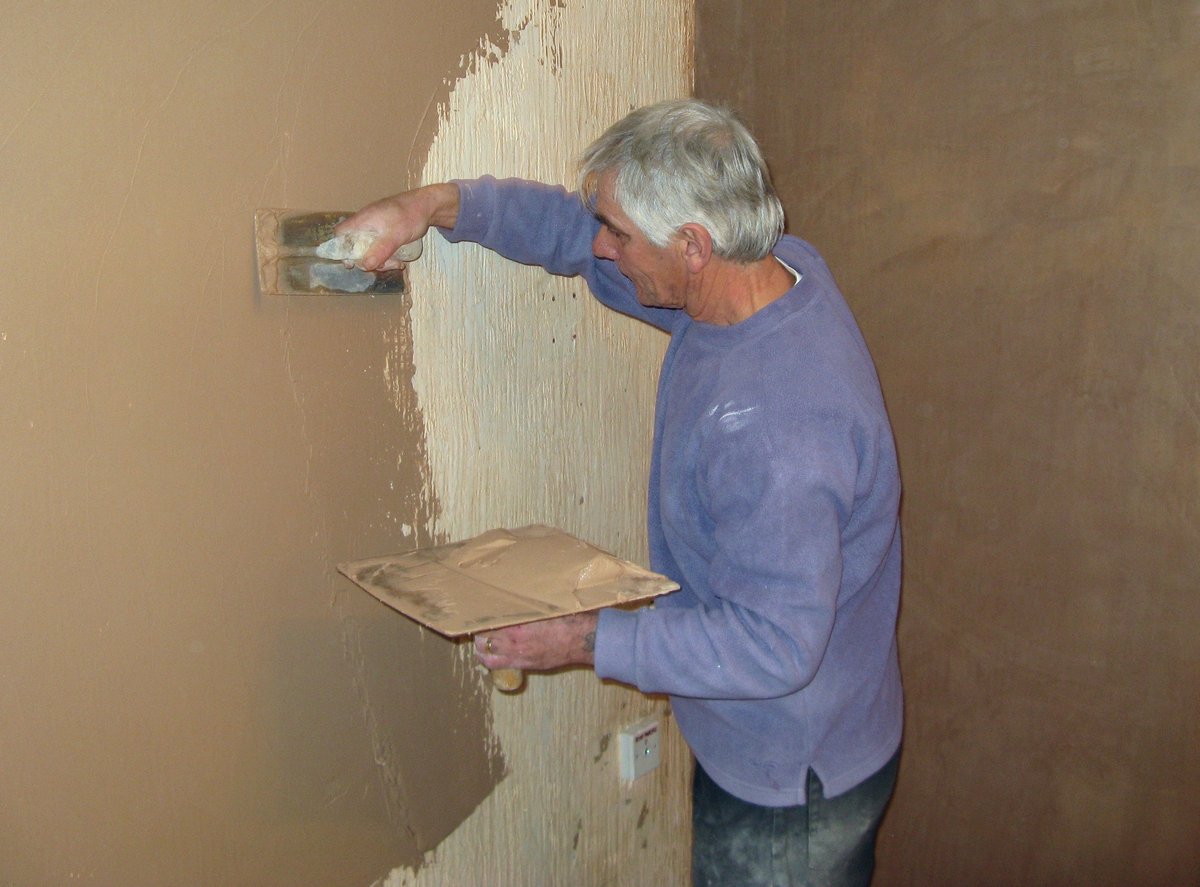
Lime putty is not expensive. On a genuine lime finish, product typically accounts for something like 10 to 20 percent of the installed price. The rest is time, and this time is not compressible the way most trade labor is.
A painter rolling a wall covers hundreds of square feet an hour. A plasterer building a burnished finish works a few square feet at a time, then returns over the same area two, four, or six more times, and each pass has to land inside a window the material dictates rather than the schedule. Coastal fog and cool East Bay evenings stretch those windows unpredictably, so applicators build slack into their schedules and price it.
Then there is the wall behind it. A high polish finish wants a Level 5 gypsum board finish, the skim-coated grade defined in the Gypsum Association’s GA-214 standard, and most houses do not have one. Existing texture comes off, joints get skimmed, and in pre-war housing across San Francisco and Alameda County the original lath and plaster has to be sounded out and stabilized first.
The last cost is supply. In California, plaster work sits under the C-35 lathing and plastering classification, separate from the C-33 painting and decorating class, both listed on the CSLB license classifications page. The pool of people holding the right license who can genuinely burnish lime is small, and small supply against fashionable demand does what it always does.
How Venetian Plaster and Stucco Actually Differ
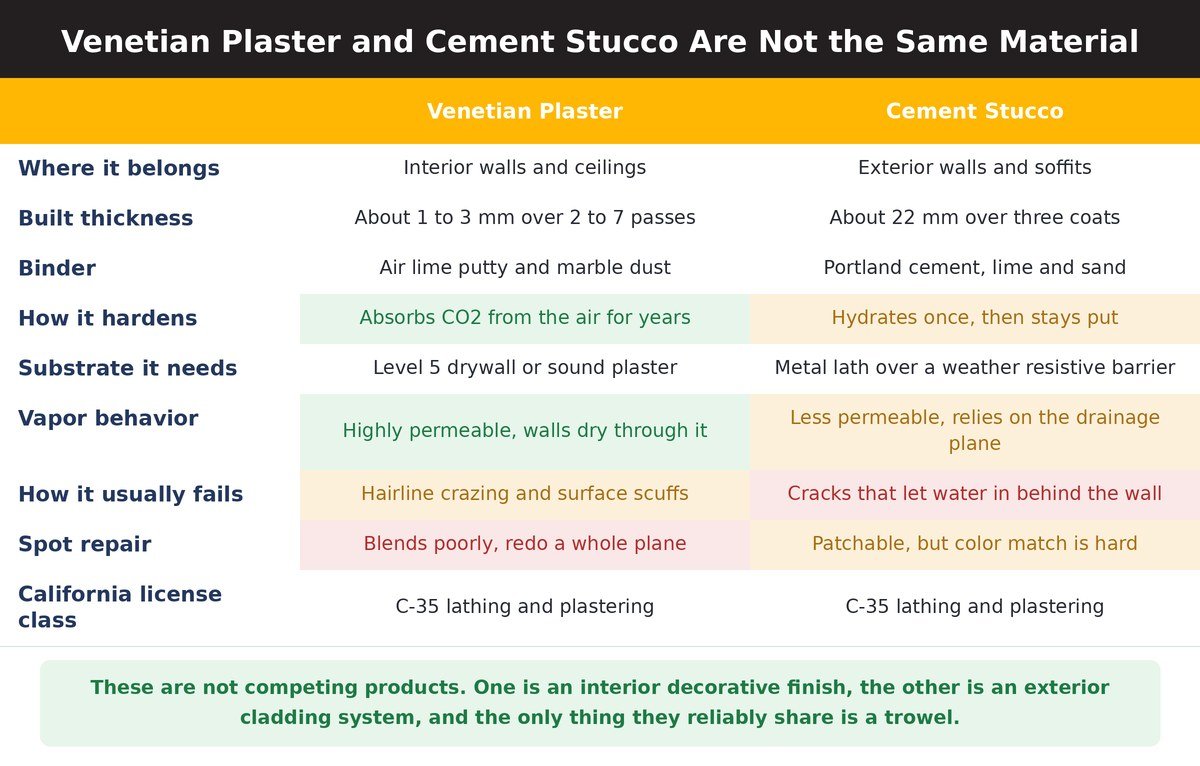
These words get used interchangeably and should not be. Venetian plaster is an interior decorative finish measured in millimeters. Stucco is an exterior cladding system, roughly 22 millimeters of portland cement plaster in three coats over metal lath and a weather resistive barrier, doing water management work a decorative finish never touches.
The binder is the real fork. Portland cement hydrates once, sets hard, and stays that way. Air lime keeps carbonating, stays more vapor open, and is more forgiving of small movement. The National Park Service’s Preservation Brief 22 on historic stucco traces that shift, documenting how American stucco moved from lime based mixes toward portland cement and giving sample mixes for eighteenth, nineteenth and twentieth century work.
So the failure modes differ in kind. A crazed venetian plaster wall is cosmetic. A cracked stucco wall is water intrusion, priced and repaired on entirely different terms, which we cover in our stucco repair cost guide. Do not let a bidder use a stucco square foot number to justify an interior plaster price.
Venetian Plaster Walls Versus Limewash on the Same Wall
Limewash is the other lime finish homeowners compare, and it is a different proposition. It is lime thinned to the consistency of milk and brushed on rather than troweled. It soaks in, dries chalky and matte, and changes the color of a wall without adding thickness or hiding anything.
The decision is whether you want a surface or a color. Limewash gives soft chalky depth cheaply and can be refreshed by anyone with a brush. Venetian plaster gives a physically different surface with real reflectance and hardness, at several times the cost.
Whether Venetian Plaster Is Durable Enough for Real Rooms
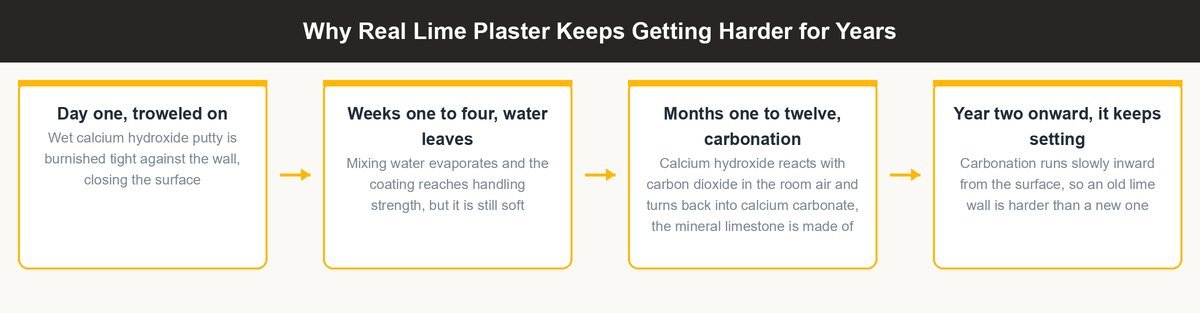
For lime plaster, yes, with a specific caveat. The surface hardens over years as carbonation runs inward from the face, and a burnished, waxed lime wall resists scuffing better than eggshell latex. Fresh lime is also strongly alkaline, the basis of its long reputation for resisting mold, though that alkalinity falls as the surface carbonates, so it is not a permanent mold treatment and should never be sold as one.
Where it struggles is impact and water. A hard knock chips the surface rather than denting it. Standing water on an unwaxed lime wall leaves a mark. Waxed grassello handles bathroom humidity and splash well, but wax is a maintenance layer needing redoing every few years, and it is not waterproofing. For a shower enclosure you want a membrane-backed assembly, and our wet room waterproofing guide explains what has to sit underneath a seamless wet-area surface.
The real durability question is what happens when something hits it. Because the finish is built by hand in overlapping passes, a patch almost never blends. The repair unit is a whole wall plane, corner to corner, which is worth knowing before you put a burnished finish in a hallway a stroller uses twice a day.
The Honest Pros and Cons Before You Sign Anything
The case for it is narrow and real. You get optical depth no paint reproduces, a mineral finish with essentially no ongoing off-gassing, and a wall that hardens rather than degrades.
The case against is equally real. It costs several times a good paint job, from roughly three times for matte marmorino to more than ten times for waxed artisan work. It needs a substrate most houses do not have. Repairs are plane-wide rather than local. Changing color later means recoating in plaster or painting over a surface you paid a premium for. And the name on the quote does not tell you which product you are getting, so the decision rests on questions most homeowners do not know to ask. If budget is the binding constraint, the honest comparison is a high quality paint system.
Getting a Straight Answer on Your Own Walls
The useful conversation about venetian plaster is not about color. It is about which product is being quoted, what condition your walls are in, and whether the room will treat the finish well. To get that assessed honestly, contact Top Tier Building Services. We are a licensed Bay Area general contractor, CSLB #1146790, and we do both painting and specialty surface finishes, so we have no reason to steer you toward either one.
FAQs
How much does venetian plaster cost per square foot?
Interior walls typically run about $8 to $16 per square foot for an acrylic venetian plaster effect, $18 to $30 for matte lime marmorino, $30 to $55 for burnished stucco veneziano, and $55 to $90 for waxed high sheen artisan work. Bay Area labor sits at the upper end, and substrate prep is quoted separately.
Is venetian plaster durable?
Real lime venetian plaster is durable in the ways that matter for walls. It keeps hardening through carbonation, resists scuffing better than standard interior paint, and lasts decades without recoating. It absorbs impact poorly, marks under standing water if unwaxed, and damaged areas cannot be spot repaired invisibly. Acrylic versions are only as durable as good textured paint.
Can venetian plaster be used in a bathroom?
On bathroom walls and ceilings, yes, if it is a lime finish that has been burnished and waxed and the room has working ventilation. Inside a shower enclosure, no, unless a waterproofed assembly sits beneath it, because the plaster is a finish rather than a barrier. Wax needs refreshing every few years and is not a permanent seal.
What is the difference between venetian plaster and stucco?
Venetian plaster is an interior decorative finish one to three millimeters thick, bound with air lime, that hardens by absorbing carbon dioxide. Stucco is an exterior cladding system roughly 22 millimeters thick, usually bound with portland cement, over metal lath and a weather resistive barrier. Stucco manages water and weather. Venetian plaster manages how a wall looks in raking light.
Can you paint over venetian plaster?
You can, and in practice it is permanent. Latex over a lime finish seals the surface, stops carbonation, flattens the optical depth, and cannot be removed without abrading the plaster off. Recoating in fresh lime plaster preserves the mineral surface instead. Acrylic venetian plaster takes ordinary paint without complication.
Why is venetian plaster so expensive?
Because you are buying hours rather than material. Lime putty is roughly 10 to 20 percent of the installed cost. The rest is four to six hand-troweled passes, a burnishing window the material dictates, substrate prep to a Level 5 flatness most houses lack, and a small pool of licensed applicators. Acrylic versions skip all four.