
Two houses on the same street, both with about 900 square feet of red oak, can get refinishing quotes $2,600 apart. Same age, same species, same footage. What separates them is everything a square-foot calculator never asks — whether the house is empty, whether there are stairs, whether a dog lived there, and how much wood is left above the tongue. The cost to refinish hardwood floors is only loosely a function of area. It is mostly a function of access and condition, and the suspiciously low bids are the ones that assumed both were easy.
This guide prices it that way, line by line, including the adders that turn a $4,500 job into a $7,200 one and the point where sanding stops making sense and you should be pricing new hardwood installation instead. Every figure below is an editorial planning range built for Bay Area conditions, not a national survey number.
Key Takeaways
- A standard sand-and-refinish with three coats of clear polyurethane runs roughly $4.50 to $8.00 per square foot in the Bay Area. Stain moves it to about $5.75 to $8.50.
- Area buys a discount, not a price. Refinishing 1,000 square feet costs about $4,500 to $7,500, while one 200-square-foot bedroom rarely lands under $1,000, because mobilization is the same either way.
- Stairs are billed per step at $45 to $150, and closets are billed each. Neither sits inside the per-square-foot number you were quoted.
- Pet urine and water damage break budgets, because both are fixed by replacing and blending boards at $18 to $40 each, not by sanding.
- A bid 30 percent under the others has usually dropped the edger and hand work, the third coat, or both.
What This Guide Covers
- What the Cost to Refinish Hardwood Floors Actually Covers
- Cost to Refinish Hardwood Floors per Square Foot
- What Refinishing 1,000 Square Feet Really Costs
- Why Access Moves the Price More Than Floor Area
- How the Condition of Your Floor Changes the Bid
- Why Stairs and Closets Get Priced Separately
- When Refinishing Beats Replacing Your Hardwood
- What a Cheap Refinishing Bid Usually Left Out
- How Bay Area Labor and Rules Change the Number
- Get a Real Refinishing Number for Your Floors
- FAQs
What the Cost to Refinish Hardwood Floors Actually Covers
Refinishing is four trades stacked into one line on a proposal, each with its own labor rate and its own way of going sideways. Splitting them out is the only reliable way to compare bids that differ by a thousand dollars, because the difference is almost never material.
Those rows are typical ranges rather than a strict sum, since mobilization and overhead ride on top of trade labor. What you are buying is mostly the labor of sanding flat, because every flaw left underneath gets locked in and magnified by gloss.
Cost to Refinish Hardwood Floors per Square Foot
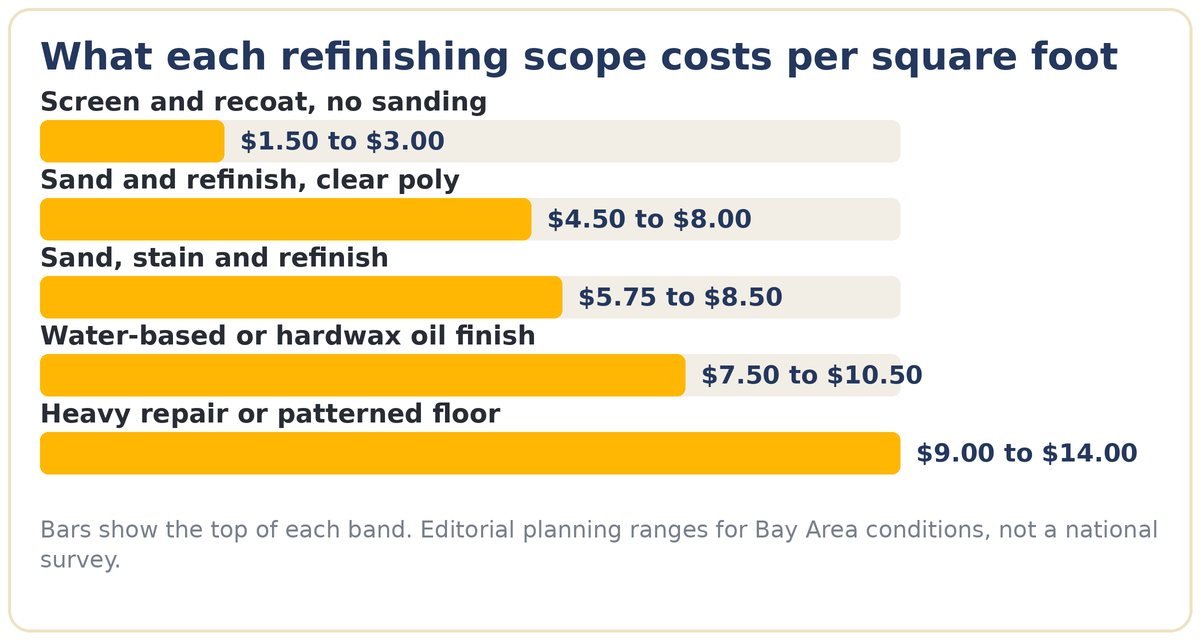
There is no single per-square-foot rate, because there is no single scope.
The first row is the one most people never hear offered. A screen and recoat abrades the existing finish and lays a fresh coat over it for a third of the price in a single day. It only works if the finish has not worn through, so check the traffic lanes and the spot in front of the sink. Gray wood means sanding is the only honest option.
What Refinishing 1,000 Square Feet Really Costs
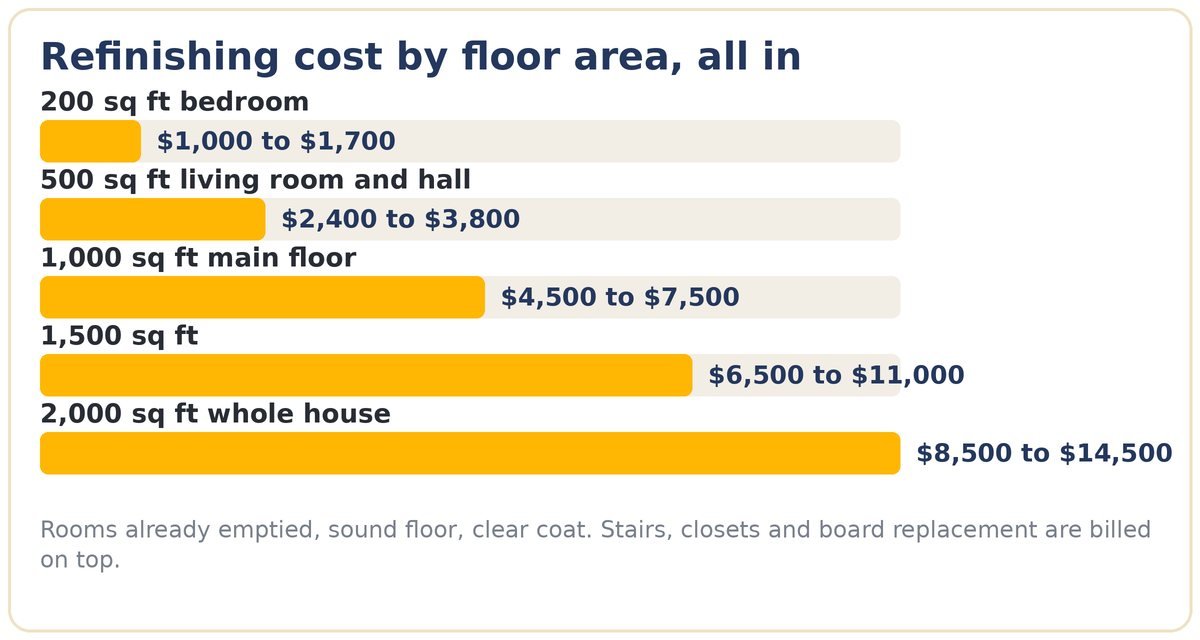
Per-square-foot rates fall as the job grows, because setup, mobilization, and haul-away barely move with area. Read the table as small jobs being expensive per foot, not large ones being bargains.
Doing rooms one at a time as budget allows costs 20 to 30 percent more in total than doing the same footage at once, and risks a visible sheen difference where a new coat meets an older one.
Why Access Moves the Price More Than Floor Area
Sanding takes about the same hours per square foot everywhere. Getting to the floor does not. Access is the most underestimated line in a refinishing bid, and the one you control most directly.
Furniture Moving and Room Clear-Out
What Clearing a Floor Costs
Emptying a lived-in level is real labor, typically $150 to $400 per floor, and it happens twice because everything comes back. Beds, bookcases, and anything with a stone top eat the most time. Clearing rooms yourself cuts the bill without cutting quality.
Appliances Pianos and Heavy Fixtures
Why Disconnects Are Billed Separately
Anything disconnected rather than lifted is a separate charge, generally $75 to $250 for a refrigerator or a washer and dryer pair, and $250 to $600 for an upright piano needing a moving crew. Some estimators fold these in and some do not, so ask rather than assume.
Closets and Tight Interior Corners
Why Closets Are Hand-Worked
Closets are priced individually at $75 to $150 each, because a drum sander will not fit and the whole floor is worked with an edger and hand scraper. The same applies under a toe-kick, behind a radiator, or inside a bay window.
Living in the House During the Work
What Phasing the Work Adds
Phasing a refinish so the family can stay puts the crew on half a house at a time, adds a second mobilization, and stretches three days into six. Expect 15 to 30 percent more. Oil-modified polyurethane also needs an empty house for odor and cure, which is where most homeowners book a hotel anyway.
How the Condition of Your Floor Changes the Bid
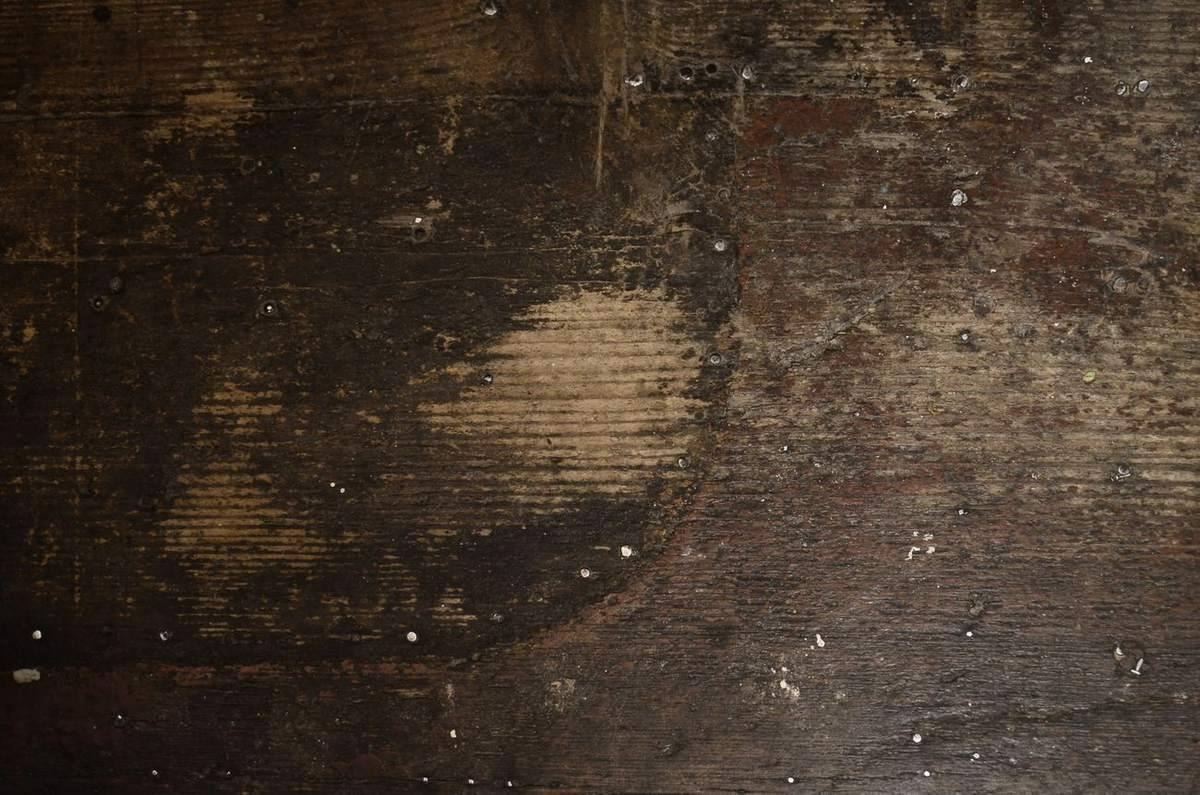
No estimator can price condition accurately from the doorway, which is why good proposals carry an allowance and bad ones carry silence. Four findings account for nearly every refinish that goes over budget.
Pet Stains That Reached the Subfloor
Why Sanding Will Not Fix It
Urine soaks through the finish into the wood fiber and often the subfloor, and the black mark it leaves is a tannin reaction no grit removes. The fix is cutting out and replacing boards at $18 to $40 each installed and blended, plus sealing the subfloor. A closet-sized area can add $600 to $1,200.
Water Damage Cupping and Crowning
Why the Floor Must Dry First
Boards that absorb water swell across their width and cup. Sanding a cupped floor before it dries shaves the high edges and leaves a crowned floor once moisture equalizes. A floor after a leak needs 30 to 60 days of drying and a moisture reading first, and the flattening pass adds $0.75 to $1.50 per square foot.
Unknown Wear Layer on Older Floors
How Many Sands Are Left
Solid three-quarter-inch strip flooring carries only about a quarter inch of usable wood above the tongue, so a floor gets a finite number of full sands, generally four to six. Engineered floors are stricter, and a wear layer under two millimeters cannot be sanded at all. The National Wood Flooring Association publishes the sand-and-finish standards the trade works to.
Face-Nailed and Squeaking Old Floors
What Nail Setting Adds
Pre-war Bay Area floors are often face-nailed, and every proud nail head must be set below the surface or it tears the abrasive and gouges the wood. Budget another $0.35 to $0.75 per square foot for nail setting. Refinishing is also the moment to fix movement underneath, which our guide on squeaky floors covers.
Why Stairs and Closets Get Priced Separately
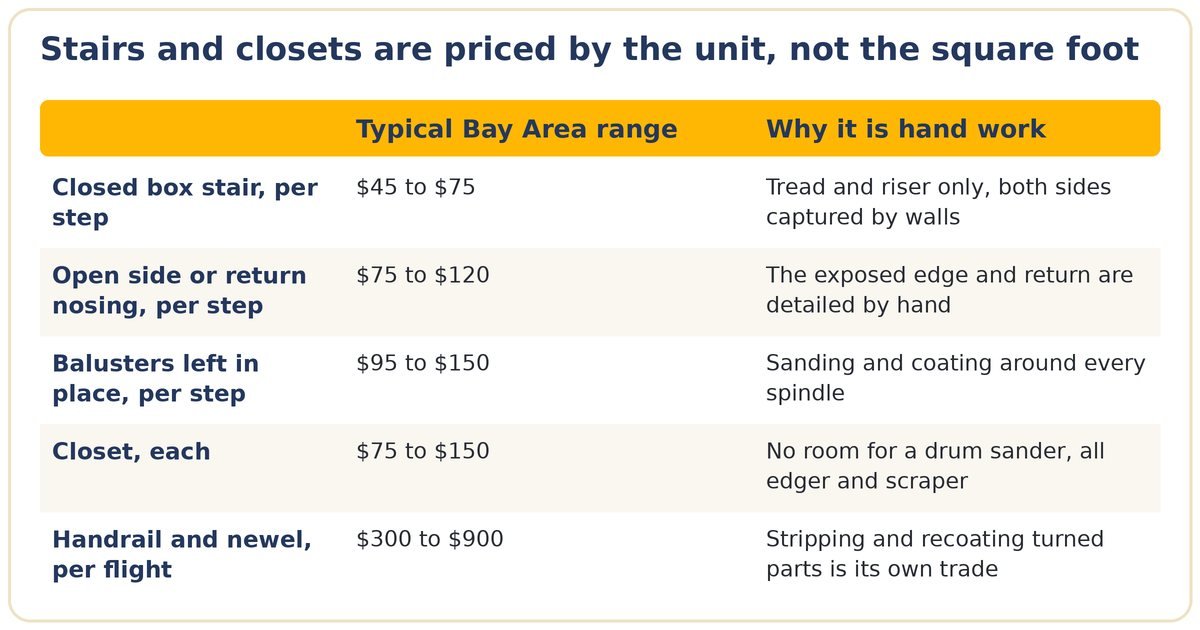
Stairs change the unit of measure. Every tread, riser, and nosing is hand-worked while the installer balances on an angle, so one flight can carry the labor of a whole bedroom. Anyone quoting stairs inside a per-square-foot number is guessing.
A 13-step flight with balusters in place is therefore a $1,200 to $1,950 line by itself, which is why many homeowners refinish the treads and paint the risers instead. That is a cost decision, not a compromise, since risers take no traffic.
When Refinishing Beats Replacing Your Hardwood
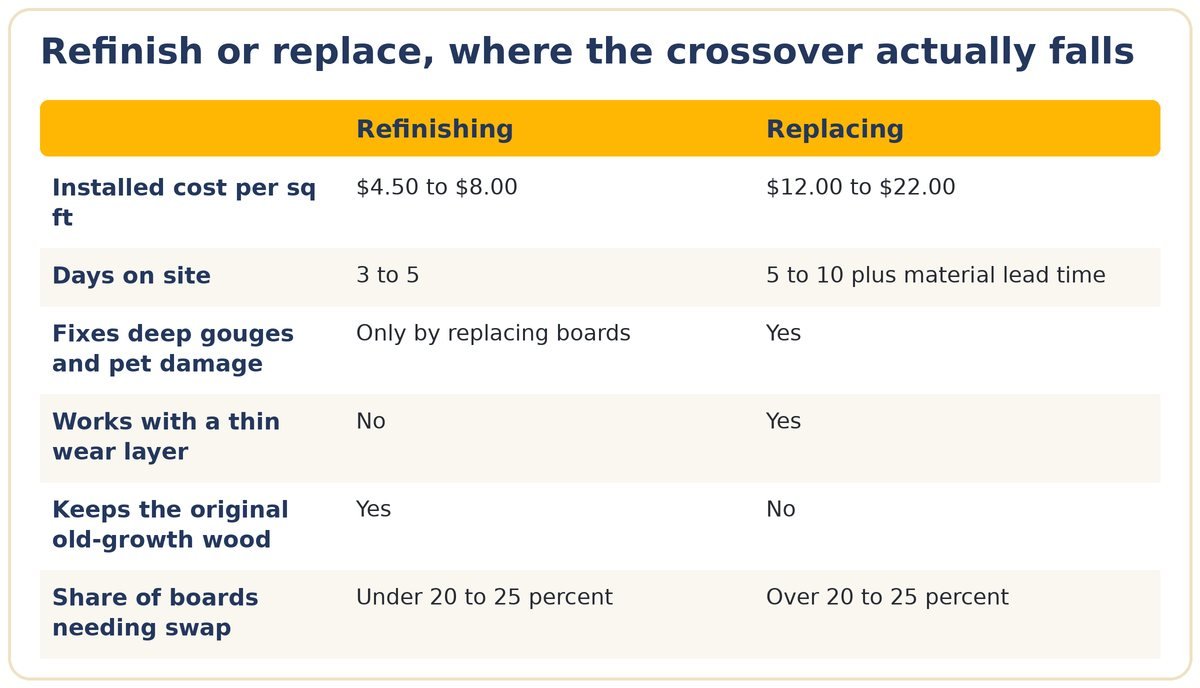
The refinish-versus-replace question has a real crossover point, and it is not how bad the floor looks. Sanding is dramatically cheaper right up until the floor cannot be sanded, at which point any money spent on it is wasted.
Refinishing wins whenever the wood is sound and thick enough, which covers most solid oak under about 80 years old that has been sanded once or twice. Replacement wins once the wear layer is gone, once more than roughly 20 to 25 percent of boards need swapping, or when a subfloor problem has to be corrected anyway. At that repair share the prices converge and you are paying refinish money for a floor that still looks patched. If the room is a candidate for something other than wood, our carpet installation cost breakdown is the other side of that comparison.
What a Cheap Refinishing Bid Usually Left Out
A bid 30 percent under the others is usually a smaller scope described in the same words. Four omissions account for most of the gap.
Edger Work Along Every Perimeter
Where the Edger Gets Cut
The drum handles the open field, but the six inches along every wall, under every toe-kick, and inside every corner needs an edger and then a hand scraper. It is slow, awkward work and the first thing cut. You see it as a darker halo of old finish around the room the first time low sun comes through.
The Third Coat of Finish
Why the Third Coat Protects
Two coats look identical to three on day one and wear through years sooner in the traffic lanes. Manufacturers typically specify three coats of oil-modified polyurethane for residential floors, and the third does the protecting. Confirm the coat count in writing, since it is invisible at handover and expensive to add later.
Abrasion Between the Coats
What Screening Between Coats Does
Screening lightly between coats knocks down raised grain and dust nibs and gives the next coat something to grip. Skipping it saves an hour per coat and produces a floor that feels rough underfoot and can delaminate in patches. It is the least visible corner to cut.
Dust Containment and Base Shoe
Containment and Base Shoe Costs
Containment means sealed doorways, negative air, and vacuum-assisted sanders instead of a bag machine and an open door. Removing and reinstalling base shoe so finish runs cleanly to the wall costs $1.50 to $3.50 per lineal foot and is often quietly deleted, leaving old finish at every baseboard.
How Bay Area Labor and Rules Change the Number
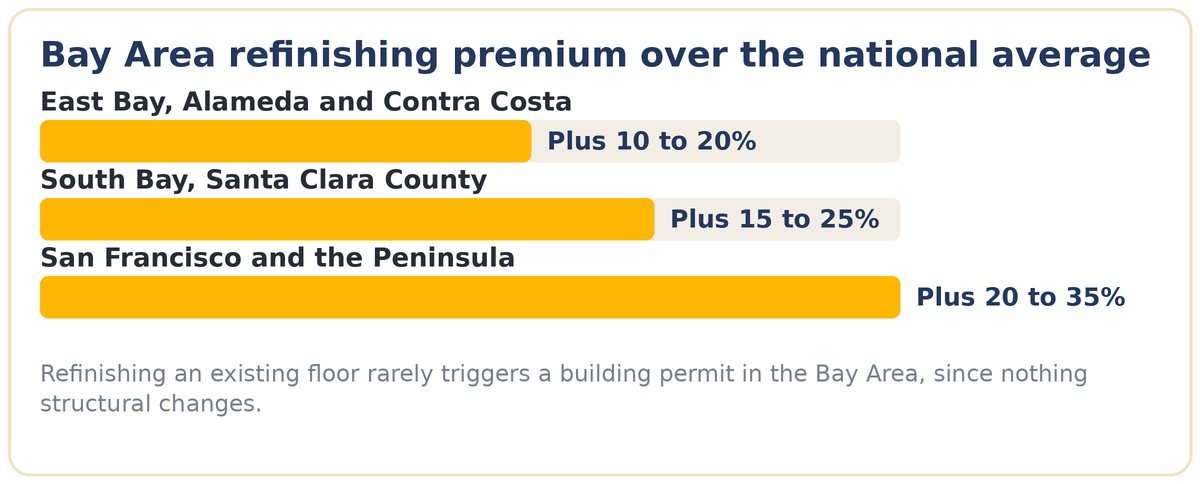
Refinishing an existing floor rarely triggers a building permit in the Bay Area, since nothing structural changes. Local labor rates and housing stock still push the number toward the top of every range above.
Two local wrinkles matter beyond the rate. Condo and co-op buildings often restrict work hours and require notice, turning a continuous three-day sequence into a week. And much of Oakland, Berkeley, and San Francisco predates 1978, so any painted riser, baseboard, or trim disturbed by the work falls under the EPA’s Renovation, Repair and Painting rule and needs a certified firm.
Get a Real Refinishing Number for Your Floors
The useful version of the cost to refinish hardwood floors is not a rate, it is a scope. What it costs at your house depends on the furniture in the way, the stairs and closets in the count, and how much wood is left under the old finish. Take this breakdown into every bid you collect and make each one show its scope line by line, with unit prices instead of a lump sum. If the wood turns out to be past saving, or you want a second read before you sign, contact Top Tier Building Services — we handle hardwood flooring installation and whole-house renovation across the Bay Area.
FAQs
How much does it cost to refinish hardwood floors per square foot?
A full sand and refinish with three coats of clear polyurethane runs roughly $4.50 to $8.00 per square foot in the Bay Area, or $5.75 to $8.50 with stain. A screen and recoat skips sanding at $1.50 to $3.00, but suits only a floor whose finish has not worn through.
What does it cost to refinish 1,000 square feet of hardwood?
Budget $4,500 to $7,500 for 1,000 square feet of clear-coat refinishing on a sound floor with rooms already emptied. Stairs, closets, furniture moving, and board replacement sit outside that figure and add $1,000 to $2,500 in an occupied older home.
Is it cheaper to refinish or replace hardwood floors?
Refinishing costs roughly a third of replacement, about $4.50 to $8.00 per square foot against $12.00 to $22.00 installed, so it wins whenever the wood is sound. Replacement wins once the wear layer is too thin to sand, or once more than about 20 to 25 percent of boards need swapping.
How much does it cost to refinish stairs?
Stairs are priced per step, generally $45 to $75 for a closed box stair, $75 to $120 where a side or nosing is exposed, and $95 to $150 when balusters stay in place. A 13-step flight lands between roughly $600 and $1,950.
How many times can hardwood floors be refinished?
Solid three-quarter-inch flooring has about a quarter inch of usable wood above the tongue, generally allowing four to six full sands across its life. Engineered flooring depends on its wear layer, and anything under two millimeters should be recoated rather than sanded.
Can I refinish hardwood floors myself and save money?
Renting a drum sander and an edger runs about $75 to $150 a day plus abrasives and finish, so a DIY refinish of 500 square feet might cost $600 to $1,100 in materials. The savings are real and so is the risk, since a drum left in one spot for two seconds cuts a dish only a professional can flatten.